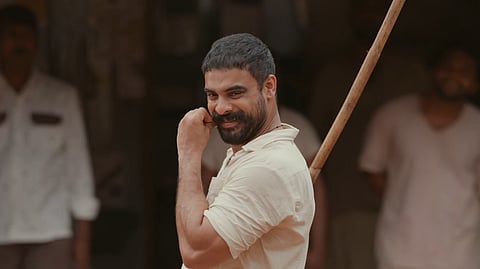


In 1957, in Kerala, the world’s first democratically elected communist government took shape. They instituted land reforms that set the landscape bleeding red. The Church was peeved. They saw the Communists as the very embodiment of Antichrist, encroaching on their land. Dijo Jose Antony’s Pallichattambi is set in these ensuing years, where the Christians in the fictional village of Kaaniyaar, on the border between Kerala and Karnataka, strap up, hiring a goon to protect them.
Kaaaniyaar’s church locks their gaze on Krishna Pillai (Tovino Thomas), re-names him Christopher Pothan, and under the shade of his muscles and 56-inch chest, they rest briefly. Pillai trains the youth in the village into a Christopher Army—not just men, but women too, and adivasis— stitching together a collage of militant unity.
Ideas and ideals echo across director Dijo Jose Antony’s films. In Malayalee From India (2024), for example, comes the idea of Kerala being God’s Own Country not because of its lacking demons, but because of its capacity to vanquish them. This gets expressed here, too. A Hindu man, with a Muslim assistant, comes to Christian support, against the communists.
Is the film, then, anti-Communist?
While trying to shut down a popular Communist play that is being staged at the village, Ningalenne Communistakki—a real play, and much like small details in this film, there are moments of resonance with what actually happened—his gaze snags at Rebecca (Kayadu Lohar), who plays the starlet lead female of both, this film and that play. Love is, perhaps, the best reason to become a Communist, and she inscribes a Communist Manifesto with a sweet message for him and poor Pillai is smitten. The film soars briefly in their interactions—full of mischief, but rooted in deep idealism. Rebecca wants to build a school with the land she has. Land that is being taken away from her.
Anyone who has watched an Antony film — Jana Gana Mana (2022), for example — knows that he twists identity until it is not an identity but a certain ideal that gets villainized. So, before the communists are villainized at the cost of the Church’s virtue, for example, the rug is pulled from beneath the narrative. No, the communists are not evil, even if communist men have the penchant for evil. That distinction keeps the film fragile. Ultimately, it is not who you are, but what you want that relegates you to villainy. Evil intentions are not inherent to a political label, but can spring forth from that. While this produces a deeply humanist film, it also produces a film full of idealism, lacking fire. We don’t feel the urge for communism in a landscape of land-owning castes. Neither do we feel the respite of faith in a landscape where it is deemed an opiate of the masses.
Anyone who has watched an Antony film also knows that his films are over-written and over-edited. Pallichattambi-proper begins after dispensing two flashbacks, one establishing consummate evil, and the other establishing the birth of that which will thumb that evil under. In the latter half, the film keeps leaning into these two flashbacks in frequent intercuts to establish its emotional torpor, completely tossing aside its tightly wound up central seed of a story. A more polished, pungent version of the film keeps playing behind the screen.
What is especially clumsy is the cameo of Prithviraj as Pattelar Kunjambu Nambiar, the evil landlord who wants to displace the Kaaniyaar people, so he can mine the mountain for all its worth. Rairu Ramana (Shatru), a ruthless hitman, is hired, and together, the two completely knock the wind from the film. In fact, the film doesn’t even know when to end—a long drawn climax involving Rairu Ramana is immediately followed by a stylized combat of Pillai with Nambiar. Crescendo is not something Antony is able to build, villainy is not something he is able to sustain, and the quick-cuts begin to resemble a scrambled assemblage of a film.
Besides, Antony’s films, like a lot of Malayalam’s prakriti padangal, have a messy, over-edited quality. They are reluctant to state their story upfront, and so keep roving around characters, moments, only to come back to it, much later in lumps of exposition. Characters dangle on the periphery of the film until they explode in context. This is not a density of world building, but a density of over-writing.
Then, the same location gets quickly stitched into a montage with multiple perspectives—some banal, some odd. Intercuts keep interesting scenes at bay. Pillai’s introductory fight sequence in Kaaniyaar, for example, is intercut with his Yakshagana performance as Ravana, and it falls flat, because the former’s playfulness eats into the latter’s terrifying—or at least, what should be terrifying—performance of wonder. Similarly, when Pillai is thrown out of the village, it gets couched into some larger frame story that will only later get clarified. This is not a density of world building, but a density of over-editing.
Tovino Thomas, with his generational aura of total mischief and total charm, is not able to rise above the film’s limitations. His performance soars with and within the film. Watch him respond to Rebecca’s forthrightness and Kayadu Lohar’s confident posture and needling gaze with a peeling loss of composure, overcompensated with some performative bravado, legs man-spreaded. It is, perhaps, one of the most gifted scenes of this film. Love really does cut people down to size, flipping them around. Even as Pallichattambi walks that path of love, it quickly steers away into the battleground of good VS evil, one that is bored by repetition, frustrated by lethargy, and drowned by density.