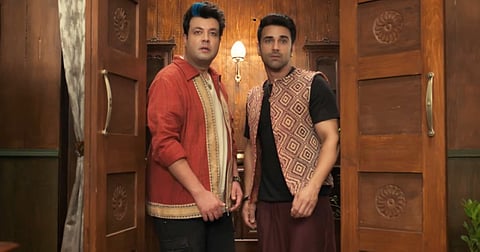


Rahu Ketu is the sort of inane and aggressively stunted Bollywood comedy in which the interval is so long that it feels like the movie doesn’t want to continue. But it does continue. For 70 more minutes. In all directions and no directions, unfolding like it’s made for a human demographic that doesn’t exist. I know there are takers for this brand of leave-your-brains-and-veins-at-home gibberish, but I am not one of those takers. I’d like to believe I’m a giver, because nothing else explains the fact that my body stayed seated in the cinema hall throughout, even though my spirit escaped (and probably had an accident on the way back). If it sounds like I’m exaggerating for effect, it’s true. There’s no other way to open the review of a movie where Piyush Mishra is still playing a Himachali storyteller who pretends he’s not in Tamasha, Manu Rishi Chadha is playing a writer who pretends he’s not in RK/RKay, Chunky Panday is playing a retired Mossad spy turned drug kingpin whose punchline is “Karma is a switch, join me and I’ll make you rich,” and Varun Sharma and Pulkit Samrat play dim-witted buddies who pretend like they’re not in Fukrey. Everyone seems to be pretending — except me.
The funny part is that Rahu Ketu has a germ of an idea. Or at the very least, an amoeba of an idea. The irony is that this film revolves around a writer (Chaddha) whose fictional characters — based on the karmic mythological figures of Rahu and Ketu (where’s the outrage when you need it?) — have gone rogue and ruined his story. A metaphor for mainstream Hindi comedies, if there was ever one. The magic diary in which he writes brings stories to life, so he crafted a tale about those mischievous harbingers of destiny — Rahu (Sharma) and Ketu (Samrat) — to remove corruption and “international drug trade” from Himachal Pradesh. Instead of doing their job, though, the two celestial figures became too human: jinxed wastrels who bring bad luck everywhere they go. They made Manali worse than it is.
An eccentric sage (Mishra) visits the confused writer and tells him to put some ‘soul into his work’ (tell me about it), after which Rahu and Ketu then become too human, drawing conscience and truth out of sinners while thinking for themselves. A girl, Meenu (Shalini Pandey), is introduced into the diary to bring the two men back on track, but even she goes rogue; she’s a cannabis supplier who defaults the order of an Israeli drug boss (Chunky Panday) whose intro features him killing a Russian boss for not sticking to his region (Goa). This Israeli baddie’s name is Mordechai, so naturally desi characters mistakenly call him “madar-chai” and “mor-ka-bhai”. Of course they do. I just realised that my name may have something to do with Rahu, but that’s an existential crisis for another day.
Once the story paints itself into another corner — I’m amazed by how the film conceals its awfulness behind the film within it — the nutty sage takes over the writing (don’t they always?) and merges the worlds of reality and fiction. Rahu and Ketu meet their makers, while everyone wants that magic diary to make their dreams come true. If I had that diary, I’d have written a story about a film critic who gets to review great movies every week. In the second half, there’s one semi-amusing thread in which Meenu gets sick of men writing fiction featuring superficial women, so she steals the diary and takes their fate into her hands. It’s a potentially fun-meta gimmick, because Meenu reduces them to puppets; Mordechai breaks all his fingers except his middle finger, a corrupt and lusty cop (Amit Sial) grows morals, and the two goofy besties have a fight (followed by a patch-up song).
But this is a film about imagination that’s allergic to imagination. So Meenu’s track doesn’t last long — and what we’re left with is dated VFX that’s supposed to be funny because it’s deliberately dated to look like a 1990s TV serial, lines like “take the cat’s consent because cats are ladies and no means no,” a Ramlila scene where a petrified Ravana flees from the cursed twosome while yelling “Jai Shri Ram,” and an underwater corpse with a stiff right hand. But the bad writer still remains a bad writer, the friends remain simpletons, and Bollywood’s favourite mountain town remains a victim of corruption, drugs (international, mind you) and overtourism. No amount of flimsy storytelling in a diary will change that. Now I’m wondering if the interval of Rahu Ketu was endless because there were too many blank pages — and minds — in between. I’d like to have a stern word or two with the writer of my life.