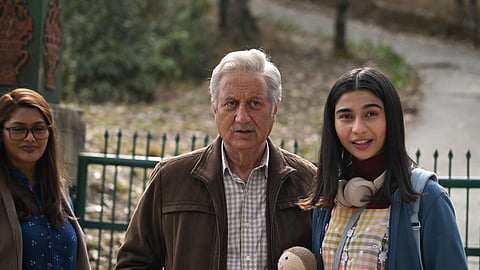


On paper, Tanvi the Great is about an autistic young woman who sets out to defy an ableist society and complete her late father’s dream. This “different but no less” 21-year-old humbles and awakens many in the process, not least her grumpy grandfather whom she must reside with during her mother’s business trip. The film is actor Anupam Kher’s second as director after Om Jai Jagdish (2002). He has mentioned in interviews that the story is personal; he drew inspiration from his maternal niece, Tanvi, who has autism. The template is familiar. In the age of Sitaare Zameen Par, it’s hard to make a sub-par movie — more specifically, an insincere one — about a neurodivergent character who beats the odds. The theme is nearly impossible to fumble.
But Tanvi the Great does. It’s 160 minutes long, vain and impossibly dull. Here’s how the story reads in the language of the modern Hindi film canon. Tanvi (Shubhangi Dutt) arrives in the cantonment hilltown of Lansdowne to stay with her grandfather, retired Colonel Pratap Raina (Kher). Her mother, Vidya (Pallavi Joshi), is an irony in human form; she heads to New York to participate in a World Autism Foundation (WAF) conference — a lazy Wikipedia-coded portion that exists entirely to explain the disorder to us through foreigners speaking in dubbed Hindi. In Lansdowne, Tanvi learns of her late dad, Captain Samar Raina (Karan Tacker), a soldier who died before fulfilling his dream to salute the flag on Siachen, the world’s highest battlefield. So Tanvi’s uncomplicated mind springs to action: she decides to join the Indian army to reach Siachen. The old colonel aside, her journey features an eccentric music teacher (Boman Irani), a morose Major (Arvind Swami) who knew her father, and a supportive Brigadier (Jackie Shroff) whose codename is obviously Tiger.
Tanvi the Great somehow reduces its central theme — a hero and her ‘superpower’ — to a secondary theme in its own film. Within an hour, Tanvi becomes a medium for a misplaced tribute to the Indian Army. The protagonist is patriotism. At one point, the tri-colour is superimposed on her singing face at an army ball; at another, she interrupts a memorial day speech to ask what bravery is so that the answer can be “anyone who wears a uniform”. The love for one’s country is presented as the cure for everything. Including Tanvi’s condition — held hostage by a transformation caused by a night in her father’s old bedroom watching weirdly elaborate videos of her parents. It’s not convincing, and neither is the design of the grandfather. This is Kher’s second consecutive role (after Metro…In Dino) as a widower with a dead son and a caring daughter-in-law. But note the difference here: he’s bitter and disillusioned, randomly introduced as a loner who gets assaulted for calling out tourists who litter, and it’s Tanvi’s influence that bridges the distance between him and the cantonment town.
Her autism is almost treated as a phase when she trains for the SSB (Services Selection Board) exam; the post-haircut Tanvi, in particular, behaves in an unrecognisable manner. I get the intent, but when amplified by Bollywood excesses, it feels a bit irresponsible. Not to mention a post-interval song that shows Tanvi catalysed by the force of prayer in a temple — further evidence that science pales in comparison to faith and Indianism. Newcomer Shubhagi Dutt does well to resist Jhilmil-in-Barfi territory, but her spirited turn is defeated by the storytelling gaze. There’s no right way to be an instrument in a film that loses sight of its own context and turns its lead into a supporting character. It doesn’t help that the visual effects are questionable at best: from the accident that claimed her father and a clumsily-shot incident in which she rescues her music teacher, to her snowy mountain trek to Siachen.
The premise of a character on the spectrum aspiring to join the army isn’t a problem. In fact, there are glimpses of a fascinating film in an interview sequence towards the end. After clearing the physical tests, in the interview round, Tanvi’s default humanity — she can’t tell good from bad, or comrades from enemies — clashes with the ideology of being a soldier. When asked about her motives, her ‘personal’ answer about her father’s goal baffles the committee. They expect a selfless and chest-beating reply. It brings to mind a story like Chandu Champion, where a rural athlete hoping to reach the Olympics enlists in the army to aid his career. Being a patriot need not involve a passion for war; he’s just driven to serve his country differently (but no less). But Tanvi the Great refuses to legitimize her worldview. Instead, her experience validates the world she occupies. She doesn’t change the system; the system chooses to change her. It does her a favour because it has a heart. If this doesn’t defeat the point of a character striving to be normalised, what does? The message being: be special, but be Indian first.