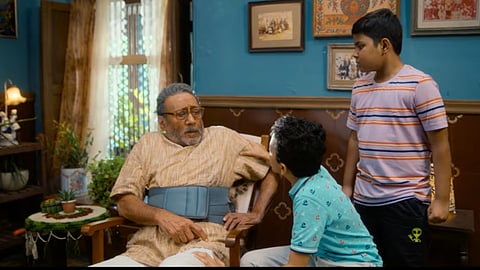


The Great Grand Superhero has one of the most charming setups in recent memory. The first half is funny, poignant, satirical and very inventive. It also has the best child actors since Stanley Ka Dabba, a film it shares an editor (Deepa Bhatia) and narrative spirit with. There’s a new mid-term admission in a small-town school; his name is Deepu (a pitch-perfect Mihir Godbole). Deepu is a clever student; he knows all the answers to all the teachers’ toughest questions. The other kids envy him and find him strange. He confesses to one of them that he’s “different” because his grandfather (Jackie Shroff) is — suspenseful drum beat — a superhero. It’s a secret, he says, that only kids below the age of 18 can know, otherwise the grand old man will lose his superpowers.
Within no time, all the 13-year-old classmates know the secret; everyone wants to be Deepu’s friend. They also want to meet this magnificent figure, whose ‘front’ is his life as a creaky pensioner who grows plants and spends his days being petrified of lizards. Whereas tasty food was a young outsider’s superpower in Stanley Ka Dabba, storytelling becomes the little loner’s superpower in this film. We learn that Deepu finds it so hard to make friends in every new town his dad gets transferred to that he now makes up stories to attract new friends. It’s harder because he’s good at studies. All he wants is company; all he has is imagination. He even crafts the rules of his little world to circumvent adult scrutiny; he has probably learned from experience that anyone above the age of 18 is old enough to call out his tall tales.
The first hour is endlessly wry and entertaining. Deepu struggles to preserve his lofty lie because of how curious the other kids are. Things change when his grandfather starts to play along. The film-making and cutting do well to tap into the innocence and unfiltered wonder of scrappy eigth graders. The animation sequences reflect the way these kids process their surroundings; it doesn’t need to be slick because they derive all their creativity from the elders who protect them with sugarcoated facts. Much of the humour is found in the reaction shots and responses of Deepu’s classmates. One of them (a standout Shivansh Chorge) is especially convinced with the superhero-and-aliens spiel, almost like he needs fresher ways of believing in divinity and magic. The skeptics involve the suspicious son of a reporter (of course), and the grandson of a former wrestler.
I also like that Deepu’s story as well as the playful visions of his friends reflect the God-fearing and traditional ways of the place. For many of them, superheroes and villains are an extension of Indian mythological characters and religious lore; that’s how they perceive anything or anyone extraordinary in their formative years. It also mirrors their understanding of the world around them. Deepu refers to a superhero mission as “Swachh Dharti Abhyaan,” reflexively using the language of political mottos and cleanliness drives. At one point, Deepu scolds his grandfather for narrating a ‘soft’ backstory of friendship and romance; violence and action are the only things that work these days, he surmises.
Given that the man himself tries to convince Deepu that he was indeed once a superhero, the film sweetly captures the circularity of life. The reason many kids share special bonds with their grandparents is because the age-groups think and perceive alike; one’s brain is developing and the other’s is fading, and the relationship is built on the uncanny intersection of these contrasting trajectories. One is beginning with a blank slate, the other is ending with a slate wiped clean of the cynicism and riders of adulthood. They resonate with each other because the youngster is discovering what it is to be alive, and the old-timer is rediscovering what it was to feel alive. Even as the roles of plausibility are reversed between Deepu and his grandfather, it’s hard to tell one’s fantasy from the other’s truth.
The film leans into how storytelling is an essential coping mechanism of everyday life to deflect the dryness of reality; some of us become professional dreamers, and some become compulsive escapists. For instance, when Deepu asks about a wheelchair-laden classmate, he is told that the heroic little girl was hit by a bullet when her army-man father fought off a group of terrorists. The audience is inclined to question the accuracy of this account, but it doesn’t matter, because it insulates the youngness of the school and allows them to stay wide-eyed for as long as possible. That some of these notions mutate into denial is subject to the upbringing of the kids and the nature of their households.
The Great Grand Superhero dips the moment it goes from being a film about children to being a children’s film. A real-world satire on comic-books transforms into an actual comic-book movie. Suddenly there are senior races, training montages, preachy social messages about humans ruining the planet, adult sons insisting that a parent is a superhero because of the sacrifices they make to raise the family, sappy dialogue, and intergalactic conflicts with the sort of visual effects that spoof superhero stories while trying to be one. The film continues to work best when it cuts to the kids’ gazes and the inherent absurdity of the situation (including two B-movie-coded ‘aliens’ who get offended by Bollywood’s representations of them). There’s a sense that the film goes too far and gets too literal to tease the distrust of the average adult viewer. It defeats the purpose of using storytelling as the grammar of communication rather than a moral language.
Despite this dive into quasi-devotional drama, it’s hard not to be misty-eyed about the naivety of The Great Grand Superhero. The affections are earned, mainly because of the meta casting of Jackie Shroff. The role combines his quirky off-screen passion for greenery (no public appearance is complete with a potted plant in hand) with his on-screen embrace of coolth and mortality. At some point, the old man mistakenly refers to a “superhero” as “superstar,” and it’s quite the Freudian slip, given Shroff’s career arc as an aging silver-screen forever-star. Every time he is asked to prove his powers and do something crazy, the lines are delightfully blurred. Every time his identity is thrown into doubt, character and performer become one. In these scenes, we are wired to root for the famous actor to flip through the archives and unleash posters of his breakout in Hero (1983) followed by all the evidence of his riches-to-roots celebrity that followed (also featuring son Tiger Shroff’s leap of faith with A Flying Jatt).
The humility and old-school indulgence of Shroff’s performance reminded me of the time I was summoned to the principal’s office in third grade after I spread a classmate’s claims of his dad being Jesus Christ. Needless to mention, both of us were punished. I don’t think I ever narrated a story again. He left school the next year once his family was transferred to a town whose name I couldn’t pronounce. Barely anyone realised he was gone; that incident was the only marker of memory. But I genuinely believed him for a while, and in a parallel universe, we all jumped aboard his flight of fancy and followed him around to see if his ‘father’ could turn water into wine. Whether he was correct or not, it would’ve been one hell of a semester. And everyone would miss him after he left. Everyone would talk about the friend who disappeared like the son of a god. To be remembered is the ultimate superpower. After all, what is a lie if not the adolescence of storytelling?