

Fifteen years ago, attending a Marvel preview screening felt like a privilege. There was magic in that fleeting sense of exclusivity, of witnessing a behemoth saga before the rest of the world caught on. You felt momentarily like a custodian of something vast and spectacular, a story that would soon belong to everyone but, for one night, was yours alone.
In the years since Avengers: Endgame (2019), that thrill has steadily eroded. Marvel’s once-electric preview nights became just another Tuesday. Film after film arrived with the same tired template, the same diluted stakes. Characters were cycled out or softened into shadows of their former selves. The legacy of familiar heroes was passed down with the awkward mechanics of a franchise too bloated to mourn its own icons. Even stalwarts like Natasha Romanoff — Scarlett Johansson’s Black Widow — were denied proper closure. And the less said about Sam Wilson’s Captain America in Brave New World, the better.
So it’s no small thing that Thunderbolts*—yes, with the asterisk, a joke that eventually pays off—emerges as something altogether rare in today’s Marvel Cinematic Universe: a good movie. Not “good for a Marvel movie,” not “better than Eternals,” but a film that feels purposeful, alive, and most surprisingly, kind. For the first time in what feels like forever, I walked out of a Marvel screening smiling, like it was 2012 again.
Directed by Jake Schreier (coming from Beef acclaim), with a screenplay by Eric Pearson and Joanna Calo, Thunderbolts* caps off Phase 5 with the kind of tonal dexterity and ensemble camaraderie that reminds you of Guardians of the Galaxy (2014). Like that film, it introduces a misfit crew of oddballs, killers, and reformed villains, many of whom we’ve met before—though never quite like this.
Florence Pugh returns as Yelena Belova, now post-Blip and working for the CIA under the watchful (and criminal) eye of Valentina Allegra de Fontaine. Julia Louis-Dreyfus plays Val as if she wandered in from Veep, all smug smiles and slippery one-liners, and it works. Val is under investigation, facing impeachment over her refusal to divest from her private military corporation, O.X.E.—a not-so-subtle jab at a certain U.S. president.
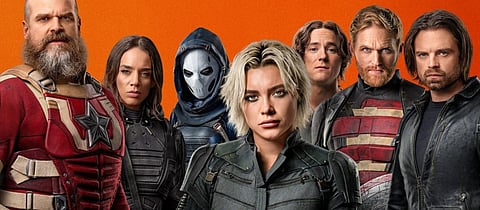
Sebastian Stan’s Bucky Barnes, now a U.S. congressman is quietly working to expose Val’s crimes. But before Bucky can catch on, Val sends Yelena on a mission to a remote O.X.E. facility in Utah, where she’s ordered to neutralise Ava Starr/Ghost (Hannah John-Kamen). Things spiral when John Walker/US Agent (Wyatt Russell) shows up to kill Yelena, while Ghost is hunting Taskmaster (Olga Kurylenko) —who is frankly wasted in this film. But the real wild card arrives in the form of Robert “Bob” Reynolds, aka the Sentry, played with jittery charisma by Lewis Pullman. Bob wakes up with no memory, no bearings, and no idea what he’s capable of, making him the most dangerous figure in the room—but no one knows that yet.
The eventual revelation is that Val has orchestrated all of this to tie up loose ends before Congress catches up with her. But instead of eliminating each other, the would-be assassins band together—joined by the ever-enthusiastic Red Guardian (David Harbour), who now runs a limo service that promises to save you from boring evenings. Their reluctant alliance “Thunderbolts,” is a name borrowed from Yelena's childhood football team, which never won a single game.
The comic-book origins of the Thunderbolts had supervillains masquerading as superheroes. But the film, wisely, is less concerned with disguise and more interested in dysfunction. These aren’t reformed criminals so much as broken people trying to do one right thing before the world writes them off. They’re called “disposable delinquents,” and yet there’s something genuine, even moving, about the way they learn to fight with each other.
Florence Pugh is the film’s emotional and comedic centre; humour and heartbreak. Her Yelena, a former Red Room assassin still scarred by grief, carries both Natasha’s memory and the weight of everything that film (Black Widow) failed to resolve. Pugh balances deadpan wit with flickers of melancholy, embodying a woman who wants to believe in redemption but isn’t sure she deserves it.
Pullman, as Sentry/The Void, is Thunderbolts*’s secret weapon. His performance is at once unpredictable and arresting, particularly as the film draws on his character’s mental health struggles. Sentry’s battle with his darker alter ego, The Void, gives the movie its most poetic and pointed metaphor: for addiction, for trauma, for the dissonance between who we are and who we fear ourselves to be.
And somehow, through this chaos, Thunderbolts* finds room for sincerity. After years of MCU entries that mistake wisecracks for soul, this film dares to look trauma in the eye—not to exploit it, but to understand it. It asks what healing actually looks like for people who’ve been trained to punch first and emote never. It asks whether redemption can exist in a genre that so often sees violence as catharsis.
One of the film’s most affecting reversals comes in its climax. Where other Marvel finales crescendo in a CGI-fuelled frenzy, Thunderbolts* chooses restraint. This is not to say that the climax isn't a superbly-executed spectacle. But, the core of the climax hinges on the punches that are withheld. On a choice made in vulnerability, not vengeance. It’s what Captain America: Brave New World failed to achieve in its limp third act.
Superhero cinema has long treated trauma as fuel: Peter Parker loses Uncle Ben and becomes Spider-Man. Steve Rogers loses everything and becomes Captain America. But in Thunderbolts*, trauma isn’t a gateway to greatness. It’s something you live with, something you learn to hold and, sometimes, something you need others to hold with you.
Because in the end, you can’t punch your way through grief. You can’t overpower loneliness. You can only hope to find people—however broken, however bruised—who see you as you are, light and void alike, and still choose to stay.