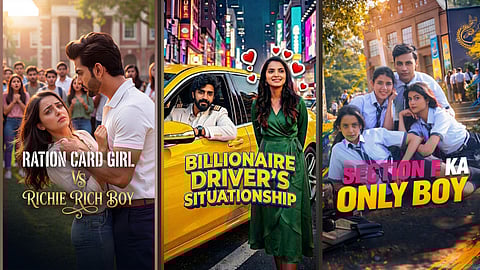


The question of whether micro-dramas should be reviewed at all is, perhaps, redundant, at least without answering the more fundamental question—what do micro-dramas represent?
If they are attempting the last-mile commodification of the moving image, then we cannot think of them as objects worthy of criticism i.e. objects to whom we bring the full force of film history, subjective taste, and objective context. For then, micro-dramas become a mere commodity, whose sole purpose is to maximise contact with our slipped attention spans. And critics, famously, do not know what to do with commodities except mourn.
I spent a few days puzzling through a dozen micro-dramas on the recently launched Tadka on the JioHotstar app, with 100+ titles bulldozed into the inauguration. Each season is around forty episodes, and each episode, between a minute and a half and two minutes. In short, these shows can be guzzled in the span of an hour. I use the word guzzled, but perhaps what I mean is endured. For one, the exhausting plotlines, full of minions and misunderstandings, so deeply wedded to formula, overstay their welcome. The “cliff-hangers” which contort a story into a pretzel weakly push the story along. The force I was expecting in the storytelling is missing. It has taken television as its modus operandi, overwritten dialogues parroted by underwritten characters who stick to their character descriptions until challenged—poor, rich, the new kid, the bully, the jock, the schemer, the schemee.
Besides, the format of micro-dramas has not been experimented with to include genres like comedy and horror. There is a very obvious and recurrent preoccupation with class—in titles like Billionaire Driver’s Situationship, Secret Crorepati Jamai, Crorepati Ka Comeback, Security Guard Ki CEO Girlfriend, Queen of Diamonds, 800 Crore Ki Fake Shadi. This is either because these shows and their limited format cannot imagine conflict as psychological or that other external conflicts—caste, religion—are too hot-button for them to touch. Besides, given these characters are caricatures of class status, with obvious shades of virtue and villainy, it would be impossible for a storyteller to, say, write a Brahmin villain or a Hindu villain. Caste and religion require a sensitivity of storytelling that class does not need, given how identity politics has not touched class the way it has consumed caste and faith. Besides, these shows lack the gumption it would take to normalise, encourage, and perhaps, even celebrate inter-caste or inter-faith love. It is, therefore, not class consciousness as commentary, but class consciousness as cowardice.
Visually, these are not shows that have thought about the vertical possibilities of the moving image—a verticality that requires new modes of framing, and new kinds of writing and setting that allow for this verticality. These are shows that could have easily been shot horizontally.
Actors don’t fit into the screen, the closeups have upper bodies with hands sawed off, or uncomfortably folded over the chest, hero introduction shots end up with half the face. We cannot have close-ups of faces. Over-the-shoulder shots have become over-the-long-arm, or over-the-cheek. Lovers cannot even trip and fall into each other’s arms in one frame—as they keep doing in Ration Card Girl VS Richie Rich Boy. In Section F Ka Only Boy, in the penultimate episode, where they are trying to show a crowded hall as the nervous main protagonist has his climactic moment on stage, reading Hamlet’s monologue, shedding his stage fright, the very idea of a crowd could not be summoned, because that comes from breadth, not height. What can height achieve which breadth cannot?
Cinema came from a lack—new technology had to be made, first the moving image, then the story, then the sound, then the scale. Microdramas emerge from a landscape of abundance. And the assumption is that nothing new has to be created. Instead, what exists must be hacked into a new form—the vertical image, the quicker story. It is not a medium made to tell stories better, but a medium to cater to an audience’s attenuated attention spans. It is technology offering a solution to a problem it created.
The question of “Can there be a good micro-drama?”, then, is immediately upended by a more pressing question, “Are micro-dramas capable of goodness?”, or can the best of the micro-drama only emerge, inscribed by its destined badness. I use the words 'good' and 'bad' not as subjective categories but as objective answers to the question—are you producing something only because it needs to be consumed?
When, for example, Dollywood Films makes Best Worst Date!, with 'smooth skin partner St Ives', it is easy to see the superior production quality as a sign of, perhaps, a better commodity, but it is never able to transcend its limited mandate.
Strangely, these shows can only be accessed on the phone app, unlike, say, YouTube shorts which can also be watched on the laptop. They don’t have the minimising function, which exists for JioHotstar’s shows and movies, where you can minimise it on your screen to do other things, like, perhaps, scroll. The intent is clear. This is the thing you scroll past. This is the thing you can watch as ambient television plays out in the background. Where else will you go? Behold the era of third-screen viewing.