

The Indian accent is a complicated thing, a battlefield of global culture.
For one, it is distinctive to the Western ear. “Indian accents and dialects are sharp,” Hetal Varia, the voice and dialect coach on A Suitable Boy and Shantaram, tells THR India, “For example, diphthongs—the switching and gliding of vowels—play differently in Indian accents and dialects. We don’t say “Home” or “Goat” with sliding vowels. It is a more open, sharp, a dart-like movement.”
Besides, we often don’t distinguish between our Ws and our Vs, “and we end up saying ‘water’ ‘why’ ‘whatever’ with a V, which an international audience won’t understand.” And then, there is the “prosody—the rhythm and speed of our speech, which is sing-song-like.”
Tamil, for example, is widely regarded as one of the fastest-spoken languages in the world, with a high syllable-per-second rate, given its short vowels and sonorant consonants. It is not uncommon for Indians to be told—can you speak slower?
It, then, becomes easy to disarm what is distinctive into a punchline. There are American shows, like The Big Bang Theory or The Simpsons, which often push a character into a comedic corner. The Simpsons’ Apu Nahasapeemapetil, for example, was described by Comedian Hari Kondabolu as “a white guy doing an impression of a white guy making fun of my father.” Indeed, the accent was voiced by Hank Azaria, a Sephardic Jew who grew up in Queens. Apu was named as an homage to Satyajit Ray’s Apu trilogy—an homage that soured quickly in the American imagination into parody.
When asked about doing accents, Kondabolu responded, “If I’m doing it, I’m basically doing Hank Azaria’s impression, which is just his impression of Peter Sellers’ impression.” Sellers, who played Hrundi V. Bakshi in The Party (1968), with his catchphrase “Birdie Num Num”, was for the longest time, the entry port for Americans into Indian culture. It was clumsy and comical.
Shows like Never Have I Ever, with a wealth of experience about the long shadow of such stereotypes in the popular imagination, merely make the accent ridiculous, particularly those of the grandmother and cousin, characters who haven’t spent time in America and are trying to make themselves legible.
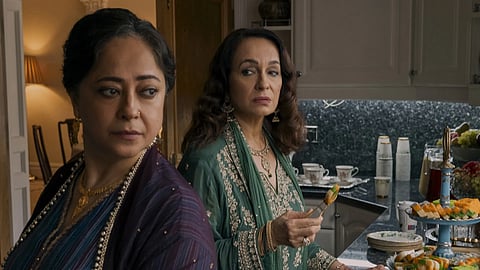
It is refreshing, then, to see actress Sheeba Chaddha playing Tahira in Bait, Riz Ahmed’s new show. She is the mother figure, a Pakistani immigrant who cusses in emphatic syllables, without letting it collapse into cliche.
Chaddha is uninterested in the larger politics around accents, simply because it comes intuitively to her as an actor. “It was not even a thing of regard for me. If you notice, everybody’s accent is different on the show—there was no pressure to create or modify or have a homogenous accent,” Chaddha tells THR India, “I told Riz I don’t like working with dialects and accents.”
The question then is, perhaps, about where the accent comes from. “We have heard the cuss words, we use them, so we know the texture and feel of these words, and how it is said depending on the context,” Chaddha notes. This native affinity produces an exaggeration—and the accent is an exaggeration—that never arrives at parody even as it flirts with it. It is a fragile manoeuvre.
While Chaddha sees “the value of accents and dialects in enhancing a performance, if I am performing and working with an accent, then half my mind is on that. It pulls me back as a performer.”
There are cultural nuances, though, that are honoured in the performance. Chaddha remembers one scene, where three words were clubbed together as one—"BastardYouChill."
“This is apparently a thing people in London do. It was there in the script too as one word,” Chaddha notes.
There is another angle to the case of the Indian accent. Where once it was prized for being distinctive, now, there is a move to make it palatable, especially in shows like A Suitable Boy, produced by the BBC, or Shantaram, produced by Apple TV. The audience is emphatically “global”, and so the accent, even as it is rooted in regional peculiarities and particularities, is reaching towards that universal.
Varia worked on the “muscularity—breath, body, voice” of the primary cast of A Suitable Boy, all Indian-origin actors. “Indians emote externally, with both our face and body, while Hollywood, for example, is more internal. An international English speaker, then, would stress grammatically not emotionally,” though Varia clarifies, “this is not a thumb rule.” Varia was told that A Suitable Boy “is not for an Indian audience. Yes, Indians will watch it, but it is equally for an international audience.”
A Suitable Boy was critiqued in India, some comparing it to Peter Salles, though that comparison might be exaggerated—for that was done with the express intent of othering, while this is a forceful attempt at assimilation, the accent arrived by stripping things, not sedimenting it with comedic weight. The pace of speech, for example, was moderated, and “when the speed of speech reduces, the weight increases,” Varia notes.
Shantaram was a more complicated project. A pandemic baby, the show’s cast list—which originally had a lot of Indian-origin actors—was changed, pooling together a primary cast from overseas due to pandemic-enforced restrictions. Varia had to “soften the Australian, Kiwi, British, and Filipino accents.” This involved a re-structuring of the way the face is used, “The shape of the mouth is the toughest to change, because you are asking them to change the way they use their mouth and tongue to speak.”
Both A Suitable Boy and Shantaram were written by white men, made for a predominantly Western audience, and it is only within that framework that any Indian demands for “authenticity” could be staged.
There is a possibility that such questions become increasingly redundant as the internet is making a monoculture, with dialects melting, sounds becoming familiarised. Perhaps, the accent, too, is loosening its sharp other-ness. The exaggerated accent, then, will soon, within a generation or two, become a relic of not just another constructed culture, but another bygone time.