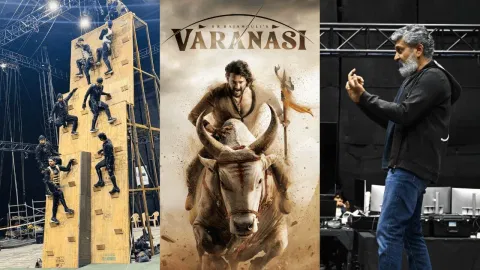


The biggest Indian film needed the biggest stage for its epic storytelling, and filmmaker SS Rajamouli didn’t look West for his upcoming spectacle Varanasi. He found the tech at home.
In February, Rajamouli launched the A&M Motion Capture facility at Akkineni Nagarjuna’s Annapurna Studios in Hyderabad, where he shot key sequences for the upcoming film starring Mahesh Babu and Priyanka Chopra Jonas.
The studio has unveiled what it claims is the country’s most advanced motion-capture facility, built in partnership with producer Shobu Yarlagadda’s Mihira Visual Labs and powered by Hollywood motion-capture specialist Animatrik Film Design.
THR India spoke to CV Rao, CTO of Annapurna Studios, and Yarlagadda, who backed the game-changing Baahubali franchise, to understand how the cutting-edge tech helped Rajamouli realise his vision for Varanasi and why the lab could help Indian filmmakers fill a crucial gap.
Edited excerpts:
For the layperson, when we say motion capture, what part of the filmmaking process changes the most?
Shobu: When it comes to live-action filmmaking, there are two areas. One, which is very useful, is pre-visualisation. You can use motion capture to pre-visualise an action sequence with multiple characters so that you know what you’re going to shoot.
And the advantage, when you’re pre-visualising with this as opposed to regular pre-visualisation, is that you can also change your blocking, lensing and camera movements, because it’s a 360-degree capture. The director can later change his mind and alter it without coming back to shoot again. So there is a lot more flexibility in that.
James Cameron’s Avatar would be an example of that…
Shobu: Yes. The other application of motion capture is when you have digital characters, like in Avatar. The character’s performance — both facial performance and full-body motion — is captured in motion and performance capture. So motion capture is when you wear the suit and you have the full body, and facial capture or performance capture is when you have a head-mounted camera, and there’s a small camera looking directly into your face; it records your facial performance.
So it is essentially a digital avatar of the face and the full body. The entire performance can be transferred onto a digital 3D avatar. In live action, wherever you are working with digital characters — digital humans, digital creatures, or any other form —the motion capture and performance capture allow you to record and transfer that data.
What was the core gap in the Indian entertainment ecosystem that pushed you to build a dedicated motion capture facility now?
CV: Annapurna has a great advantage because we produce films and also have actors in the family, who go and shoot with other producers as well and come back saying, “Man, we don’t have this in our facility. When can we bring it?” So we always keep discussing it.
We have seen clients who do pre-visualisation using regular cameras, keeping two or three cameras with the stunt choreographers and the team. They shoot for 10 to 15 days to get an idea of how to execute the sequence in a real location. If the director does not like the shot, they have to go back and take the shot again to get it into the edit. The feedback was that Indian directors were looking for a big mo-cap (motion capture) facility. The serious discussions first began in 2023.
Our studio is equipped with state-of-the-art Vicon Valkyrie (VK26) cameras, which deliver high-fidelity motion tracking for complex performance-capture workflows. We also have Vicon Live for real-time data streaming and Vicon Post for advanced post-processing and data refinement. For real-time visualisation and virtual-production pipelines, we integrated Unreal Engine live preview, enabling immediate feedback and seamless interaction between performers and digital environments.
Shobu: Rajamouli and I were doing some test projects and realised we did not have a facility that could answer our needs. We had to travel out of the country if we wanted a really good facility and wanted to do some good work... that is when we first started thinking about it.
Then we realised that as the scale of our films is increasing, there is more and more action, and there is more use of digital characters in our films. Which meant there is a growing need for this kind of thing, and a good facility will always be required — not just for our internal productions, but for other productions also — as the scale and ambition of filmmakers increase.
So this enables filmmakers to scale big while saving time?
CV: Yes, because with this pre-visualisation, they understand what the requirements are before they go to shoot. They can finalise the production design as well as all the manpower. The cameraman can finalise all the equipment and doesn’t need to bring everything out to the location and dump it there in the corner, and maybe not even 50 per cent of it is used by the end of the day.
We have seen big films that did pre-visualisation using regular cameras for 25 days, and the actual shoot went on for 65 days for a 12-minute action sequence! Imagine the amount of money the producer has spent? What if you had done proper pre-visualisation and then gone for shooting? They would have done it in less than 60 per cent of the time.
What were the biggest technical or infrastructural challenges in bringing this here in India at the scale you wanted?
CV: Budget. We wanted to get the best 26-megapixel camera. So the budget went from, let’s say, ₹100 to ₹400. But we had to do it, and quality was the reason that we got Rajamouli’s project to debut this with.
“If you confirm to me that you are going to get this infrastructure to your facility, I’m going to shoot,” is what he had told us.
Because he had visited many places abroad. Wherever he went, he saw motion-capture stages with 20-foot height, which he was not happy with. He was really looking for a facility that could build a customised one for him of 36 feet. No one had built that kind of stage.
He said, “I have sequences where my artist will be sitting at 30 feet. Then his own height will be 6 feet. That means 36 feet of height has to be there to capture the data. Can you do it?” And we did it.
Can you talk a little about Varanasi and how the technology was used there?
CV: The sequence in the film will be almost 25 minutes long. I can’t tell you much, but it’s a thrilling scene. Since we have released the BTS of Varanasi, you know now that it is being captured on a motion-capture stage. Otherwise, you wouldn’t have been able to figure that out!
But the pressure would have been huge?
Shobu: Yes. We were working to the Varanasi team’s timelines. So we had to get these cameras imported and installed, then the Animatrik team had to come in to train our local team, and then testing had to happen. There was already a lot of crew commitment and scheduling from the Varanasi team. So we had to do it within that timeframe.
Various actors, choreographers and stuntmen had to come in from all over the world, so there was no chance of postponing our launch. Those dates were already blocked based on the promise we had given. But ultimately, everything came through in the end. The biggest thing was that Rajamouli was happy with it.
What was the first moment during testing when you and the team felt it's all on track?
Shobu: During testing, we can see the test data and then we know that it is flowing in seamlessly and we are seeing it on the monitors. But that is still okay, because that is with one or two characters. I think when Rajamouli actually pulled off his first shot the way he wanted it, and he was happy with that shot, that was when we really felt it. That was a sigh of relief for us.
CV: When we completed all the tests and gave a one-hour demo to Rajamouli, we told him, “Sir, we need another week to test.” He said, “No, everything is ready. Let’s shoot from tomorrow.” So the next day we started shooting, and he was extremely cooperative.
Varanasi is a global film and comes armed with massive expectations. So what was the first proper day of the shoot like?
CV: I had written every step for him — roll, roll Unreal, roll Vicon, rolling, action — as he was shooting on a motion-capture stage for the first time. And he took that big printout and was reading from it! I was literally nervous. Everything had to go right. Then the moment he said, “Action, cut, done,” we all clapped. But I was under a lot of pressure on that day!