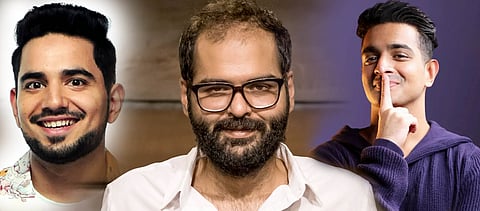


With the loud and brutal response to both Ranveer Allahbadia’s off-colour humour on Samay Raina’s show India’s Got Latent and Kunal Kamra’s acerbic digs at politicians in his comedy special Naya Bharat, 2025 is gearing up to be a watershed year in the history of Indian comedy — a history that is still quite young, barely yawned into teenaged rebellion, now disciplined shut.
In June 2005, The Great Indian Laughter Challenge debuted on air. The same year, YouTube was founded. Through both, the idea of the comedian as an artist was being forged, becoming acceptable, even desirable. As comedian Raju Srivastava notes in the documentary I Am Offended (2015), the mimicry artist — who was usually a filler, to be slotted between musical performances as a reprieve — began headlining shows now. Comedians were called for corporate events, where baby-food, idiot-proof humour was being fed. For the jokes with edge, that bled, spaces like Canvas Laugh Factory mushroomed. Recognisable faces like Vir Das entered the public consciousness.
In 2009, Jay Hind!, India’s first stand-up show was launched on the internet — a new force, one that collectives like All India Bakchod with their witty, relevant, and quick footed virality took to its precipice.
But when a subculture becomes an industry, the mainstream money and the mainstream gaze falls upon it. The #MeToo tremors completely shook up the comedy circuit until strands of it came undone. Murmurs of censorship were on the horizon, when in 2012, Jay Hind! kicked up a storm among the Sikhs because of a mention of the 1984 anti-Sikh pogrom in a joke, and members of that crew publicly apologised, with one of them kept under police security. But it was the public outcry and FIRs filed against AIB after the All India Bakchod Knockout (2015) comedy roast that signalled a new era, where fringe elements, backed by politicians, could set the tone for what is and isn’t acceptable. The lawyers were mad at Vir Das, the DJs were mad at Rahul Subramanian, the bikers were mad at Gaurav Kapoor, Lata Mangeshkar was mad at Tanmay Bhatt, the Maharashtra Navnirman Sena (MNS) were mad at Agrima Joshua, vandalising The Habitat where she performed — the threshold between an uncomfortable joke and a defaming one was slowly eroding.
Now, with cabinet ministers threatening action, chief ministers making comments on conspiracy and public morality, and mobs and municipalities running amok tearing down premises with hammers and hamfisted rage, the difference is that this censorship is institutional, immediate, and its consequences are far reaching before it even arrives at the doorstep of the courts.
It is this public trial that undoes so many careers. Sourav Ghosh, for example. In 2017, he performed in Mumbai, a joke on the Maratha king Shivaji — basically, how all the airports, and even the railways terminal was named after him, “I knew he was a great warrior. I did not know he was also a travel enthusiast.” Online furore to this comment led to the Yuva Sena, the youth wing of the Shiv Sena, issuing a letter to comedy venues to blacklist Ghosh, threatening that “[i]f the artist is not blacklisted then protests will be carried out in Shiv Sena style.” The MNS wrote a letter to the Cyber Cell of the Mumbai Police and lodged an FIR against Ghosh, who then apologised, retired from comedy, and retreated to Kolkata where he opened a comedy club.
It is self-evident now — if you want to be a comedian, you need to have a lawyer. Initially, lawyers were needed by comedians to fight against companies who would not pay the full amount if an uncomfortable or disreputable joke was cracked during their corporate shows, or to fire-fight when shit hits the fan. Post-2015, with the Jio SIM card revolution, a large swathe of people got access to the Internet on their phones — the same Internet which allowed the flourishing and democratising of the comedy scene — commenting, eng/raging, and pooling this rage into a public outcry.
While earlier, the lawyers were a reactive measure, in the past few years, lawyers are being hired proactively. “In the last five years, at least, a certain prevention-is-better-than-cure attitude has crept in, because so many comedians have been pulled up. But this also has a lot to do with streaming platforms coming in, with standards and practices protocols, running clearances to see material before it is filmed and after it is shot,” Priyanka Khimani, the lawyer who represents comedians like Vir Das tells The Hollywood Reporter India.
“Even the milquetoast comedians have lawyers now,” a comedian tells us on conditions of anonymity. Lawyers have become a sounding board for comedians. As Khimani notes, “In the last few years, it is not even trial by media, it is really just throwing you to a mob — that is the anxiety that has forced executives, buyers, and creators to be more careful about what they are putting out into the world.”
But lawyers are only a band-aid solution to the splitting of a soul. Comedian Masoom Rajwani tells THR India, “There is nothing called lawyer-proof-ing a joke. It is like a disclaimer before the video. It depends on the person taking offense, how big you are, and what your politics are. My lawyer always tells me — I am assuring you there won’t be a legal case on you, but I can’t say anything about the mobs.”
To have a lawyer on retainer, though, is an expensive undertaking — most comedians cannot afford that. “They have already had to fight just to pursue comedy — moving to a big city, trying to make it work beyond a side hustle,” Ravina Rawal, founder and CEO of Deadant, a comedy-focused media and entertainment company tells THR India. “Maybe the top 10-15 comedians can afford legal help, or those signed with agencies like OML and The Collective who have a legal team in place. But for the most part, comedians are running their jokes by each other in green rooms — as favours," she adds.
“Rajneeti, Religion, Randiyapa — stay clear,” a comedian tells on conditions of anonymity. Comics are devising strategies of coping. Masoom notes, “Changing active voice to passive voice. Not naming the person, drawing an analogy, instead.” But even these might not suffice, for Kamra, despite not naming Eknath Shinde, is being hauled over coals where Shinde is the punchline, though never named explicitly.
Some comics have pointed out that this strict lawyer-proofing is for their sketches that go online, for brands, for streaming platforms. “My live performances, on the other hand, are feral, not so much what is online,” another comedian told THR India, laughing at the horror of an Excel sheet they receive with notes from the lawyers, organising their jokes under A, B, C categories of decreasing urgency.
The lawyers are also useful in assessing the risk of a live show. “You might feel strongly about being well within your rights to perform a show, but is the audience at risk? Will they be safe? Then we need to take a call about whether to cancel the show or not,” Khimani notes, giving the last minute cancellation of Vir Das’ show in Bangalore in 2022 after the outrage over his ‘Two Indias’ monologue as an example. The aftermath of these cancellations — contractual, ticketing, venue sunk costs, etc. — need to be dealt with, the logistics of a censorship regime.
The upshot of this is what Khimani calls “a quietus — networks are going to be scared to touch material, executives are going to be scared to greenlight stuff, comedians themselves are going to be scared to come out and perform.” The performances paraded will be what Rawal calls “broad, basic, un-evolved comedy in the guise of being ‘clean’ and family-friendly”.
Comedy is, after all, an art form, and like any art form, it needs to be honed. If comedians are going back to their day jobs, focusing on their back-up plans, courting brands, Rawal argues, “they won’t get to focus on their craft. You have to do it enough. You need to be allowed to do it enough to eventually say something subversive — that takes years.”