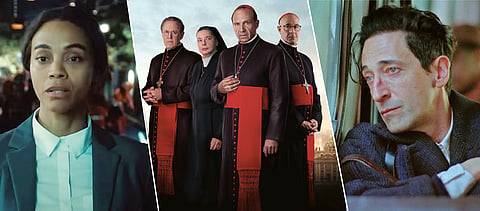

There are two ways to look at the Oscar season this year, what pundits are calling unseasonably “weird”: one as a collection of films, one better than the other; the other as a collection of scandals, one meatier than the other.
The joke is that Conclave — nominated in eight categories, including Best Picture — about the College of Cardinals meeting at the Vatican to choose the Pope’s successor, a film full of ribbing and subterfuge, is manifesting in real time, by knocking down its competition, one after the other.
First came Emilia Peréz, with thirteen nominations, a musical about a transgender drug lord in Mexico, directed by Jacques Audiard — a French man — full of Spanish that felt wrong, and trans representation in which sincerity and irony bled so messily, the film could not fathom which is what.
Karla Sofía Gascón, the Spanish actress who plays the Mexican mobster — the first openly transgender performer to be nominated for an Oscar — went on a scorched earth campaign, except that earth was her plot of land. After giving interviews saying her competition is trying to tear her and her film down, old tweets by her resurfaced — calling George Floyd a “drug addict swindler,” and dog whistling Islamophobia with “Is it just my impression or are there more Muslims in Spain? . . . Next year instead of English we’ll have to teach Arabic.” Her account was shut, and her apology was made, except it wasn’t an apology but a plea for sympathy, that her racism was taken out of context. Discussions were opened on whether nominations could be rescinded. The gossip vines are abuzz about whether Gascón will be attending the Oscars, and if she does, what will be the protocol?
Then, there is The Brutalist, the almost four-hour Great American Epic shot on VistaVision, 70mm, about a Jewish architect who escapes the Holocaust and immigrates to the United States of America, nominated in ten categories — including Best Picture, Best Director for Brady Corbet, Best Actor for Adrien Brody, Best Supporting Actress for Felicity Jones, and Best Supporting Actor for Guy Pearce. In an interview, the editor Dávid Jancsó revealed that they used AI to perfect “certain sounds” of Brody’s and Jones’ Hungarian accents, as well as to make the architectural plans in the retrospective that closes the film. Especially given the anxieties around AI replacing human labour that unions in Hollywood — for actors and film and television crew — have expressed, the anger against The Brutalist is timely, immediate, and sets a precedent for what is and is not allowed, what will and will not be celebrated. At the Golden Globes and BAFTA, Brady and Brody won Best Director and Best Actor, respectively, setting the stage for what could be an Oscars sweep.
Then, there is Fernanda Torres, nominated for the Brazilian biopic I’m Still Here, who had to apologise after a clip of her wearing blackface in a comedy sketch int the past resurfaced, and Mikey Madison, star of Anora — nominated in six categories, including Best Picture — saying she declined an intimacy coordinator for her sex scenes, undermining an industry practice, that though smaller, pockmarked the Oscars landscape.
Then, in the ultimate ode to Conclave, the pope actually fell ill.
The thing about the Oscars is that these scandals around films are not separate from the artistry of the film itself — the Oscars are, after all, a celebration of the best campaign as much as it is of the best cinema. Magazine spreads, dinners, screenings are part of the game you play. Michael Schulman, author of Oscar Wars: A History of Hollywood in Gold, Sweat, and Tears wrote about how in the 1990s, Miramax under Harvey Weinstein began the reign of the aggressive, bloody Oscars campaign, with Weinstein badmouthing DreamWorks’ Saving Private Ryan to give a leg up to Miramax’s Shakespeare In Love. Shakespeare In Love won that year, a win that was both shocking and in hindsight, upsetting.
The other thing about the Oscars is that, one the one hand, it celebrates certain kinds of cinema and actors, but as a zero-sum-game, with other promising, prominent misses — for example, the absence of the erotic pulse of Challengers, the absence of cinematographer Sayombhu Mukdeeprom who lensed Queer, Challengers, Trap, and Grand Tour, and the editing out of Grand Tour and Universal Language in foreign language films is difficult. It is also hard to believe that All We Imagine As Light does not belong on the list of Best Picture nominations, when Wicked — which has ten nominations — and Dune: Part 2 have cozied a spot, not to mention A Complete Unknown, the Bob Dylan biopic that has been deemed too conventional, too cute to be taken seriously.
The Oscars are, famously, not about the films, but the noise around them, noise that then congeals on their artistry until it becomes imperceptibly one. A mix of guilt, gossip, and gumption — true, artistic gumption — the Oscars is a celebration of cinema, and to think that cinema is just about the movies is naive. Cinema is also the afterlife. And the Oscars will never let us forget that.