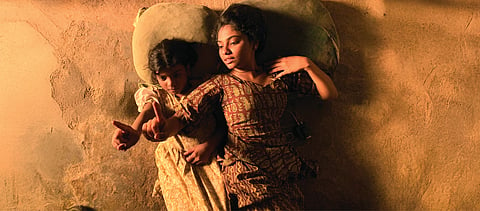


On paper, Anuja is a noble project. It’s made in association with Salaam Baalak Trust, a Delhi-based non-profit organisation that supports street kids. It stars one of its children, Sajda Pathan, as a gifted nine-year-old garment factory worker who is conflicted between earning a livelihood and getting an education. It's an Indian American production. It is backed by diaspora-global celebrities like Mindy Kaling, Priyanka Chopra Jonas and Guneet Monga Kapoor. And it's about spirited orphans in a big bad world. Which is to say: Anuja is so noble that it's only a project. At its best, it's a creative presentation slide. At its worst, it's less of a short film and more of a look-poor-people-hungry-people aesthetic. It brings back memories of the famous and infamous Slumdog Millionaire (2008) — and not in a good way.
The 23-minute short opens with the older sister, Palak (Ananya Shanbhag), narrating a popular caregiving fable to little Anuja. They speak to each other like they come from different backgrounds; Palak sounds a bit urban and Anuja, far more authentic. The craft is awkward, as if the camera expects these characters to behave at a certain pitch. It soon emerges that Anuja has the chance to apply for a prestigious boarding school scholarship, and Palak secretly sews bags at the factory to sell and collect money for her exam fees. This sets the tone for an Aladdin-era tale that features curated vignettes and faces straight out of the ‘Museum of the Western Gaze’: a greedy paan-chewing boss, a kind security guard (whose smile when he lets Anuja go is unintentionally creepy), a chase sequence set to dholak beats, sweatshop and grime shots, and a cutesy montage of the girls spending their surplus cash on popcorn, jalebis and an old Bollywood classic. The checklist is complete. At one point, they jokingly go through the matrimonial section in the newspaper and scoff at an ad demanding a fair-skinned girl and homely values. Ironically, they belong to a film that looks like it might have advertised for dark-skinned actors and brown-washed values.
Anuja is sweet in parts, but it's sweet in a very designed and bleeding-heart manner. There's no room for ingrown warmth, cultural improvisation or organic storytelling. It's a carefully calibrated PSA formula that's happy to be a formula. Every frame goes: “Y’all want to see the real India (the one you've always imagined before visiting)? Here you go!”. I don't particularly like the term “Oscar bait,” but this film nails the term in a way that's depressingly successful. It's now a Live Action Short nominee for the 2025 Oscars, following in the footsteps of other similarly awards-gazey productions like Period: End of Sentence (a 2019 winner in the short documentary category) and The Elephant Whisperers (a 2023 winner in the same category).
As admirable as its journeys on the international circuit have been, it's hard to escape the fact that they've been tailored to do just that — to reiterate preconceived Western notions of how true Indian stories must look and sound. It's not a new symptom. There's a clinicality and awareness about them, a “gotcha!” vibe that evokes social and apolitical reach rather than artistic integrity. The producers’ quest for glory often appropriates the essence of these stories into a sort of cookie-cutter exoticism. An impression is sold, but no expression is made.
While the most striking feature-length documentaries (All That Breathes, Writing With Fire, Against The Tide) coming out of the country have dared to capture and reveal an India that outsiders rarely see, the shorts have been distinctly safe and curated to massage the White Guilt syndrome. Widely acclaimed feature-length counterparts like The Lunchbox and All We Imagine As Light have gone a long way in dismantling (or at least challenging) the gaze, but something like Anuja then comes along to prove that everything and nothing has changed. It doesn't stop short of breaking the fourth wall. It literally breaks the wall, makes big eyes and asks the respectable jury — not so much the audience — to introspect. And introspection, as we know, is the currency of commercial validation.