

So many Ramayanas there are, too many, that the earth is groaning, burdened by these multiplying, multiple interpretations — the fourteenth century Kannada poet, Kumaravyasa, thought. Three hundred Ramayanas — those are how many Camille Bulcke, the Belgian Jesuit missionary and scholar of Indian literature, enumerated back in 1950, listing translations from Kannada to Assamese, Gujarati to Javanese, Kashmiri to Tamil, Laotian to Marathi, Santali to Sanskrit, Tibetan to Prakrit, some of these more than a few centuries old, some even older.
While plurality is the trademark of a civilisation that houses the number of languages and just as many dialects as India does, what can be gained by charting worn-out paths? Instead, Kumaravyasa turned his translating eye to the Mahabharata. Others stayed put.
What can be gained, though, is a question people put to Om Raut’s Adipurush (2023) which tried to insert the hero worship of the actor Prabhas into the devotional worship of Rama, failed to do so because hero worship, unlike devotional worship, has its limits. It is a question also put to Mani Ratnam whose Raavan/ Raavanan (2010) steered so far away from the source text, it was not an adaptation of as much as a trampolined leap from. Ditto for Aravindan’s Kanchana Sita (1978) and Nina Paley’s Sita Sings the Blues (2008), which serve as interpretations more than variations.
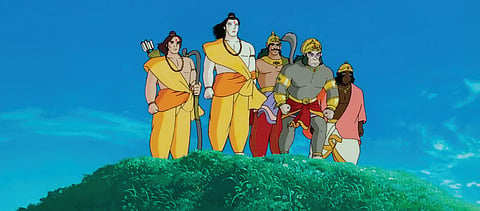
Put the same question to Ramayana: The Legend of Prince Rama, the 4K re-release of the Japanese-Indian animation film from the 1990s, and what emerges is a complicated answer of the lengths to which a film will languish to get made, and once made, languish again, to be seen.
While the film insists it is an adaptation of Valmiki’s Ramayana, it is, in fact, closer to Tulsidas’ Ramcharitmanas, which axes the scenes of Rama questioning Sita’s fidelity, banishing her when she was pregnant with twins, and lassoing them back into his palace after years of separation, with Sita insisting on being swallowed by the earth. This film’s tilt is entirely devotional — the scene of him killing Vali, another blemish on the character of Rama, is papered over in a gorgeous montage.
Directed by Yugo Sako and Koichi Sasaki from Japan along with Ram Mohan from India, the film came out of the 1980s when Sako was touring India. A documentary filmmaker, he was shooting the waterways of Asia, including the Ganga, when he crossed paths with controversial archaeologist BB Lal, who was excavating sites in pursuit of Ramayana relics in Allahabad. That a 2000-year old text could still keep a civilisation searching tuned Sako in.
He made a short documentary on this excavation in 1983, when the Vishwa Hindu Parishad (VHP), having got wind of this, wrote to the Japanese Ministry of Foreign Affairs — they thought Sako was making a film on the Ramayana, and anxieties regarding a foreigner re-telling an Indian story and their possible agenda were raised. Sako sated their concerns, meeting Har Mohan Lal, VHP’s Secretary General. It was here, in this conversation, that Sako pitched his idea for an animated Ramayana.
VHP came on board, and Sako began researching, reading as many as ten versions of the Ramayana in Japanese in the year 1985. VHP connected him to Ram Mohan, a seminal figure in Indian animation, behind the Cartoon Film Unit in the Films Division in the 1950s, and the vaporous idea was slowly given shape. Sketches were being made, meetings were being pinned, and politicians were being wooed.
Initially, the film was meant to be a co-production between the Indian and Japanese governments. But the 1980s was also when the Ram Janmabhoomi movement was gathering steam across the country, demanding the uprooting of the Babri Masjid in Ayodhya, considered the site of Rama’s birth.
Despite being a documentary filmmaker with no prior animation film to his credit, Sako conceived of the film as animated for he saw Rama as a figure no live-action flesh and blood body could personify. Coming from Japan, the land of anime, but pitching his story in India, a land where animation was yet to take off, considered more suited to juvenile humour than doe-eyed devotion, there was stiff resistance. Even Sunil Dutt got involved to push Sako’s film forward — alas.
“The Government of India said that the Ramayana is a very sensitive subject and cannot be depicted as a cartoon character. We tried to insist… but they didn't understand,” Mohan said in an earlier interview. The film was eventually produced privately in Japan, forming the Nippon Ramayana Films, with reportedly 800 million yen ($6.7 million).
Hindi scholar Narendra Sharma became the script consultant, Rani Day Burra became the co-writer, and Vanraj Bhatia was roped in as the music composer. Nachiket and Jayoo Patwardhan, an architect couple, were called on to sketch these worlds, palaces, landscapes, and weaponry.
Indian artists were involved in the art setting, dialogue, and music, while the Japanese artists were storyboarding with original drawings, animation, colouring, photography, and were doing the editing. With no mobile phones nor emails, images were sent back and forth across countries through couriers, stitched with brief calls between the two teams.
Mohan also flew to Tokyo a few times, to supervise the designs and gestures. “For example, they didn’t quite know how the dhoti was worn; they used to draw it like pajamas. So one, we had one gentleman actually demonstrating how to wear a dhoti,” Mohan notes in an interview. Similarly, the gesture of folding hands, and touching feet to take blessings needed to be explained — through a translator, though.
After roughly two years, between 1990 and 1992, working with over 450 artists and nearly 1,20,000 hand-drawn cels or transparent sheets, the film was completed in December 1992, when the Babri Masjid was demolished by a mob. The film’s path to release would be just as long as its making. This film was in English with Sanskrit songs. Actors like Rahul Bose and Cyrus Broacha voiced some of the characters. It premiered at the International Film Festival of India in 1993 and showed a few times on Doordarshan. It was only years later, in 1997, that a Hindi dub of the film had a limited theatrical release, one made without fanfare or promotion.
Hindi film actors Shatrughan Sinha and Amrish Puri were roped in. Arun Govil, known for playing Rama in Ramanand Sagar’s Ramayan, voiced Rama, here, too.
In 2000, the film was released in America as The Prince of Light — 20 minutes shorter. Kartik Mohan, son of Ram Mohan, notes in an interview that the American distributors found the story too convoluted, asking if they could chop the court intrigue scenes and make it look like Rama and Sita went to the forests for their honeymoon. The film was dubbed in American English. Narrated by James Earl Jones, the voice of Rama was given by Bryan Cranston, who would go on to become popular for his role of Walter White in Breaking Bad.
It was in 2002, when the leading kids channel, Cartoon Network, decided to telecast the Hindi dub of the two-hour feature film as half-hour episodes every Saturday evening, leading up to Diwali — when it telecast the entire feature film — that Ramayana: The Legend of Prince Rama rose up to the public consciousness. A whole generation calls this film the “Cartoon Network Ramayana”.
In 2022, to celebrate 70 years of Indo-Japanese diplomatic relations, the 4K remastered version of the original English film was shown. Prime Minister Narendra Modi’s 2022 visit to Japan and his subsequent paean to Japanese absorption of Indian stories, specifically pointing to this Ramayana in his radio show, set the ball rolling for a wide Indian release.
The colours are gleaming, the sunlight on water dappling. The purples as though scrubbed clean, the yellows against it, as though the colours existed for the sole purpose of contrast, and the backgrounds painted, touched by the breath of Monet — no sharp edges to the leaves, to the Nataraja, the pillars; a watery wallpaper to press their sharp bodies against. The animator Chetan Sharma at the 2022 screening of the film noted that the film was “a testament to what Indian animation could have been”.
The master data to the Hindi dub was lost. So Geek Pictures India — which wanted to bring the film back to India — freshly translated and dubbed the film. Last year, with the finished film, Geek Pictures India collaborated with AA Films and Excel Entertainment to bring Ramayana: The Legend of Prince Rama in four languages: English, Hindi, Tamil, and Telugu. The film is all set to be released in 4K for the first time in theatres across India on January 24, 2025.
Today both Sako and Mohan are no more. But their collaboration, which endured four decades, dipping in and out of obscurity, being tossed by the waves of prevailing politics, stands as a testament. That, like its source text, it endured.