

Hisaab Barabar (“Account Settled”) unfolds like a Shankar spectacle minus the spectacle. Which is to say it’s just a bland, stagey and preachy social-message drama that repeats the words “common man” and “accounting” while somehow shoehorning the term ‘New India’ into its monologues. That’s the staple of New Hindi Cinema. When the citizens wake up, it’s always Naya India; otherwise it’s just another one-man-against-the-system story. And the system is neither the private sector nor the government — it’s only a few rotten eggs.
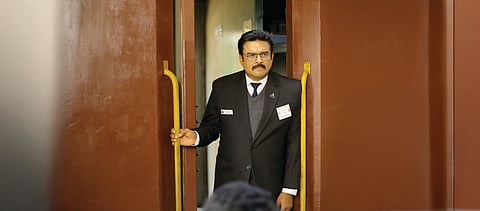
Hisaab Barabar stars R. Madhavan as the super-honest and statistics-crazy Radhe Mohan Sharma, a New Delhi ticket collector who notices a discrepancy of ₹ 27.5 in his savings account. He does the math (the background score features a calculator-punching sound as numbers float over his head) and uncovers a subtle but massive interest scam by the bank, which is owned by a villainous billionaire (Neil Nitin Mukesh) who seems to have watched too many reruns of the late Nirmal Pandey in One 2 Ka 4 (2001). We know he’s evil because the film opens with him throwing a lavish terrace party, acting nutty and comparing the common man to a donkey. We know he’s corrupt because he is often seen standing in front of a huge mountain of cash; talk about coming straight to the point. We know he’s eccentric because he plays his bank ad jingle on his phone and randomly dances to it in the middle of the street.
The premise is technically interesting because it focuses on a financial system that amasses its fortune through invisible discrepancies. Nobody wants to go through the bureaucratic hassle of addressing the absence of small amounts every month, and most monthly bills — electricity, cellphone, internet, bank statements, the “terms and conditions” that nobody reads — are designed to exploit our conditioning. Radhe is a typically pious everyman hero, a bit like Anil Kapoor’s character from Nayak: The Real Hero (2001). When he becomes a thorn in their flesh, he is bullied and silenced in familiar ways: he’s jailed for a day, accused of corruption himself, suspended from his job, his son is threatened, and his house is razed. It’s the simplistic Sirf Ek Bandaa Kaafi Hai-coded universe; the nobility is just as loud as the injustice.
The problem with Hisaab Barabar is the problem with most modern social vehicles. The film-making is dated and awkward. Every stroke is broad. For instance, its idea of comedy (because what’s a Bollywood movie without some slapstick?) is Radhe getting into a physical tussle with a bank employee before the manager intervenes; this is followed by the manager and employee getting into a tussle. At another point, a panicked henchman rushes to the evil CEO’s dinner meeting and literally falls face first into a bowl of raita so that he can say the line: “sir, sab raita phail gaya” (a gastronomic proverb for “we are screwed”). The film’s idea of goodness is Radhe being a TC who uses a blackboard on the platform to teach young railway employees every day. The film’s idea of a love story is Radhe discovering that the sub-inspector in charge of the case is a former flame (Kirti Kulhari) he once rejected. It’s hard to tell the flashback portions (symptoms: she has red hair and a nose piercing) from the current timeline — even when she speaks in TED-Talk-ish mottos like “I invest in moments”. The film’s idea of Radhe’s transformation and crisis is staging a fight on the platform where a young shopkeeper is pushed onto the tracks by a customer and crushed by a train.
The resolution is on autopilot, too. One moment Radhe is insulted by the hammy villain and the next, “common men” come to his rescue and suddenly decide to boycott the bank in a nationwide movement. Revolution is a cinch. The fact that there is a resolution is naive in a children’s-fairytale sort of way. Movies tend to offer quick-fixes, but Hisaab Barabar takes the demonetised cake. A scene features Radhe sitting on top of the investigative committee’s table while proving his innocence one bill at a time. It’s the kind of performative thing an Akshay Kumar character might have done a decade ago.
But it’s 2025 and it doesn’t matter who’s doing it anymore. R. Madhavan plays a middle-class man like a middle-class man might play R. Madhavan. His Radhe is an animated idea, not a person. He’s a righteous machine masquerading as a human. In an anti-capitalism movie, it’s only fitting that he loves his Amul milk and butter. And his screensaver has the words “hisaab barabar” floating across the computer, lest we forget his life’s mission. The bar is not high for this genre, but it’s like watching satire getting high at a bar. The intent is to fool the viewer into interpreting a good message as a good film. It’s a tiny discrepancy, of course, and it eats into our moral bank accounts... one Hindi production at a time.