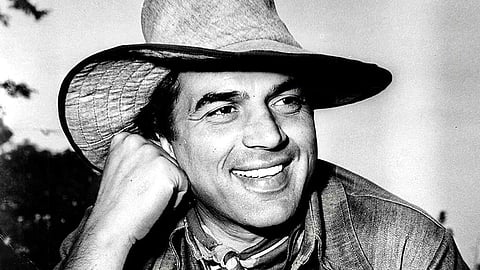


Dharmendra, one of the definitive male leads of Indian cinema, the Veeru of Sholay and the ‘He-Man’ of Bollywood, passed away in Mumbai on Monday, November 24. He was 89.
Admired by generations for his handsome ebullience and dynamic screen presence, Dharmendra was a defining star of Indian film. In a career spanning over six decades, he displayed his mettle in more than 300 films, embodying a wide range of characters and shades, from the leapingly muscular to the haltingly romantic. Along the way, he also blossomed into a brilliant comic performer.
Dharmendra was born in a middle-class Sikh family in undivided Punjab, in 1935. His father, Kewal Krishan Singh Deol, was a schoolteacher and headmaster in Sahnewal, Ludhiana. A handsome young Jat, Dharmendra’s journey into the world of films began when he won a Filmfare talent hunt in 1958 and moved to Mumbai. He got his first acting break in the film Dil Bhi Tera Hum Bhi Tere (1960). Though the film movie not succeed commercially, Dharmendra was well on his path, exhibiting unusual versatility in his early career. He was cast by Bimal Roy—one of the leading directors of the time—as the compassionate prison doctor who takes a liking to Nutan in Bandini (1963). Later, his performance in Hrishikesh Mukherjee’s Anupama (1966) was noted for its restraint and sensitivity, and in Satyakam (1969), he landed one of his most powerful roles as an idealistic engineer battling a corrupt world. Mirroring the moral collapse of the times, his simmering intensity in the film would set an archetype—that of the angry common man, let's say.
As his career took off, Dharmendra transformed from a soft-spoken romantic into a rugged screen hero, with toughly-textured roles in Haqeeqat (1964), Phool Aur Patthar (1966) and Yakeen (1969). Meanwhile, hits such as Mera Gaon Mera Desh (1971), Seeta Aur Geeta (1972) and Yaadon Ki Baaraat (1973) cemented his popularity at the box-office. Another notable film from this period was Vijay Anand's Blackmail, a thriller with an enduring soundtrack, including the timeless romantic number 'Pal Pal Dil Ke Paas'.
Then came Sholay. In Ramesh Sippy’s iconic Curry Western, Dharmendra immortalised the part of Veeru, the loveable rogue whose onscreen camaraderie with Amitabh Bachchan became an emblem of everlasting friendship. With Bachchan cast as the brooder, Dharmendra was left to do the comic heavy-lifting, and his chemistry with Hema Malini was among the film’s many highlights. The same year, he shone in a more unrestricted comedic role in Hrishikesh Mukherjee’s Chupke Chupke (1975), playing a botany professor who disguises himself as a garrulous chauffeur to prank his in-laws.
The term 'sex symbol', typically bestowed on uninhibited female actors of the time, could easily be conferred on Dharmendra. Few male stars, for instance, were so unembarrassed with displaying their supple chest and thighs, as evidenced by the swashbuckling production Dharamveer (1977). Dharmendra remained a formidable box-office draw through the late 70s and 80s, delivering hits like The Burning Train, Chacha Bhatija, Ram Balram (another two-hander with Amitabh Bachchan), Naukar Biwi Ka, and Rajput. He scored another mid-career winner with Hukumat (1987), a Western-flavoured action drama with hats and machine guns.
By the century's turn, Dharmendra had settled into amiable elder statesman roles. Yet, when the scene called for it, he could leap into urgent action, as in the climax of Pyaar Kiya To Darna Kya (1999).
An outsider to the industry, Dharmendra became the founding patriarch of an illustrious film family. He was married to Prakash Kaur in 1954, with whom he had four children, including actors Sunny Deol and Bobby Deol. In 1980, he married his frequent co-star Hema Malini, with whom he had two daughters, Esha and Ahana Deol. His newphew, Abhay Deol, and grandsons Karan and Rajveer are also actors.
Dharmendra briefly entered politics in the aughts, winning a seat in the Lok Sabha from Bikaner on a BJP ticket. He was awarded the Padma Bhushan, Indian’s third highest civilian award, in 2012.
In the new millennium, Dharmendra reinvented himself as a mature and reliable character actor. He was memorable in unshowy roles in Johnny Gaddaar (2007) and Life in a… Metro (2007), and appeared alongside his sons in the boxing drama Apne (2007). The trio also bumbled through the comedy franchise Yamla Pagla Deewana, named after Dharmendra's iconic song from Pratigya.
More recently, he played a gentle soul reminiscing a past love in Karan Johar’s delightful Rocky Aur Rani Kii Prem Kahaani (2023), winning a new generation of fans.
Dharmendra’s final screen role will be in Sriram Raghavan’s Ikkis, a war drama where he plays the father of Arun Khetarpal, a braveheart who died in the 1971 Indo-Pakistan War. From the shy, introspective doctor in Bandini to the misty-eyed veteran in Ikkis, it's as though Dharmendra’s journey echoed the coming of age of Indian film. He will be emphatically missed.