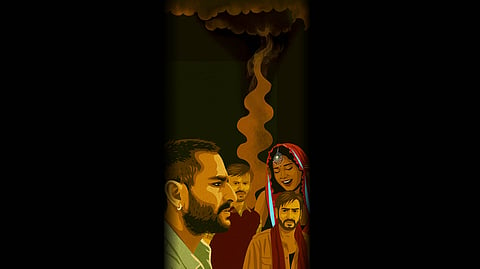

Filmmaker Vishal Bhardwaj’s Omkara, the 2006 reimagining of Othello announces itself not as a polite translation of Shakespeare but as a full-throated, regionally specific eruption: a parable about power, honour and the slow-motion mechanics of betrayal that refuses to let you look away. It’s the kind of film that, nearly two decades on, reads less like a high point in one director’s career and more like a foundation text for contemporary Indian cinema.
What makes Omkara exceptional is Bhardwaj’s refusal to domesticate the tragedy into mere period pastiche. He relocates jealousy and political muscle to a modern small-town ecosystem where caste, electoral violence and local patronage distort relationships.

The screenplay, co-written by Bhardwaj, translates Shakespeare’s mournful architecture into Hindi idioms and rural power rituals without diluting the play’s fatal logic. In doing so, he preserves Shakespeare’s architecture: jealousy, betrayal, misunderstanding — while making every scene feel indigenous.
The cast is central to its enduring power. Ajay Devgn as Omkara (Omi) is both alpha and unravelling, a leader whose trust becomes his undoing. But it is perhaps Saif Ali Khan’s Langda Tyagi who haunts most: ambitious, broken in places, corrosively eloquent in others. This role was once nearly played by another star; Bhardwaj revealed in an interview with Mid-day, “Aamir [Khan] would share what he had in his mind…So, I told him that I have this Othello, and this Langda Tyagi character with me. He said, ‘Whenever you make this film, I’d love to be considered for Langda Tyagi.’”
[Saif Ali] Khan turns what could have been a cartoonish villain into a coiled and corrosive presence: sly, wounded and absurdly persuasive. Konkona Sen Sharma, Vivek Oberoi and Kareena Kapoor Khan (among others) colour the story with nuance and tragic resonance; the result is a chorus of performances that feel both theatrical and painstakingly authentic. Contemporary reviewers and retrospectives singled out the acting and ensemble work as central to the film’s power.
The music, scored by Bhardwaj with lyrics by Gulzar, never feels decorative; it is an aural shorthand for the film’s moral weather, and songs such as “Beedi” cut against the grain of the tragedy to give the film a pop-cultural afterlife of its own (the soundtrack even crossed unexpected borders, finding listeners abroad). Sound design, production design and cinematography work in lockstep to make the world feel politically saturated; those crafts were recognised in awards circuits, as were the film’s more visible achievements. At the National Film Awards and Filmfare Awards ceremonies the film collected an array of honours that underline how its technical choices were integral to its storytelling.
What gives Omkara its edge and lasting resonance is its commitment to exposing the messy, intertwined roots of personal and political tragedy. The film doesn’t allow jealousy to be only emotional; it becomes political. The bitterness of a rumour, the weight of caste, the precariousness of power — these aren’t backdrops, they are active agents. When Langda Tyagi manipulates Omkara, or when Omi misreads loyalty, the stakes are always both personal and community-wide. This is not just Shakespeare filtered through a new geography, but Shakespeare amplified by the real inequities of Indian politics and rural society.
Critically, Omkara changed expectations. It showed that a literary adaptation need not be decorative or aristocratic, it can be rough, unpolished, and still deeply intelligent. It fused popular cinema energy with art cinema sincerity. Its performances, especially Khan’s, have become reference points; its imagery and lines still echo in public memory.
In short, Omkara belongs in the pantheon of Indian films over the past 25 years because it is rare: in its ambition, in its moral clarity, in its emotional intensity. Bhardwaj took one of the most famous tragedies in Western literature and made it bloodied, local, raw — and in so doing, made something universal.