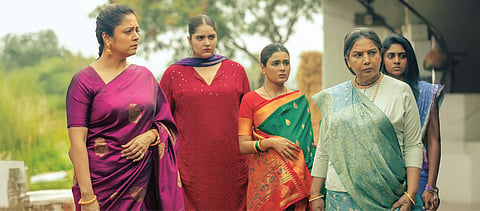


In a housing society in Thane, the staff of VivaLife Pharma uncovers a drug scandal. Dabba Cartel reimagines the crime drama through the lens of five seemingly ordinary housewives who secretly run a high-stakes cartel. As ambition, friendship, love, and betrayal collide, their world becomes a maze of deception and power.
With a powerhouse ensemble cast led by Shabana Azmi, Gajraj Rao, Jyothika, Nimisha Sajayan, Anjali Anand and more, the series brings a fresh, female-driven perspective to the genre.
The Hollywood Reporter India sat down with creator Shibani Akhtar, director Hitesh Bhatia, and producer Farhan Akhtar to unpack the creative vision behind this Netflix show.
Edited excerpts:
This show flips the script on the traditional gangster narrative, introducing a female crime syndicate — a subgenre that's emerging now. For each of you, what was the creative pull towards this genre?
Hitesh: For me, I wasn’t thinking about genre or subgenre at all; it always comes down to the story — whether it excites me and I connect with it. When I first heard the story, what stood out was that these women are not criminals. That, to me, was the most interesting aspect of this journey.
Whether they’re male or female, or what genre the story belongs to... all of that was secondary. What mattered was that it’s a character-driven story about normal people dealing with everyday life, making difficult choices, and watching their world turn upside down because of those choices. That’s what made it so exciting for me. We hadn’t seen a story like this on-screen before, and that was the creative pull for me.
Shibani: I completely agree with Hitesh. For me, it’s the world of the story. You have this housing society in Thane, with these women who you’d never expect to be part of a crime syndicate. They’re thrust into this world, and now they have to navigate it. Most crime stories revolve around existing criminals — usually men.
What’s interesting here is that these women run a dabba business; it’s such a uniquely Indian setup. The dabba business is deeply rooted in Indian culture, and incorporating that into the story was a great choice. It really sets Dabba Cartel apart.
I also love how the housing society connects to a larger pharmaceutical scam. We wanted to create a world different from what’s typically seen, and I think that’s what draws people in.
Farhan: I love the way the characters are written. We have five unassuming women going about their daily lives, their husbands go to work, and they’re left behind, tending to children or running small home businesses. But suddenly, their lives are thrust into this massive, dangerous game.
What I found fascinating was the juxtaposition of their world with the big pharma scam happening on the other side. Whenever we think of crime shows, especially those involving drugs, our attention usually goes to recreational drugs and street dealers. But pharma scandals operate on an entirely different level. Just a couple of days ago, there was news about something similar. So this contrast, this parallel, made for an incredibly interesting setting.
Shibani, this show is your baby. Where did the idea come from? And why Thane? We’ve seen Mumbai explored so much in cinema, but not Thane.
Shibani: As a creator, coming up with an idea feels amazing. But once it’s out there, it belongs to so many people — the writers, the production house, the platform, the director. It becomes a collaborative effort, and little things evolve along the way.
Honestly, I don’t even remember where Narcos Thane (from the trailer) came from. It must have been in some conversation. But Thane was always part of the story from the beginning. Initially, the concept was about a kitty party that somehow turns into a drug cartel. Then it evolved — a housing society, a dabba service, a specific type of woman from a specific world. Once everyone got involved, the idea grew and expanded, and today, Dabba Cartel is what you see.
Farhan, you mentioned the juxtaposition of the dabba service and the pharma scam. What does this contrast bring to the show?
Farhan: The drug business is just the backdrop. The real story is about ordinary people caught in extraordinary situations that spiral out of control.
These women never set out to do this. They didn’t have criminal intent. But as you've seen in the first three episodes, how certain circumstances force them into this world. The show doesn’t glorify anything; it’s about survival and the unexpected turns life can take.
And, of course, we’ve never really seen women in this space before. Typically, drug cartel stories focus on men, with women either unaware or complicit. But here, the women are in charge, which shifts the narrative in a really exciting way.
Hitesh, this is a genre jump for you. Your debut film Sharmaji Namkeen was so feel-good and warm. How did you find the tone and texture of Dabba Cartel?
Hitesh: I don’t know how I found it, but it was a conscious effort. More than the genre, my focus was on doing justice to the story and telling it in the most unique way possible.
This was a highly collaborative process — Shibani, Farhan, Ritesh, Abbas, the writers, the DOP — everyone contributed to the vision. We referenced different styles, experimented, and discarded what didn’t work. Choices like setting it in Thane, the way we used rain, the lighting patterns — everything was a deliberate decision to serve the narrative.
Shibani: I want to add that when you live with a script for three years, you have expectations. But when you finally see it come to life, it’s incredible. What Hitesh did beautifully was make choices that enhanced the relationships between these women. You can have everything on paper, but in the moment, the way a director guides a scene makes all the difference.
The way he portrayed the nuances of female relationships was remarkable. He approached it with a sensitivity and depth that felt authentic. I know he hates praise, but he deserves it!
The ensemble cast for the show is quite incredible. Were these the actors you originally envisioned in these roles?
Shibani: Before the idea was even fully fleshed out, I had one name on a whiteboard: Shabana Azmi – Drug Cartel. So she was always going to be part of the show. What would she do? We had no idea then!
Everything else evolved organically. We wanted actors from different regions — South India, Bengal — to make the cast feel inclusive and fresh. We wanted faces that hadn’t been seen together before, and I think we achieved that.
Farhan: I strongly believe that roles find the right actors. It happens every time. Once an actor embodies a character, you can’t imagine anyone else in the role.
Would you say that streaming has changed the casting game?
Farhan: Streaming has completely changed the casting game. Earlier, unless a film was in theatres and someone told you to go watch it, you wouldn’t discover new talent. Now, you can see incredible actors from all over India on streaming platforms. You can literally audition someone by watching their previous work at home. It’s a game-changer.
Hitesh, working with such a powerhouse ensemble — was it easy to align all the energies or was there creative friction?
Hitesh: No, no friction — just excitement! When we did our first reading at Excel’s office, seeing them all together — Gajraj, Shabana, Jyotika, Nimisha, Anjali — it was a moment. They are powerhouses of talent with years of experience. Honestly, I was nervous at first about handling such a diverse group. But they made my job easier.
I remember my first meeting with Shabana ji — I had prepared for it, but she stumped me with one backstory question about something from ten years before the story of Dabba Cartel even begins! It made me realise how meticulous she is. Working with actors like that challenges you and elevates the entire process. It was a great learning curve.