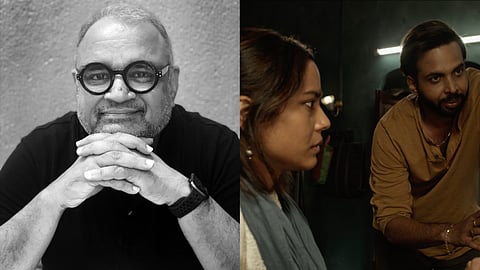


The 90s will remember Bharatbala as the man behind the music videos of Vande Mataram (1997) and Jana Gana Mana (2000). With composer A.R. Rahman, Bala struck out as the man who made patriotism palpably cool for the MTV generation.
He followed that with two feature films Hari Om (2004) and Maryan (2013), and then decided to embark on what he describes is a “lifelong project” — Virtual Bharat, a 1,000-film digital museum that is archiving India’s art, culture, and landscapes, releasing on YouTube.
After more than a decade, he is back with a feature film, Banaras, set during the Mahakumbh, starring Neeraj Kabi as a musical maestro living with dementia and navigating his fraught relationship with his two children, played by Abhishek Banerjee and Shahana Goswami.
Bala describes the film as “a family divided by music, finally united by music.” Banaras premiered at the International Film Festival of India (IFFI) 2026 In Goa.
We caught up with Bala right after the premiere, where he spoke about the project, his relationship with Rahman, and the enduring legacy of his Vande Mataram days.
Excerpts from a conversation:
How was the premiere of Banaras?
We had two full houses! It was overwhelming to see how the audience responded. We had the entire cast and crew, and even Rahman sat through the film, observing how the audience was reacting. He was taking notes.
Taking notes? Is he going to further work on the score?
See, there was this overwhelming emotional reaction at the end. Rahman says that he wants to push the melody more, add one more symphonic rendition, to twist the emotional quotient further.
You have known Rahman since the days he was Dileep, from your ad jingle era. You worked with him in Vande Mataram, your feature film Maryan (2012), and now Banaras. How has the relationship changed as you both evolved?
To be honest, we are the same as we were 40 years ago. Our lingo and enthusiasm still has that bachpana (childishness). He has seen it all, but when we sit together, all of that is out of the window. He will still call me if he gets excited about anything, unrelated to films. When I get an idea, I talk to him, irrespective of whether I do the music with him or not. Everybody is a fan of AR Rahman, but I think Rahman is a fan of mine (laughs). We are always in discovery mode.
I was planning on making a documentary on Mahakumbh. Instead, this one line came to me as a musical idea for a fictional feature film. I was in L.A. He was in Istanbul. I wanted to do only one song for this film — one anchoring song in a film about a musical maestro. Now we have nine compositions. Films don’t have songs. These compositions are the protagonists, along with the relationships in the screenplay.
You made Maryan in 2013. What about this project made you return to feature films?
I never went away. I don’t differentiate between fiction and non-fiction. The Virtual Bharat films also make you feel the way you do when you watch a fiction film. It is all cinema. Banaras is an engagement of fictional actors in the real world of Mahakumbh, absorbing that universe, and flowing with it. They are people in the crowd.
You shot with a whole crew during Mahakumbh? It sounds like a logistical nightmare.
We shot for 40 days inside Mahakumbh with the actors, with light and (sync) sound. It was a logistical nightmare! We had all the permissions from the government. But there, you have to become a pilgrim to make the film. You can’t be a film crew.
Were you improvising as you were shooting?
We had the scenes mapped out, but some things were organically absorbed. However, I didn’t change the script for that.
I want to ask you about Virtual Bharat. You had described it as a 1000-video project. How far along are you?
It is a lifetime’s project. We have done 124 so far. I took nine of those films this year, and made it into a 90-minute feature. We call it The India Experience Season 1. We had screenings in the finest theatres in New York, LA, New Jersey, SF, Boston, San Diego, etc. to packed houses. We are going to do 100-120 screenings next year. People are releasing their films directly to streaming, and here we are, taking our short documentaries on YouTube, making a movie out of it and taking it to cinemas. Ten days ago, I had another screening, for The India Experience Season 2. Next year, we will screen Season 1, 2 and 3 across North America. We are focusing on that market and building a big community, with cultural conversations and engagements. I intend to take Banaras also like that.
What about India?
The India Experience is having its premiere in India at IFFI, and we want to start with 20 cities and go to 100 cities across India. For Banaras, we just started feeling how the audience is reacting. We want to bring it to the audience in the first quarter of 2027 after taking it to a few more festivals.
You produced and directed the Vande Mataram/ Maa Tujhe Salaam video in 1997. Recently, when asked about the song, you said you were protected by your innocence—you never saw it as a Muslim lyricist (Mehboob) and composer (Rahman) working together. Two things: today, the discourse is horrifyingly divided. Then, the way people engage with cinema has changed. Given these twin forces, how do you introduce this idea of love for the nation or patriotism with Virtual Bharat and The India Experience?
I don’t subscribe to the idea of patriotism. I subscribe to the idea of humanity. I want to use the tool of cinema — the language I understand — to share that with a wider audience. In Dallas, for example, we had a massive screening of The India Experience. Regular Americans sitting next to me were so enthusiastic. I asked one of them, sitting next to me, what it is that he saw in the film—and he didn’t know I was the director. He said that, even though it is from a country showcasing its culture, it is an epic showcasing humanity, and that is universal. Malayalam, Marathi, Punjabi, Nagamese, Marathi—it is not being seen as separate languages, but linking it to humanity. The audience is ready, we just have to take it to them.
I am saying innocence is alive even today. You must trust their innocence. People find ways of preserving it, submitting to it, and celebrating it.