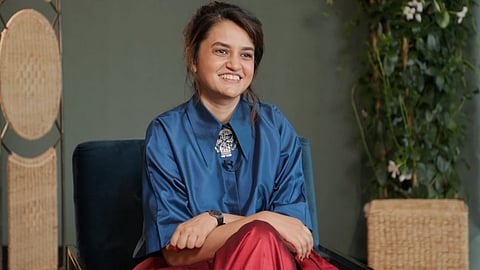


Payal Kapadia, writer and director of Grand Prix-winning All We Imagine As Light (2024) is no stranger to the Cannes film festival. In 2017, her short film Afternoon Clouds premiered at Cannes. She followed it up, in 2021, with her debut feature film, a hybrid documentary, A Night of Knowing Nothing, which won the Golden Eye Award. The global journey of All We Imagine As Light, too, took flight from Cannes.
After serving on the main jury last year, Kapadia returns to Cannes this year as the Jury Chair for the Critics’ Week, a parallel section at the Cannes Film Festival, organized by the French Syndicate of Cinema Critics. Following is an email exchange with Kapadia, as she gears up for her fortnight at the French Riviera.
Excerpts...
Chairing the jury, you follow in the footsteps of storied filmmakers like Kleber Mendonça Filho, Joachim Trier, and even a filmmaker you deeply admire, Miguel Gomes. How do you see the mandate of this jury as different from, say, your presence on the Cannes jury last year?
This year I am going to be in the jury of Critics’ Week, which focuses on first and second features. This already makes the selection quite different from the main competition which has mostly established directors. I think that filmmakers take more risks at this stage and it will be interesting to see. Along with this, there will also be a short film competition—another unique feature of the Critics’ Week. Historically, the Critics’ Week section has had some marvellous gems over the years, from filmmakers who have gone on to vast careers, so it is really exciting to be able to watch these films.
In your statement, you mentioned, “Film criticism is one of the key components of the independent and art house film ecosystem.” What has been your relationship with criticism—in both senses, the encouraging kind and the challenging kind? Has criticism sharpened, questioned, or deepened your relationship to your own films?
Yes, it still stands true for me that film criticism can be very helpful for independent filmmakers. As the film gets widely written about and contextualised, it helps the film reach out to potential audiences in the right way. I think it’s important, especially as a small film can get completely lost in the loud marketing of big movies. Critics can nurture a fragile film. Besides that, it certainly has deepened my understanding and relationship with my work—I think that film criticism can reveal something about your film that even you may not have thought of. Which is interesting as it gives you a whole other reading of the film. This can be both positive thoughts as well as negative ones. Either way, it has helped me to understand my own blind spots. You have to take from it what helps you grow.
The director Christian Petzold, when asked to advise young filmmakers, said the following: “When you’re a film student and you make two or three shorts, many festivals invite you to present your films. You can travel halfway around the world for two years with a short, and stay in four-star hotels, festival after festival, and sit in bars for hours with students from all over the world, every night in a different bar. It's a lot of fun, and you can fall in love with this lifestyle. But you can't work. It's impossible to work. My advice is: don't go to festivals; first, work.”
What do you make of this?
Well, there are two parts to answer this question. Firstly, for Indian filmmakers, it's not possible to travel the world with a short film. Sadly, festivals have much less money now than they did before, especially for shorts and rarely pay to get you across the world. Even when we were students, it was mostly the support from FTII along with institutions like the French and German Institutes that allowed students to go. So I think for Indian filmmakers, to be able to go at all as a student is an eye-opening opportunity. As for me, I met my producer at a film festival! We decided to work together because of this. So, for Indian students, it can really be a wonderful opportunity.
For feature films, it’s a whole different thing. Going to different territories to release your movie helps as a promotional exercise. A bit like when Bollywood and Hollywood movie stars do promotions. We have to do this in our own tiny way with indie films.
Now the second part of the question is very important. I think that a filmmaker’s job is interesting because we have so many facets to it. In the first writing stage—it needs some hibernation. Some time alone. But then in preproduction you are engaged with people—meeting hundreds of potential collaborators, going to different locations, meeting people and persuading them to act in your movie. I love this part of filmmaking. Shooting is much the same—being in new locations, rediscovering your own city and seeing the text come to life. But then comes editing and you have to retreat into the dark abyss of the editing room. It goes like this. Some filmmakers are very good at doing more stages at once. Sadly, I am not one of them and I take each one as it comes.
Film festival juries have come under a bit of fire this year, with the Berlinale Jury’s response to Gaza, including controversial statements made by Wim Wenders. What is the role of being a jury chairperson at such a moment? How would you navigate these questions?
Film festivals bring people together from all over the world. Thousands of journalists and press are there, too. So it is important to have a political position because it will reach out to many people. I think one has to have a political standpoint if one has to make cinema. It’s absurd to me to think otherwise.
What are the films at Cannes you are looking forward to?
This year there are some wonderful films in competition. I am excited about the films from Hamaguchi, Kore-eda, Ira Sachs, Lea Mysius, and Emmanuel Marre. Marre’s last film Zero Fucks Given was a gem from 2021 Critics’ Week. From the other sections, I am excited about the new movies from Dominga Sotanomar, Radu Jude, as well as Valentina Maurel. Lastly, there is a short film from a student from FTII, Meher Malhotra, called Shadows of the Moonless Nights, which I am excited to see.
What can you tell us about your Mumbai trilogy?
I am writing the film at the moment. It is based on an idea I have been mulling over for years. I take a long time to write. I am enjoying this time to delve into it!