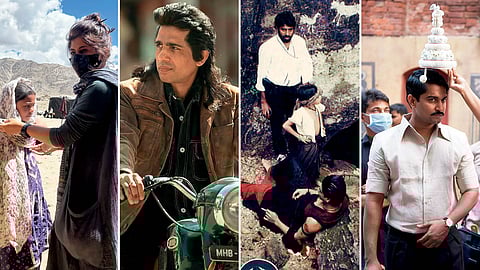


The Internet couldn’t get over how cool Akshaye Khanna looked when he walked into the frame in Dhurandhar, with Flipperachi’s “FA9LA” playing in the background; the way his shawl swayed as he danced, the sunglasses that added a hint of charisma, and of course, the black Pathani.
This is how cinema has always worked: long before the audience knew the designers’ names, they remembered the moments (who can forget Sridevi’s chiffon saris billowing in the wind?). But for decades, costume designers in Indian cinema have existed in a strange paradox: central to how films are remembered, peripheral to how films are made. In the hierarchy of fashion, costumes have long stood below couture. Within film sets, it has often stood below all else.
Smriti Chauhan, the costume designer behind Khanna’s look in Dhurandhar, puts it bluntly. “A director would know who his production designer and director of photography are, but will the costume designer ever be the first head of department hired? Definitely not.”
This invisibility is not accidental; it is systemic. Designer Manish Malhotra, in an interview with The Hollywood Reporter India earlier, described an industry where costumes were once treated as afterthoughts. “There were no scripts provided, and producers didn’t regard costume designers as integral to storytelling; they saw us as merely catering to actresses,” he said. “Payment was minimal, sometimes not even (given), and respect for the profession was scarce.”
“The way this starts is small,” Chauhan explains. She still hears things like, “It’s just a costume, we’ll manage it in a week.” Her timeline, she says, is almost always decided by someone else.
While working on Delhi Crime season one, Chauhan recalls an email informing her of the colour palette for her costumes. When she asked who had decided it, the answer was simple: “Aisa hi hota hai Bollywood mein (This is how it works in Bollywood).”
“I understand their [the director of photography and production designers] involvement, but why is the costume designer not part of that meeting?” she asks. “Who is creating that visual language for the people in the frame?” She also shares that Richie Mehta, the show’s director, is a close friend — and since that incident, she’s never been left out of these conversations. But for most costume designers, this inclusion remains the exception.
Research, for Chauhan, is paramount. For Dhurandhar, director Aditya Dhar’s only brief was Pathanis; Chauhan handled the rest, researching regional variations rooted in Lyari, where the film is set. She reveals that Khanna was unsure about how the Pathani silhouette would look on him.
“We were shooting in Leh and for Akshaye sir’s song we made two options — one in linen and one in a thick silk fabric,” she says. “In our first few meetings he told me he feels very cold, so I kept a warmer option.” For Angrezi Medium, she spent a week in Rajasthan; for Delhi Crime, she spent hours at the INA police station in New Delhi, observing and talking to inspectors.
Neha Bajaj, the costume designer behind Guns and Gulaabs (2023) and the upcoming Toxic, says, “People don’t realise the extensive amount of background work, research, sketching, fabric picking, silhouette selection that goes into designing a character. Most often, we design a character which includes hair, make-up, wardrobe, and even body language.”
While she created her own visual narrative for Toxic, she turned to her family’s albums for Guns & Gulaabs. One detail she recalls vividly is adding a knife to Gulshan Devaiah’s denims. “He wore it every day, despite knowing that there was no scene showing him using it. It made him feel like [his character] Atmaram,” she explains. “That’s important for it to translate into the correct body language.”
But can she predict what will go viral? “Absolutely not,” she says with a laugh.
The struggle for recognition has played out differently across India’s film industries. In Hollywood, there’s even a separate category for those who distress garments — breakdown artists — who receive their own credit.
In India, however, until Manish Malhotra arrived on the scene, they went entirely uncredited.
“Down South, the idea of costume designers came in way later than even Bollywood. The biggest stars down south still have costumers,” Chauhan says. Neeraja Kona, who has done close to 100 films, predominantly in the Telugu and Tamil film industries, says that she was among three costume designers when she started in 2012.
“There was a demarcation between the people coming in from Bollywood and the ones working here. Over time, the importance seeped in,” she explains. “But earlier, whenever we were given a reference, it used to be from a Bollywood film. We were always looking up to what they were doing and recreating that here.”
Similarly, Anu Vardhan, one of the first female designers in South Indian cinema, who began her career with Aśoka (2001), recalls how art directors once doubled as costume designers. “People just picked things up because they looked nice. The clothes weren’t character-driven.” Over time, she notes, South Indian films have developed more nuanced design, complete with detailed references.
In the South, the relationship between stars and designers has evolved differently. “I personally style Nani, so if he’s doing a film, they suggest my name to the director,” Kona explains. “The film I’m working on now stars Srinidhi Shetty and Venkatesh. I style Srinidhi, so I’m doing the entire film as well.”
Styling big stars comes with its own challenges. Vardhan, who recently worked with Ajith Kumar in Good Bad Ugly, recalls knowing the actor since their Aśoka days. “Ajith wants everything to be very subtle and classic. But [director] Adhik [Ravichandran] had a different sensibility,” she says, adding that while it was outside her and Ajith’s comfort zone, the director’s vision had to be balanced.
Budgets and recognition have evolved, though slowly. Kona says, “Yes, they now understand what we’re spending it on. I’m also talking about the remuneration of stylists themselves.” She adds, “I’ve seen the differences come about in the salaries, and it’s a good sign.” Chauhan echoes this by adding that costume design is a strenuous job and after a certain age, sustainability becomes difficult. “So, many do commercials and ad films to pay the bills,” she says.
Besides compensation, Kona points to the question of legitimacy. For years, Telugu film posters listed only the chief technicians — the director, producer, music director, editor. Costume designers were never included. “The first time I saw my name was five or six years into my career.” It was for the Sivakarthikeyan-starrer Aayalan. “It’s a very small thing,” she adds, “but for a technician, it’s huge.”
Work that demands such research and precision is far from easy. As Bajaj points out, many newcomers from reputed fashion colleges enter the industry expecting glamour — shopping, designer wear, and celebrity. Instead, they are often confronted with long hours, logistics, and operation-heavy work. Many grow disillusioned after spending days seated in tailors’ shops.
There is also a long-standing hierarchy between couture and costume design, despite the comparable labour involved. In an interview with THR India last year, designer Tarun Tahiliani remarked, “Serious designers do not design for movies,” reflecting the perception that cinema costumes occupy a lower rung than fashion design.
Vardhan says that while some films offer opportunities to showcase striking clothes, most are ultimately character-driven, leaving limited scope for fashion-led expression. Kona, however, sees value in fashion designers entering costume design, especially for period films or era-specific narratives.
While the technical process may overlap, the intent differs. Fashion design allows for time, freedom, and personal expression. Costume design operates within constraints — budget, schedules, and narrative.
Designer Vikram Phadnis, who has worked extensively in both fields, explained the distinction to THR India succinctly: “A fashion designer has to think of the consumer. It must feel as good as it looks. Costumes can be larger than life but you can use cheaper fabric because it has to look good.”
The fabrics may be different, the hours longer, and the recognition slower to arrive, but the shift is undeniable. Costume designers are no longer content to remain invisible.
They’re demanding their place in pre-production meetings, fighting for proper credits on posters, and insisting their work be recognised as essential to storytelling.
Because if clothes make the man, and in films, the character, it is these designers who give shape, texture, and life to that vision — and the industry is finally beginning to see what audiences have known all along.
To read more exclusive stories from The Hollywood Reporter India's February 2026 print issue, pick up a copy of the magazine from your nearest book store or newspaper stand.
To buy the digital issue of the magazine, please click here.