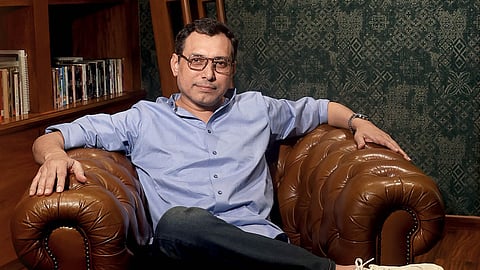


At any given moment, Neeraj Pandey has one project on the floors and another dominating the charts. The filmmaker, who burst onto the scene with the 2008 thriller A Wednesday!, went on to deliver Special 26 (2013), Baby (2015) and M.S. Dhoni: The Untold Story (2016). In recent years, he has transitioned to streaming.
His Special OPS series remains among the platform’s biggest hits, while his latest outing, Taskaree: The Smuggler’s Web, made history as the first Indian series to debut at number one on Netflix’s Global Top 10 Non-English TV list in its opening week.
“These milestones matter only when one looks at it as reassurance, but the focus is always on the work,” he tells The Hollywood Reporter India.
In this conversation, the filmmaker talks about balancing direction with his role as a creator, steering his banners Friday Filmworks and Friday Storytellers, and why he remains optimistic about the Hindi film industry amid uncertain times.
Edited excerpts:
Did you foresee Taskaree’s success?
Actually, we never think that a project of ours is going to break out. You’re always thinking about whether it’s going to work or not, but to what extent — I don’t think we have thought about that with any of our projects, because that’s not in our control. And it’s far too complex.
How do you greenlight titles?
We try to keep it simple by asking ourselves what the trend is and what the audience wants. But it has always been solid stories that have the wind in their sails to drive. We try to bring a new experience to every story and that’s paramount; to try to explore that genre in as diverse a way as possible.
How globally aware is your process?
We are completely mindful of what’s going on not only in India but globally. We look at subjects and stories from that lens — that this is going to be a new experience, something that hasn’t been explored. We have to come up with something new, something more exciting, something very diverse from whatever we’ve already done. Otherwise, there’s no fun in the chase. I’ll also put in a word for our partners here — the streamers and other producers — they place a lot of trust and faith in whatever we start exploring. That helps a lot.
How many scripts are in development at any given point in time?
At least four to five projects on the streaming front. We need to increase our film scripts, so we are working on that as well. In the next couple of years, you’ll see that coming into play in terms of releases. There’s an equal mix of theatrical and streaming now — at least four to five projects in both categories.
What’s your franchise playbook?
There is no formula. We do what we do and then hope that it lands. We do look at subjects that are franchisable when it comes to streaming, and that also goes for theatrical releases.
When it came to streaming, we were very clear that every season should have a logical end to that particular story. There’s no carry-forward just for the sake of it. Of course, the characters will overlap and the story will go on, but there has to be a logical end because you don’t want viewers to feel cheated.
We emphasise a lot on writing. It’s the spine of a good show. The more we invest in it — in terms of newness — the better it is. We don’t have extensive writers’ rooms; mostly it’s two people, sometimes three, but the process is very efficient.
How do you even measure success on streaming?
Platforms have been very discreet about numbers. The only yardstick we have is that if they are interested in doing more, then we know they are happy (laughs). There are metrics like ‘trending’ and how long a show stays there on the global chart.
Do streamers push data on you?
Data can be a good tool. But clinging on to it is a huge handicap. You cannot create anything new which doesn’t have a precedent because there’s no data on that. This business runs on gut and intuition. A lot of the work we have done — films and shows — did not have a precedent.
Over the years, people’s faith has increased because if it lands, it’s a win-win for everyone. It enables us to experiment more and make more edgy decisions.
How do you land on the right budget for your titles?
Scale and budget are not the right way to look at it. It has to be led by the idea and the story to begin with. You can work around the budget you have, but the idea has to be interesting, and then you figure out how to tell that story and make it feasible.
It’s not a star-led setup that we are chasing. It’s always the idea. For that reason, we work with a lot of newcomers and that has paid us dividends.
Any advice for young producers?
There’s no one way to get it right. But even if you have the best talent, there’s no substitute for a good story. The right emphasis should always be on the story that you’re telling.
What are your production hacks?
The biggest hack we have figured out is planning — extensive planning! Especially when you are shooting abroad — because of cultural differences, language barriers and different work ethics, you have to adapt quickly. One thing we are very clear about is timing and punctuality. It becomes a discipline and then the unit starts moving like clockwork. The clearer you are about what you want, the easier life becomes.
Does the current industry slowdown worry you?
The phase we are going through right now is a very tricky one. We are still regrouping. This is a low that I have not seen ever since we started, barring the pandemic. But I think we are on the mend. The big question has always been what the audience wants, and we will see where it lands.