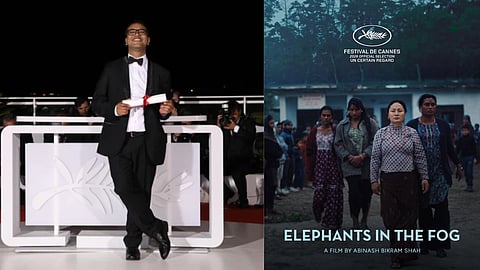


Abinash Bikram Shah’s feature directorial debut with Elephants in the Fog is the first Nepali feature film to be selected in Cannes’ Un Certain Regard section. The film is set in a Nepalese village bordering a dense forest frequently threatened by wild elephants, and follows the lives of four transgender women living on the margins of the community. Led by Pirati, a disciplined matriarch torn between duty and personal desire, the group survives through ritual performances and nightly elephant patrols. As Pirati dreams of leaving everything behind in pursuit of a “normal” life with her Drum Master, her attention begins to drift from the family she has held together. When the youngest member, Apsara, disappears during a patrol, Pirati is forced to confront guilt, growing hostility from the villagers, and problems within her own chosen family.
Shah is a Nepalese filmmaker, writer, and producer known for several acclaimed short films such as Lori : Melancholy of my Mother's Lullabies (2022), which competed for the Palme d’Or Short at Cannes and received a Special Jury Mention. He also co-wrote Shambhala (2024), which premiered in competition at the Berlinale.
In an exclusive interview with The Hollywood Reporter India, Abinash spoke about his creative process, what drew him to the story, and finding his ideal Pirati in Pushpa Thing Lama.
I want to begin by asking you, where did this story about a Kinnar community, in a village in Nepal, come from?
The flicker of the story came during the time of lockdown. I was mostly scrolling through my phone to avoid the horror of COVID. During that time, on TikTok, I saw this trans woman creating amazing videos — very joyful, very vibrant — giving a glimpse into the community and the lives they were living.
What struck me most was the jarring contrast. The world around them was often filled with cruelty, but instead of dwelling on it, they kept making videos, and it was so much fun to watch them. That was the initial idea.
Slowly, I began to realize that this community has this idea of a chosen family — redefining kinship, creating mother-daughter relationships — and that was the point that hooked me. All the films I've written so far, and the short films I've made, mostly deal with such family relations. Lori: Melancholy of My Mother’s Lullabies (2022), and also the film that I wrote, Shambhala, both deal with mothers. So it was something that immediately hooked me. I reached out to them just to know if there was anything I could do. For me, that chosen family was the hook.
I read that the casting process took almost two years because you wanted actors from the trans community. How did you find your lead actor, Pushpa Thing Lama?
It took almost five years to write the story. I went looking for actors without a story, just to know them. They are in a very different part of Nepal, so I went everywhere they stayed. From there, I started writing the story. When I had the treatment and the first draft, I was invited to Sundance for the writing lab. At the directing lab, I had to make a two-minute scene for practice. I had no idea whom to cast. But during my visits, Pushpa was already in my mind, because for me, the main character had to look like her.
It all came from visiting them and having conversations with the community. For that Sundance scene, I asked my casting director to see if she was interested. She was, of course.
When we worked together on the scene, we did a little rehearsal. But the problem was that she was very influenced by heightened drama from Nepali TV serials and Indian TV series. So that one scene didn’t work very well. But after doing the scene with her, I became even more convinced that she could do it.
I worked with her for almost two years. With Pushpa, it was always about the look — I was so convinced that Pirati should look like her.
And then it became about convincing her that the acting I wanted was not the acting she was imagining. Pirati is a woman she knows very well. It's a story about herself. Not just her, but most trans women in Nepal. To make her believe that, took quite a long time. In my short films as well, I mostly work with non-actors to bring authenticity, because I’m quite an outsider myself. So for me, it's very important to cast actors from the same community.
With Pushpa, it took time to build trust and to convince her that this was her story, not some other creature’s story.
You talked about how you put tension into the movie because you do want it to be released. You want a wider audience, right? So is there a release plan post Cannes? What are the next steps for you?
First, our plan is to go through the festival circuit. In Nepal, my plan is definitely to release the film, though it’s hard to show this kind of film to a wider audience there. We have to plan it very carefully. Right now, we are looking at an October-November release in Nepal. And hopefully in India too, because the community I’m dealing with is very common in India. Many of them originally came from India. As Pirati mentions in the film, they belong to the Kinnar community there as well, and now they are part of a Nepali community too.
And when you were told that it's been selected for Cannes, where were you and what was your first response?
I was actually talking to my sound designer online. My French producer had also joined the call. Suddenly, he mentioned that the film was selected in Un Certain Regard. I didn’t even know what UCR meant at first. Later, I understood, and it was such a great moment.
Who all will be in Cannes with you?
Abinash Bikram Shah: From Nepal, more than 20 people will be there. My cast — Pirati, Joon, Chameli, and Apsara — will all be there with me.
I’m really looking forward to it. They come from very different walks of life, and for me, being with them in Cannes is very special. Like I said, it feels like a promise I kept. I made this film with them. I didn’t go there with a finished script — I went there to dig around, to meet them, and slowly the script came together through those meetings. Now the film is finished, and I’m going to Cannes with them. It’s very lovely.
How long was the shoot?
It was a 35-day shoot. But the overall process took much more time.
This is your first feature and you're in Cannes, and it's the first Nepalese film to be selected. What does it take for a filmmaker to be in love with a story and to just stay with the story and have the faith that someday you'll get to make this film?
Yes, it’s great to be in Cannes. For me, after meeting these women, the reason to make this film became even more urgent. The Nepali title of the film is Tini Haru, which translates to “them,” because they are treated as “them.”
That urgency, and the trust I gained from meeting them over the years, made me stay with the film. Almost everyone in the community knows me now, and I didn’t want to break that trust.
I never doubted that the film would be made. The challenge was how to make it authentically — as an outsider, as a man — how honestly I could tell the story of these trans women and this Kinnar community. That was the real challenge.
Even if I had to wait, I knew I would make this film. It became a promise to them. I had to show them as my family.