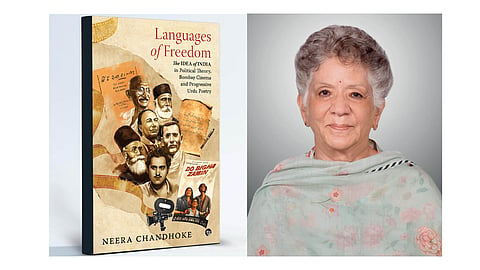


In her latest book, Languages of Freedom: The Idea of India in Political Theory, Bombay Cinema, and Progressive Urdu Poetry, political theorist and public intellectual Neera Chandhoke traces how ideas of freedom, justice and collective aspiration travelled across political thought, poetry and popular culture.
In the chapter devoted to Bombay (Mumbai) cinema, she charts the arc of post-Independence filmmaking, arguing that the idealism of the freedom struggle gradually gave way to disillusionment, escapism and eventually, new forms of cultural politics.
Speaking to The Hollywood Reporter India, Chandhoke reflects on cinema’s relationship with freedom, nationalism and inequality, and what contemporary Bollywood reveals about the India we imagine — and the one we choose not to see.
Edited excerpts from the conversation.
THE HOLLYWOOD REPORTER INDIA: The cover features Do Bigha Zameen, which you describe as bearing witness to the failures of post-Independence land reform. Can the film also be read as a critique of Nehruvian industrialisation and urbanisation, and a departure from Gandhi’s vision of swaraj?
NEERA CHANDHOKE: The priority of the post-Independence government had been made clear in the years before Independence. In 1938, the Congress Party established a National Planning Committee that foregrounded planning for state-led development by a domain of experts outside and thus secured against the din of politics. The Bombay Plan of 1944 mandated that industrialisation was the only route to assure the wellbeing of people. The focus on industrialisation and its concomitant urbanisation after Independence, effectively banished Gandhi’s emphasis on swaraj through self-reliant development to the margins. Predictably, half-hearted land reforms resulted in major neglect of the agrarian sector, and to rural poverty despite Nehru’s commitment to socialism. In effect, socialism and industrialisation co-existed in an uncomfortable relationship till 1991. Ultimately neither ideology could alleviate the plight of the rural poor as shown in the film.
THR INDIA: Your analysis ends with Mughal-e-Azam. Do you see the decades that followed as marking a turn towards escapism in mainstream cinema?
CHANDHOKE: Two factors influenced films produced in the two decades after Independence. Filmmakers and lyricists were influenced not only by the freedom struggle, but also the ideology of the Progressive Writers Association and the Indian Peoples Theatre Association. Both these organisations had radicalised political language and brought to the fore keen awareness of the social and political function of culture in a highly unequal society. Think of Sahir Ludhianvi and Majrooh Sultanpuri, Prithviraj Kapoor, Balraj Sahni and Saadat Hasan Manto among others who came from this background.
They were deeply disappointed by the Partition, and the incapacity of the Indian state to provide the basic preconditions of life to its people — ‘Rehne ko ghar nahin hai, saara jahan humaara (We have no home to live in, yet the whole world is ours)’, sang Raj Kapoor on screen for Phir Subah Hogi (1958).
By the 1970s, India saw the rise of a new generation more occupied with personal problems such as unemployment and hunger than being inspired by the freedom struggle. Though the 1970s were marked by the New Wave cinema, the same intense sense of despair at collective hopes betrayed was not a dominant feature of these films. Amitabh Bachchan’s films were more concerned with familial revenge than the generic concept of justice which is what Mughal-e-Azam focused on. And over time cinema became escapist with some exceptions such as Sudhir Mishra’s films.
THR INDIA: Despite many filmmakers having lived through Partition, early post-Independence cinema largely avoided the subject. how do you view today’s renewed fascination with Independence- and Partition-era stories, from Freedom at Midnight to Main Vaapas Aaunga?
CHANDHOKE: History shows us that at least two generations that have witnessed or heard about trauma from their families, tend to avoid speaking about it, or write about it. Memorialising begins with the third generation. In India, if I recall correctly, it was around the 50th anniversary of our Independence/Partition in 1997 that historians, literary figures, poets and cinema began to deal with August 1947 in a major way.
This is a welcome development because we must learn to acknowledge and come to terms with our history. If we push traumas to the corners of our collective psyche, memories and rumours fester like unattended sores and lead to communal violence.
But we must also remember that B.R. Chopra and Yash Chopra, who were refugees from what became Pakistan, made Dharmputra in 1960. Sahir Ludhianvi wrote an unforgettable song or rather dirge, for which N. Dutta composed the music, ‘Yeh Kiska Lahoo Hai, Kaun Mara’. This song holds relevance for us even today. If only we could ask— whose blood is this, who died — we will realise fraternity, which is one of the values of the Preamble to the Constitution, and which is integral to our collective existence.
THR INDIA: If the cinema of the 1930s and 1940s was socially purposeful, and the cinema of the 1950s reflected disillusionment with the Nehruvian promise, how would you characterise post-2000 Bombay cinema?
CHANDHOKE: The answer has to be in two parts. One, since 1991 and liberalisation in India, the globalisation of the film industry and its renaming as Bollywood led to a spurt of films reifying orthodoxy such as patriarchy, chauvinistic festivals such as Karva Chauth, obedience to parents even when they are unjust, uncritical celebration of wealth, and lavish festivals. These films are made for the diaspora, for Indians who have no desire to come back to the country but who long for their country.
Examples are Aditya Chopra’s 1995 Dilwale Dulhania Le Jayenge and Karan Johar’s Kuch Kuch Hota Hai. They are not critiques of ill-being and poverty as the 1950 films were. Nor do they focus on agrarian problems, unemployment and drugs, that bedevil states like Punjab. They are salutations to an India which is one of the most unequal societies in the world, but where no one utters the word unequal. We talk of India as a future super-power and of an unprecedented GDP. We convince ourselves that we are a soft power, a Vishwa Guru, and therein lies both our folly and those of our films. Where art and culture stop asking questions, society lapses into decadence.
Two, in the last decade, action films tend to concentrate on external enemies and focus in horrifying detail on tremendous violence as in Dhurandhar. This is disastrous for a society where violence has become the accepted way of doing things, and where political vocabularies have become violent. Given the major influence of films on the Indian psyche, this is nothing short of a disaster. We have lost the art of singing ‘Hum panchi ek dal ke (We are birds perched on the same branch)’.