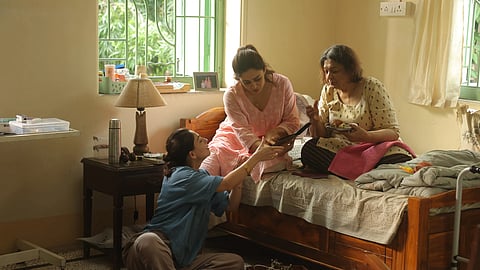


Tighee, the Marathi film directed by debutante Jeejivisha Kale, has been slowly and steadily warming up the audience. “It has been said about Marathi cinema that it is a word of mouth phenomenon. I had only heard of it before. Now I am experiencing it,” Kale tells THR India. “We have had our shows increase in the last five days—not just the number of screens, but also the number of shows per screen. People are watching the film again, taking their mothers and spouses and friends.”
The film follows the fragile but full-bodied bond between three women, the mercurial and ailing Hemalata (Bharati Achrekar), in Pune, and her two daughters—Sarika (Sonalee Kulkarni), her younger daughter and caretaker and Swati (Nehha Pendse), the elder daughter, married, working, and in Mumbai. When Hemalata falls seriously ill, all three are brought together under one roof and old resentments flare up, alongside tender nostalgia, and a mystery that threatens to unsteady their sense of self.
A single child, Kale knew that she would make her directorial debut with a film about siblings. “When my father was sick, I felt very alone, with no one to turn to. I come from a nuclear family,” Kale shares. This seed sprouted and with a rough plotline sketched with characters, she went to writer-director Nikhil Mahajan—whom she considers a mentor—to write the screenplay, padded with Prajakt Deshmukh’s dialogues.
In a conversation, Kale breaks down her decisions and expands on her directorial intuitions. Excerpts...
Talk to me about writing and casting the sisters—Sarika (Sonalee Kulkarni) and Swati (Neha Pendse). They look so unlike each other, but there is also this headstrong instinct that makes them feel like they belong to one family. How did you find the actors, and through them, the characters?
There was no strategy behind casting them. I intuitively felt that my Swati was Neha. She also decided to financially back the film. Then, the family had to be built around her. While working on Raavsaheb (2024) I saw Sonalee perform a scene where is doing multiple things while also paying attention to someone in front of her with deep focus. I realized I found my Sarika. It was a lightbulb moment.
We workshopped the characters, and that intuition I had was positively reciprocated by the actors.
What about Bharati Achrekar?
This role was made for her. It is important for the actors to know where to stop being emotional, so the audience begins their emotional journey. Someone with great control on comic timing, like Bharati, would only be able to hold this rein tighter.
What about the men? On the one hand there is Swati’s husband, Malhar (Pushkaraj Chirputkar), who is a bit of a loser, constantly asking her for money, and then there is Gandharv (Nipun Dharmadhikari), Sarika’s business partner, who becomes the incarnation of all that is perfect in men. Was this contrast conscious?
Malhar is a victim of his situation. He is unable to look at it objectively. Both Sarika and Malhar have been harrowed by the pandemic—their careers have suffered. But Sarika is not someone who gives up. She is angry because she has a lot to give and the world around her is always crumbling.
Malhar, like a lot of men, gives into his pessimism. You see Malhar deteriorating. He is not able to get over himself as a failure. Someone who wants to do more, but is just unable to act on it. That is his tragedy. Gandharv is objectively the greenest flag in the film. He understands that women are humans who don’t need to be put on a pedestal, and can be called out. He is not very reactive, and has no romantic interest in Sarika. He is just there. Such examples are few in cinema.
Something that itched here—and this is a spoiler—is that sexual desire is seen as threatening in the film. Either it is the creepy boss or the paedophile. There isn’t space for safe erotic desire being expressed in this film. Was this conscious?
This film doesn’t speak about desire, so I didn’t see it in that way. It talks about how women need to find power within themselves, and exercise their own agency. When you are born into a woman’s body, being desired is an invariable consequence. So maybe the question didn’t even arise in me.
Unfortunately, since I am talking about the lecherous gaze and paedophilia, it is coming under the umbrella of sexuality and desire, but where we are coming from is agency, consent, and power dynamics and how only a woman can take a stand for herself.
The past few films, with the Jhimma movies and with Asha and Sthal before that—there is a spate of Marathi movies led by female characters, some of which are doing well commercially. You have been an AD, working in Marathi cinema since 2014. Do you see any shift towards cinema that anchors the female perspective in different ways?
Marathi cinema has always had strong female characters. You cannot go without mentioning Smita Patil who played a lot of powerful roles. Alka Kubal, too, has done a lot of leading roles in feature films, of a different flavour, and was one of the successful Marathi actors, still very well respected.
Women are represented really well in Marathi cinema. Tighee is only an addition to it. It is not a strategic decision to get women into our movies, nor necessarily progressive stance. It is just how we intuitively look at the world. I don’t remember ever feeling like I am not part of the world, when I watched Marathi films. I never felt like “this was a change”. But, perhaps, the kind of stories are changing, with different dimensions of womanhood being explored.