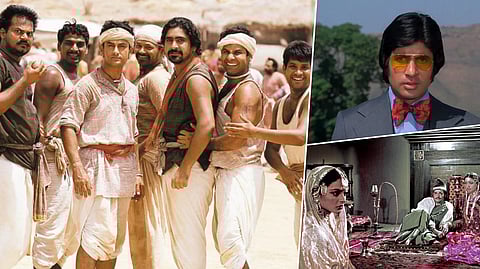


Like everything else in Hindi cinema, costume designing, too, was once the mandate of men. But post-Independence, “the appearance of well-educated, upper-middle-class female designers, each collecting a credit on the film, emphatically tipped the scales,” Clare M. Wilkinson-Weber wrote in Fashioning Bollywood: The Making and Meaning of Hindi Film Costume.
Following are three designers who paved the path for costume designing as an art form, infusing glamour and grace in equal measure into what we today call an industry, but which is also an aesthetic — Bollywood.
As a student, Bhanu Athaiya enrolled at the J.J. School of Art in Mumbai to become an artist, and later, the sole female presence among what is called the Bombay Progressive Artists’ Group. Working initially as a freelance fashion illustrator and a columnist, she made the leap into costume design with Guru Dutt’s C.I.D. (1956), working on his later projects as well, including Pyaasa (1957), Chaudhvin Ka Chand (1960) and Sahib Bibi Aur Ghulam (1962).
“Starting with Bhanu Athaiya, the category of “dress designer” (the term conventionally used in place of costume designer) took shape in the post-Independence era,” Wilkinson-Weber writes. Not just glamour, Athaiya even brought a semblance of rooted realism and rigorous research into her costumes. For example, for Amrapali (1966), when dressing actor Vyjayanthimala, she referred to the cave paintings in Ajanta and Ellora. “It is believed that the monks who lived there dyed their robes orange from the parijat flowers found on the many bushes dotting the hillside. Vyjayanthimala looked exactly like a picture from that era,” Athaiya noted in her autobiography, The Art of Costume Design.
Over the course of her career, she worked with directors such as Yash Chopra, B.R. Chopra, Raj Kapoor, Vijay Anand, Raj Khosla, and Ashutosh Gowariker, and won two Filmfare Awards — in 1991 and 2002. In 1983, Athaiya was awarded Best Costume Design for Richard Attenborough’s Gandhi (1982), becoming the first ever Indian person to win an Academy Award. She passed away in October 2020.
Like Athaiya, who would spend time in small villages while preparing for films such as Reshma Aur Shera (1972), Leena Daru, too, would travel to folk festivals to take notes on what women wore to celebrations and dances. Daru belonged to a generation of costume designers who made class context and social milieu of their characters immediately apparent. Also like Athaiya, she is also an alumnus of the J. J. School of Art — bringing into costume designing a flair that would elevate it into an artform.
Daru entered the film industry when she designed a sari with a zip hidden in the pleats which allowed actress Asha Parekh to dance without fear of the sari unravelling. Parekh, impressed, swept Daru into her filmography. From the playfully erotic “Choli Ke Peeche Kya Hai” from Khalnayak (1993) and “Ek Do Teen” from Tezaab (1988) to the demure opulence of Muzaffar Ali’s Umrao Jaan (1981), and the sensual Utsav (1984), Daru created watermarks of female presence that still stain the public imagination.
Most influentially, Daru draping Sridevi in entirely white outfits in Chandni (1989) — a colour associated with widowhood and renunciation — was, as Wilkinson-Weber writes, not just “provocative but also incredibly influential. Almost instantly, the color white became not just acceptable for young and married women but highly desirable.” Daru won the National Award for the Sridevi-starrer Lamhe (1991). She passed away in July of 2020.
Mani J. Rabadi is most well-known for giving actor Helen her unusual and iconic cabaret looks, with chicken feathers and sequins, beads and nets, glitter and frills. Funnily, though, as Rabadi noted in interviews, “I’d never seen a cabaret in my life — I used to produce out of imagination.” Her contribution to glamour in Hindi cinema is notable; she was the brain behind many looks for actor Parveen Babi — who was known for her ‘sex kitten’ image — and Dimple Kapadia being the very image of Christian youth in Bobby (1973), a kind of sexualised innocence which influenced the styling of later films such as Twinkle Khanna in Barsaat (1995), and even Karan Johar’s Kuch Kuch Hota Hai (1998).
The leotard from Jewel Thief (1967), the thigh-slit dress in Don (1978) — Rabadi’s costumes were a vision of glamour that was both tantalising and unprecedented. She made the erotic glamorous, while also reframing the demure as glamorous, with Bhagyashree’s hand-painted white dress in Maine Pyar Kiya’s (1989) “Kabootar Jaa” and Madhuri Dixit’s purple sari in Hum Aapke Hain Kaun (1994), which became, through reverence and repetition, some of the most enduring looks of the 1990s. Rabadi won the National Award for her work in Vijaya Mehta’s Peston Ji (1982). She passed away in 2013 but her legacy endures.
To read more exclusive stories from The Hollywood Reporter India's February 2026 print issue, pick up a copy of the magazine from your nearest book store or newspaper stand.
To buy the digital issue of the magazine, please click here.