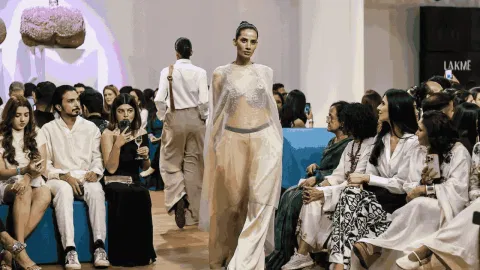


Attend a fashion week once, and it’s clear: there’s one show on the runway, and another front row — a battleground for those in the business. Celebrities, editors, buyers, influencers, and die-hard fashion fans all scramble for the most coveted seats in the room.
This past weekend, The Hollywood Reporter India stepped into the Jio Convention Centre for Lakmē Fashion Week (LFW) x Fashion Design Council of India, to find the familiar chaos is in full swing. PR agents and show directors dashed around; guest lists in hand, phones pressed to ears. Designers’ teams hustled to seat buyers and sponsors, while celebrity managers pleaded for prime spots.
A 2023 Forbes piece traces the front-row phenomenon back to Christian Dior’s 1947 show — when photographers were first allowed inside, while a 2010 Indian Express article, Shefalee Vasudev (now editor of The Voice of Fashion) aptly deemed these seats to be “The site of power play, fashion politics and dressing games”.
“It’s part of the negotiation if you're a celebrity,” says Sujata Assomull, contributing editor of Vogue Business and founding editor-in-chief of Harper’s Bazaar India. “It's status, and that’s a big part of our fashion industry, like it or not.”
Some try and resist the fight. Designer Anamika Khanna, who closed LFW’s opening night last year with no seating, explains: “It’s not fair to decide who’s important and who’s not. I knew I would get thrashed for [doing away with the front row], I knew a lot of people would not come,” in an interview with THR India in 2025. This year, she set up a seating plan that wrapped around the room, giving everyone a front-row view. “Democracy,” she says after the show ends.
Fashion designer JJ Valaya, who is also a founding member of the board of governors of the FDCI, does the same. “There are expectations and sensitivities,” he says. “I have increasingly been designing the ramp in a way that we don't have more than two rows in all.”
“But still, there are always people who are unhappy with their seats,” Bhavika Morparia admits, who is the founder of the PR agency Elevate Promotions, which represents Khanna, Amit Aggarwal, Aisha Rao, among others. She says front-row curation balances brand friends, key media, influencers, stylists, celebrities, and KOLs, depending on the brand’s goals. And despite best efforts, limited seating and the number of people vying for them make it impossible to please everyone. That said, she emphasises that the process is always guided by an appreciation for the industry’s support and longstanding relationships, with every effort made to ensure collaborators feel valued and included.
But in an era where shows are livestreamed, and critics command audiences on Instagram, does the front-row seat still hold the same power?
Stylist and creative director Nikhil Mansata, who has worked with actors like Deepika Padukone and industrialists like Natasha Poonawalla — and handled the guest list for Dior’s Mumbai show in 2023 — says the front row actually holds more power today.
“The strategic value of the front row has intensified; it is no longer merely about viewing a collection. For a celebrity, a front-row seat serves as a public endorsement of a designer and signals a formal alignment with a luxury house,” he explains. “Because these guests are integral to the livestream and provide significant entertainment value, their seating placement and visibility are now more critical than ever.”
Assomull agrees. Having attended international fashion weeks, she recalls last season when every major luxury house debuted with new creative directors. “Yet the moments people remember? Anna Wintour speaking to Meryl Streep at Dolce & Gabbana, or King Charles sitting front row for an up-and-coming designer in London — whose own name many have forgotten.”
“But while earlier, the front row was largely occupied by editors, buyers, industry insiders and longstanding patrons, today, it reflects a wider cultural landscape. I value the balance when the authority of fashion and the energy of popular culture come together,” Valaya says.
Assomull recalls being seated back row at a Dior show herself.
“I didn’t react, but Diet Sabya [an anonymous Instagram critic] posted, ‘Oh, look where Sujata’s sitting, she’s at the back row.’ I found it amusing, but I guess it is important.” She adds that for an Indian designer, she might have been upset — but for Dior, it reflected her standing as an Indian journalist.
“When you’re in the industry, seating shows your standing,” she says. At a recent Tarun Tahiliani show with theatre-style seating, many journalists were upset about being on row three, despite having the best view. Editors, she notes, no longer carry the weight they once did. “It’s a numbers game now.”
There’s another hierarchy within the media itself, where certain publications are prioritised over others. At Kartik Research’s show this season, some members of the media were seated in a separate room, ostensibly for a closer view of the garments, while a live performance by Sudan took place in the main show space. For many, it raised a basic question: how does one cover a show they’re not fully present at?
“They want front row coverage, but won’t give front row access,” says Janvi Manchanda, managing editor at Hauterrfly, who recently called out the issue on Instagram.
“Digital media is invited and accredited for the optics and then handed ‘free seating’ and expected to cover a show they’re not important enough to be respectfully seated for,” her post read. “Placement in rooms like these is never random. It reflects intent, respect and hierarchy.”
She adds that even PR teams are often caught in the middle. “But as a designer, a big industry name, it’s your name, your brand and your show, where a whole section of media is being disrespected,” she tells THR India on the way to the media room for quick bytes with designers and showstoppers. “I have seen senior-most journalists from digital publications sitting back row, and these issues never reach the people who can do something about it."
An anonymous journalist echoed the sentiment, adding that they chose not to attend a show after being assigned ‘free seating’ while competing publications were placed in front row.
“Well, it’s now full of influencers — good in a way, but exhausting,” says show director Aparna Bahl Bedi, whose 30-year career spans designers like Tahiliani, Anita Dongre, and Manish Arora, among others. “And the regular fashion crowd tends to avoid this, so front rows are increasingly sponsor-driven.”
She continues, “There are celebrities, but they haven’t come of their own will; it's contractual.” Bedi longs for a time when fashion weeks drew people from all walks of life.
“Demand stems from fashion’s increased industry exposure via various social media platforms. The industry has become democratised, bloggers validated. Those with talent, an artistic eye [and] a credible voice have been authenticated and have bred a whole generation of wannabes who fill up our inboxes,” says Sara Byworth, associate director of RMO Communications, which looks after press and publicity for designers like Preen and Giles in London and Tibi in New York in a 2014 BBC article.
But Mansata notes the distinction: influencers offer immediate, niche access, while celebrities bring glamour and global reach. Celebrity stylist Tanya Ghavri, who frequently styles stars like Tara Sutaria and Shraddha Kapoor, adds that when she attends a show with a celebrity, seating is discussed before.
When asked if creators get priority seating, Morparia says it depends. “If confirmations come in advance, we prioritise accordingly. But if we’re short on seats, we align with the designer’s strategy for that show,” she says.
Assomull critiques the trend: “They randomly invite somebody with x number of followers [to sit] front row but don’t think of the connect they have to the brand.” Post-COVID, the front row filled up rapidly with such faces, especially after creator Masoom Minawala walked for multiple shows, she explains. Internationally, it makes sense: Anna Wintour and Meryl Streep at Dolce & Gabbana, or Helen Mirren and Glenn Close at Erdem, fits the narrative.
“Earlier, a designer would extend invites through friends; a mix of consumers, the glamorous and the artists,” Bedi adds, not liking how transactional it has become today.
Assomull agrees, and adds, “A well-curated front row says the designer has soul and substance while one that isn’t says that they're it for the numbers.” What's also important is that faces on the front row come season after season — like Sarah Jessica Parker at Fendi — as it shows loyalty and consistency. “Now, many celebrities do it only if they’re paid, forgetting the long-term play, especially in India,” she adds.
Some designers are lauded for their front rows — Anita Dongre, Payal Singhal, the late Rohit Bal, Sanjay Garg, and for the others, “fixers,” or seating managers manage VIPs and celebrity demands with help from PR agencies or in-house teams.
At the end of the day, the front row isn’t just about who’s popular right now — it’s a mix of story, strategy, and a little bit of politics. Mansata focuses on consumer interest and brand equity, Morparia insists it’s as much about relationships as relevance, and Bedi points out that standalone shows are doing it better. Put it all together, and the front row starts to feel less like a random lineup and more like a carefully cast ensemble. Because really, at a fashion week that’s still very much a trade event, every seat tells a story — and who’s sitting in it says a lot more than one thinks.
“It’s an interesting time,” Bedi adds. “Let’s see who survives the front row battle.”
Front Row Dos and Don’ts by Nikhil Mansata
Wardrobe: Don't overdress! Additionally, avoid wearing visible logos or branding from a different house; your appearance should reflect an allegiance to the hosting designer.
Clear Sightlines: Keep your legs uncrossed and avoid obstructive headgear to ensure photographers have a clear vantage point and guests behind you can see.
Timing: Arrive by the invitation time. While shows traditionally begin 30 minutes later, being seated early is essential to ensuring everything runs on time.
Interacting: Make an effort to speak with those seated next to you and try to avoid using your phone except to capture the collection during the show.
The Finale: Acknowledge the designer’s final bow with a round of applause.