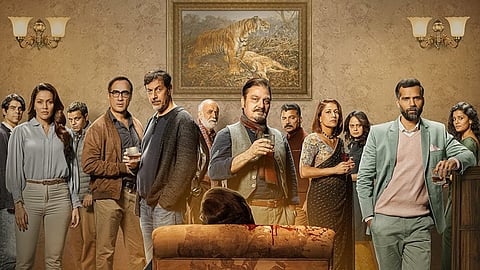


15 friends (an introvert’s nightmare) meet at a holiday home for a wedding anniversary party. One of them is found dead after midnight. 14 of them become suspects. Nobody is allowed to leave. Rajat Kapoor’s Everybody Loves Sohrab Handa shares a thematic universe with Rajat Kapoor’s Kadakh (2019): overlapping cast members, colourful characters, a dead body, an annual party, free-flowing banter and tense arguments, fragile bonds and incriminatory secrets. But the staging is slightly different. Kadakh was about a couple trying to hide the corpse of a man who accidentally kills himself before their Diwali party. This film is a whodunnit that, in terms of social suspense and tonal flow, shares a universe with ‘psychological’ dramas like Death in the Gunj, Monsoon Wedding (plus a murder) and Titli. It unravels as a deceptively poignant indictment of modern society, armchair morality and rage, and the many ways in which we reverse-engineer our values to fit in.
The template is conventional. The aftermath of the incident and a live police investigation are intercut with the festivities of the day that builds up to the moment. Amidst all the camaraderie and reunions, we see the little microaggressions and signs and hidden agendas through the day. The future victim, Sohrab Handa (Vinay Pathak), is revealed to be a difficult man. He offends everyone. He is brash, loud-mouthed, cynical, provocative, and has zero filters. He causes several awkward silences. In other words, everyone there has a motive to hate — and therefore kill — him. Forget his reluctant friends and resentful business partners, even his old father can’t stand him. But he’s the most prosperous of them. They are tethered by history and nostalgia.
The film is fluidly acted and directed, stays rooted in societal dynamics and personalities, resists stylistic flourishes, unfolds as an observational urban satire, and thrives on the ‘cinema’ of chaos and conversation (bonus: people speaking over one another and cutting each other off mid-sentence). You can tell that the crew is composed of seasoned theater veterans. The spatial awareness is great, the energy is organic, and at no point does one pocket of the place feel isolated from the other. All of them seem to be present at all times, regardless of who the camera focuses on. For instance, when some of them gossip in the kitchen, it still feels like the other actors are performing outside — not resting or waiting for their own scenes. When there’s a private chat in a bedroom, there’s a sense that life is continuing beyond the space.
These are small but underrated touches that not enough chamber dramas wield. When there are so many people, screenwriters often struggle with exposition; all their names and equations with each other have to be conveyed through dialogue before the viewer gets invested. This film does a neat job of weaving it all in through both lived-in vibes and plot placement — the policeman asks pointed questions in one timeline, and a few outsiders in the group become the medium to delve into other identities. For once, the specifics don’t matter. As long as we vaguely know of the attendees and their degrees of separation — brother, father, wife, colleague, friends, caretaker, professors and their age-gap plus ones — the story doesn’t get sidetracked by the details. I also like that one of the newcomers is a psychiatrist (played by Kapoor himself) who doubles up as the ‘detective’. He is trained to be sharp and perceptive, so he makes educated guesses and operates as a vessel of information for the audience.
Unfortunately, a whodunnit is invariably defined by the climax. The twist. The big reveal. In that sense, Everybody Loves Sohrab Handa resorts to a corny genre gimmick. It’s like life suddenly collapses into fiction. But I believe it’s the execution that’s a bit off (especially parting exchanges like “What will save us, professor?” — “Beauty”), not the idea behind it. Without giving away too much, it’s safe to say that the twist is a satisfactory riff on generational abuse, repressed masculinity and the complicity of privilege. The obvious subtext is that everyone is responsible for Sohrab Handa’s fate: the people who nurture, empower, love, antagonise, indulge and befriend him. Nobody is beyond reproach, not least the upscale whims of an urban demographic that loves discussing the world they are responsible for corrupting.
But the political subtext is that a Sohrab Handa is never allowed to survive in this day and age. He is more of a concept than a person. He may not have been a likable or pleasant human, but despite the glibness of the last few minutes, it dawns upon us that he is actually a tragic hero. He’s the only ‘authentic’ person on the trip; he isn’t afraid to call out the performative intellectualism, the ideological hypocrisies and studied correctness of those around him. He has a go at each of them — at the risk of alienation — because he knows that they’re all fake and opportunistic in the most mundane ways. It’s almost poignant that the big reveal humanises him instead of feeding our initial impression of him. The uncomfortable truth is that many of us can see right through our families and friends and colleagues, but we fear conflict and resist serious engagement with their problematic traits. Nobody wants to dislodge the compromised peace of a group; we tend to convince ourselves that the good memories (and familiarity) outweigh the bad ones. Being an accomplice is easier than being a party pooper.
I felt a strange kinship with someone like Sohrab, because he expresses everything he feels without worrying about the consequences. He doesn’t do it smartly, but is there a smart way to be honest? He’s not eloquent, he’s caustic, but I know people who might secretly envy him for being able to speak his mind in an age of intolerance, artifice and keypad activism. Vinay Pathak plays him as more than an entitled jerk; he somehow conveys the wounded soul of a man who is too aware of his surroundings while also making it complicated to respect him. He’s done with all the pretense and people-pleasing. Perhaps those like him pay the price for daring to be unpopular in an environment that’s averse to the culture of criticism and accountability. Perhaps he is brave and destined to be remembered. Perhaps everybody does love Sohrab Handa — even if they don’t know it yet.