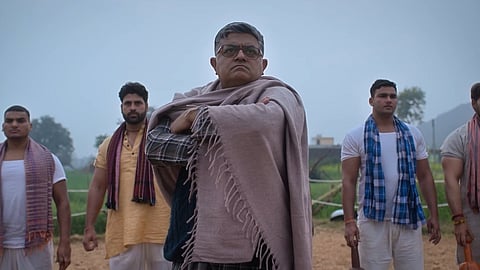


Dupahiya is a homegrown series that’s difficult to write about. Not because it’s mediocre or anything, but because it’s the kind of low-stakes, minor-key and watchable satire that strives to be forgotten the second it ends. It’s almost too easy to engage with as ambient and family-friendly entertainment; the cast is likeable; the craft is playful; everyone gets a track (read this in Oprah’s “everyone gets a car” voice); the setting is familiar.
Season 1 revolved around a stolen dowry motorbike in the crime-free village of Dhadakpur. The Panchayat hangover was strong, despite a broad storyline connecting its several characters. But Season 2 sheds the hangover — ironically, Panchayat itself has mutated into its own imposter — by being more thematically distinct. Besides the dramedy, it grows up a bit and stays tethered to the India of today. I’ll remember it more than the first season because it’s not as…content. Pun unintended.
The central family of Dupahiya is stuck in a sort of anticlimactic limbo. They’re facing the repercussions of a rousing end to Season 1, where the wedding is called off and the almost-bride makes grand declarations of independence and female agency. Now she’s struggling to live up to that monologue. Roshni Jha (Shivani Raghuvanshi) is studying day and night to become the village’s first woman officer, but she’s not very smart; the exams are around the corner and failure is imminent. The wedding drama cost her father and mild-mannered patriarch Banwari Jha (Gajraj Rao) his job as a government school teacher, so he pins all his hopes on his daughter’s exams; she feels the pressure, and ropes in lifelong crush Amavas (Bhuvan Arora) to help her with an ‘unconventional’ solution.
Son and part-time item dancer Bhugol (Sparsh Shrivastava) continues to dream of internet virality and a superstar career in Mumbai; he is told to help a woman unconditionally to break a curse of ‘femininity,’ so he gets invested in sister Roshni’s plan. And poor Banwari gets a financial lifeline when his land is chosen to erect a mobile tower on. Only, the villagers oppose it because they believe that phone waves cause sterility and other health conditions. Finally, there’s Inspector Mithilesh (Yashpal Sharma), the cop who takes it upon himself to expose a systemic scam.
I like how the primary narrative is structured. Every episode covers one day leading up to the all-important exams. Desperate measures are resorted to, but the writing refuses to get too heavy or judgmental. Each character shows compassion, but it always comes with an asterisk. The father stops at nothing for the tower money because he wants his daughter to restore the family honour. The daughter stops at nothing to crack the exam because she can’t let her family down after all those fiery promises. The son vows to help her so that his Mumbai dream isn’t stalled anymore; Amavas does it to prove his love to Roshni; the cop wants to prove himself and make the headlines; the sarpanch stalls the plan to please the naive villagers and win the elections. Naturally, most of them discover the meaning of true compassion in pursuit of their own benefits.
Usually, when there are multiple arcs and relationships, it feels like a series is inflating its runtime for the heck of it. Dupahiya indulges in some horizontal storytelling, too — like the surplus thread of the budding romance between the mobile-tower officer and the sarpanch’s daughter; or the random interest in the inspector’s marriage. Not all the transformations are convincing in such a format; you know it’s going to be preachy in a short-cut-like manner, where the focus moves from one track to another in checklist fashion. There’s a sense of formality about these transitions. But the storytelling in this season stays compressed. It treats each person — no matter how quirky or theatrical — as the protagonist of their own life with their own motives. It would’ve been tempting, for instance, to reduce the young mobile representative to an arrogant figure in a setting full of traditionalists. But even his face-off with Banwari isn’t a deal-breaker in terms of character. If anything, you understand his stance better than the villagers; he’s just trying to do his job, while those like Banwari shift the goal-posts of morality.
One of the reasons the template works this time is because of the cast. It’s not just the endlessly elastic Sparsh Shrivastava who stands out as the crowd-pleasing Bhugol. Gajraj Rao leans into the cocktail of levity and brevity; you feel for Banwari Jha because he reaches a point of no return as the provider who struggles to retain a semblance of self-worth. Shivani Raghuvanshi nails the wide-eyed ambiguity of Roshni, even during the shaky heist-coded portions towards the end; ditto for Bhuvan Arora, who does a good job of playing the crooked alpha softened by the girl he loves. My favourite performance of the lot, though, is another veteran we take for granted in Hindi cinema: Yashpal Sharma. As the cop who shapes the soul of the series, he resists goofy caricaturing in favour of being the one adult who understands the seriousness of the situation. You don’t expect him to be the ‘hero,’ especially after the uneven first season, but Sharma’s screen presence makes the corniest scenes work.
The merit of this season also lies in how eerily topical it is. Roshni’s crisis revolves around a NEET-style entrance exam and a paper-leak scam run by a famous coaching center. She evolves from one of many cheating students to someone who must do the right thing to save herself. Student protests are mentioned a couple of times, a journalist tips off the cop after his own editor tells him to “leave such investigations to Dhruv Rathee,” an attempted suicide is quickly addressed, and the entire finale is dedicated to the anatomy of a scam that generates incompetent professionals across the country. The humour and set-pieces don’t always click, but the show remains grounded by its timely relationship with the real world.
It’s not often that lightweight franchises pick up urgent themes; it’s mostly an assortment of vague and caste-blind references that co-exist with the eccentricities of the environment. In that sense, Season 2 of Dupahiya upgrades the cutesy-village-universe formula more than others of its ilk (Panchayat, Gram Chikitsalay). Beneath the low-calorie filmmaking and ‘timepass’ patterns, there’s a genuine curiosity about why Indians behave the way they do. It may feel like the tone trivialises the crisis, but it actually humanises the genre. It’s watchable, because it watches us back.