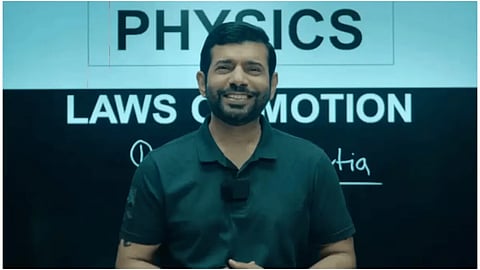


Hello Bachhon (“Hello Children”) is the perfect example of how not to tell a real-life story. It’s also the perfect example of how not to tell a story. And how not to tell. And just how not to. Based on the life of Physics Wallah (PW) cofounder, YouTuber and EdTech star Alakh Pandey, the TVF-created series unfolds like a 5-episode-long corporate video that, at its best, becomes an unwitting Shark Tank parody. Why not just make a branded documentary with fictional recreations instead of a chatbot-coded dramatisation with zero curiosity and project-graded nuance? What is the point of using fiction when every line sounds like a motivational quote, every character sounds like a brown-washed hologram, every scene looks like a live-action brochure, every student storyline feels like a reality-show montage, every exchange has the depth of an Amar-Chitra-Katha-esque moral lesson, and every note looks designed to romanticise middle-Indian aspiration and the predatory education empire? I can safely say that the Hindi biographical drama has reached its nadir with Hello Bacchon, a series I could’ve watched on mute and been none the wiser. Sincerity has never felt so insincere.
Even as a mechanical visual representation of a company and its leaders (a version of saying “even as propaganda”), the series makes strange narrative choices. For starters, the protagonist’s journey doesn’t ever seem like a journey. Pandey’s already grappling with advanced conflicts when the series begins: funding v/s teaching; affordability v/s margins; passion v/s commerce. The arc of PW going from a successful startup to a unicorn is not exactly an underdog arc. He’s already a big deal on the internet for underprivileged students across the country, so most of the writing simply keeps reminding us that he’s a big deal and divine angel; that he’s an industry disruptor; or that he’s unlike the other money-minded businessmen that run cash-grabbing and oppressive JEE-training institutes. There are no other shades. The investor interactions and pitches are staged like giant exposition dumps with bullet points; at no stage does a sense of humanity reveal itself in any of these challenges. It’s impossible to invest in the central human because he may as well be a mythological figure with a halo over his head.
Then there’s the anthology-styled PSA structure. Pandey and his partner Prateek’s hustle to scale up (of course Pandey is portrayed as a business simpleton who loves teaching) is juxtaposed with the grassroots story of one exoticised teenager every episode. Bihar is sepia-toned, Mumbai is Slumdog Millionaire and Gully Boy-toned, Haryana is bluer, Allahabad is yellower, you know how it goes. Each of these kids and settings are inspired by actual success stories, but the craft is so dumbed down that I’ve seen more genuine AI-generated content. All the strugglers get magically transformed by watching one video of Pandey or hearing about the low fees (“4000 only? Wow!”). It’s not enough that their lives are changed by the “tattooed Sir” in a glimpse; every resolution is treated as a medicine for the whole country. Poverty is solved in one episode, drug-addiction in another, patriarchy in the next, dreams in the next (a kid hoping to be a cricketer hits the books when he is humbled by the sight of his dad working two jobs). Sample some of the algorithmic dialogue: “doctors aren’t gods, they become gods,” “when one person leaves the well of poverty, he can take five others with him,” “do you want to be the best teacher or build a platform where everyone is the best teacher?”, “I’m not going to the factory, I’m going to make my life,” “education is not a privilege but a birthright” and my favourite: “people like us have no rights; your father used to get thrashed at work, do drugs and beat me up, you also should get used to this life”.
Some of it sounds like a prank, especially when decent actors pop up in cameos to say the most condescendingly basic words that reduce the screen in between to a formality. We know next to nothing about what drives Alakh, why he’s unique, why he’s compassionate with a capital C, or even why he loves teaching so much. The series thinks it’s being clever and poignant when the scene of a kid breaking down a wall in his village for money is interspersed with Alakh declaring that he must break barriers. There’s that age-old gimmick of two employees bitching about him in the washroom so that he can emerge from a stall with a knowing face. There’s that age-old gimmick of someone mentioning they’d rather eat in a dhaba than a restaurant so that Alakh gets a brainwave of pitching to grassroots investors. There’s the TVF habit of fetishising Kota, comparing it to Gurukul and then doing a token suicide-attempt track to balance out the makers’ reverence for the system. It’s 2026, why is comicbook-level literalism still being sold as glossy infotainment?
I can go on about Hello Bachhon, but it says something when even the criticism of such shows gets repetitive. It’s also boring to keep pointing out the same issues and the same publicity-posing-as-art intent from the same sources. One of the good things to come out of the Indian streaming wave is a second — or only — lease of life for talents like Vineet Kumar Singh. It’s true that Chhaava put him on the mainstream map, but he’s been chipping away for years in little-watched and resourceful titles (the most significant being Mukkabaaz, his career best). But it’s never nice to see commercial productions like this reduce him to a hollow medium. There are sparks of the actor’s truth in a screaming match between the protagonist and his conservative father. For the most part, though, the series is much more concerned with being a glorified YouTube tutorial in which there’s nothing to tell a performance from a voice-over. You could argue that the title alludes to not just a teacher’s greeting but also the preachy tenor of a show catering to a pre-teen audience. But your argument would be wrong. And then you’d be at the risk of being lectured by an encyclopedic face from the screen.