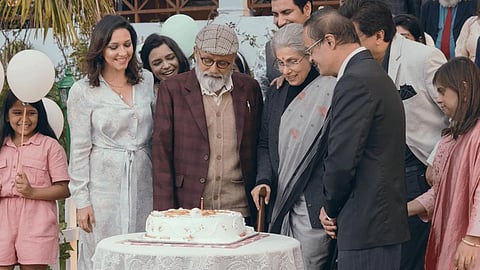


It’s comforting to watch something like Jab Khuli Khitaab. It’s a bit like going to a small circus in the age of curated theme parks. It’s clumsy at times, you can see the strings, some of the treatment is dated, but there’s an old-fashioned goodness seeping through its veins. Based on his play of the same name, Saurabh Shukla’s film opens with a 70-something man, Gopal Nautiyal (Pankaj Kapur), going about his morning routine with his wife Anusuya (Dimple Kapadia). He catches her up on the news, helps her get dressed, jokes around, and discusses their adult children who are now visiting them at their family home in the mountains. They’ve been together for ages. Except this is a one-way conversation: Anusuya has been in a coma for two years. He misses her; all she can do is listen. The story kicks into gear when Anusuya suddenly wakes up from her coma, and her husband’s unconditional care guilts her into confessing to an affair 50 years ago. The rest revolves around a mopey Gopal wanting a divorce, Anusuya resisting, even as they try to keep their ‘spat’ a secret in the busy household.
As you can tell, the premise deals with relatively heavy themes. The meaning of long-term companionship, infidelity, a belated crisis of trust, the futility of agency at an advanced age, a lifetime of truth measured against a moment of lies. You can also tell that the film is determined to offset this gravity with a light-hearted tone. The background score, the playful songs, a comic-book-coded lawyer, the staging of the family characters: Shukla almost deliberately pits the sobriety of the situation against the one-big-happy-family genre of storytelling. Initially, it’s disarming to see that Gopal and Anusuya stay pensive — they’re not being funny at all — with the film instead choosing to find humour in the absurdity of their circumstances. It kind of reflects society’s trivial gaze towards an old couple looking to separate in the twilight of their lives; why would anyone take them seriously? At times, it feels like Gopal is even trying to hijack the tone with his brooding, his anger, his male ego and his drinking; he’s competing with the levity of the film-making to reclaim the betrayal he so strongly feels. Eventually, though, the dissonance between treatment and subject emerges; the difficult story tries hard to be relatable through the whims of its telling. Someone mentions that the matters of the heart are complicated; the film often ends up infantilising these matters more than normalising them.
But Jab Khuli Kitaab works more than it doesn’t. There are allusions to the Great Indian Marriage Syndrome — where unhappy couples stay hitched not only for the sake of their kids and social pressure but also to guarantee themselves a twilight of caregiving and company. Nobody wants to die alone, so they choose to live alone together. Here Gopal and Anusuya enjoy a happy marriage for decades, and yet they reach the same point of having to make a choice (and having no choice). He is so enraged that he hasn’t considered a future without her; she is so sorry that all she can think about is the peaceful future he deserves. I also like that the visiting family isn’t just ambient noise. They have roles to play; their personalities supply the filmy atmosphere. For instance, Anusuya is revealed to have never liked her Parsi daughter-in-law; it’s a minor detail that informs the dysfunctionality of the household. While the couple goes about their crisis, the background features a potential match for their neurodivergent son. The film builds up to a big occasion, which in movie-speak means that the catharsis might be a public spectacle. There might be an absolute ending.
But one of the reasons Jab Khuli Kitaab feels different is because it’s willing to acknowledge — even at the cost of narrative identity — that time is often the only healer. In other words, unlike stories, life doesn’t offer a neat resolution; it just goes on, and trusts that hearts can forgive without forgetting. It’s not just the marital struggle at the center, but also a parent-child dynamic that commits to this message. What this does is make the movie feel ‘incomplete’. But there’s a sense of wisdom and lived-in experience about how it chooses to unfold. If it was slightly shy about delving into the depth of togetherness, it has no qualms showing that the pain itself is the medicine. It doesn’t try to be satisfying. There’s also something about seeing veterans like Pankaj Kapur and Dimple Kapadia in such roles. It’s a 180-degree turn from their kooky Finding Fanny excesses, and they employ the fragility of growing old — and in turn, our reluctance to accept the mortality of artistes — to great effect. The lack of vanity, the alarming honesty of withering away, pulls the viewer into an inescapable space of reckoning. Their very presence becomes a reminder that time, too, is a one-sided conversation. It will listen and pass. But it’s the nonlinearity of memory that’s the healer.