

Some shows are so long and expansive that they become like senior family members — you don’t know if you like or dislike them because you’re inherently attached to them. Especially if nearly 500 minutes are consumed in one day, for professional reasons. Sankalp is (finally) over, but I have to be honest: I find myself missing how talkative and busy and overbearing and old-fashioned it was. I’m not sure what to do with my time anymore. There’s a certain sort of antiquity to a Prakash Jha directorial in this age: a narrative that’s about politics without being political, a potboiler about grassroots power and wise teachers and manipulative king-makers and faithful students, a traditional assortment of characters with shifting allegiances, mythology-fuelled dialogue, a chessboard that’s supposed to convey mind-games and twisty moves and metaphorical pawns. Even when I wasn’t paying attention to one of its 15 subplots, I grew to respect the scale. It’s not peak storytelling, but it’s the kind of committed mid-tier entertainment that reclaims the genre from the algorithmic clutches of modern streaming. In short, Sankalp is watchable because it doesn’t pretend to pander.
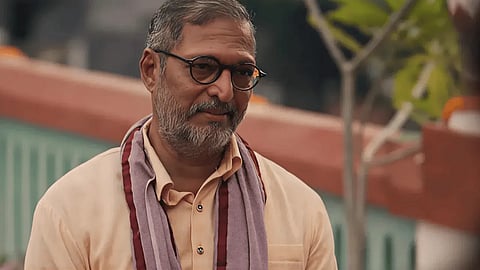
Created by Reshu Nath, the 10-episode drama reimagines the Chanakya-Chandragupta (mentor-mentee) equation in a contemporary setting. This setting is a version of the one in Aashram, the addictive Godman-themed hit from the same makers. The ‘aashram’ here is an educational academy named Gurukul, of course, and its Chanakya-coded chief is the revered Ma’at Saab (Nana Patekar). The first episode builds the multiverse nicely: this divine figure (a god voice-over introduces him only to never appear again) has spent three decades buying gifted children from impoverished families in Patna and putting them through his bottom-to-top institution, which ranges from sanskari school lessons right to a Delhi Civil Services training center (called Chanakya Coaching Classes, of course). But it isn’t so much a business as it is a slow-burning masterplan for world domination. Ma’at Saab is building an army of faithful government servants, ministers and cabinet leaders across India who’d do anything for their silver-tongued guru. His favourite is Aditya Verma (Mohd. Zeeshan Ayyub), a star IPS officer who soon invites his wrath for making a mistake and refusing to offer penance. Their conflict springboards into a plot packed with political rivalries, loaded histories, hidden skeletons, and center-versus-state tensions.
As one might expect, there’s a lot of talking, threatening, flashbacking and scheming in Sankalp. There are almost too many characters, all of whom are somehow shoehorned into an elastic storyline. There’s the Delhi Chief Minister (Sanjay Kapoor) who spends most of his time raging and demanding to know “What the f*ck is happening?” in different tenors. There’s his smug party leader, Waqar (Neeraj Kabi), who pulls the strings. There’s Ma’at Saab’s mysterious hostility towards them and a vintage revenge track; there’s his co-founder and friend, Suhasini (Meghna Malik), who shares his vision. There are his other Chandraguptas, including Parveen (Kubbra Sait), the one righteous officer who struggles to process the calculative ways of the environment. There’s an elaborate counterfeit-currency scam she pursues, which features a henchman named Kasturi who grows in narrative stature. There’s a student-politics angle, a journalist with incriminating footage, a kidnapping, a manhunt, and much more. Mainly, the episodes reveal just how wide Ma’at Saab’s web is — nearly every character works for him, descends from his Gurukul, or secretly works for him. After a while, it’s hard to keep track of whose loyalties lie where, whose are changing, who wants to take down who, and why entire scenes revolve around conversations that could’ve been one-line emails.
The series struggles to juggle and balance every arc; sometimes the bossmen are forgotten for long stretches while meandering secondary tracks are fleshed (and flushed) out. That’s the nature of the genre beast. Even when it’s convoluted and unfocused, Sankalp thrives on letting the big picture emerge in installments. There’s the constant reminder that Ma’at Saab has dedicated his life to the weaponization of pawns on a chessboard that’s defined by kings and queens. The craft remains dry enough to not obstruct the sheer volume of story. Some of the CGI (those stormy-river shots) is clumsy, the backstories are temple-in-film-city basic, the cultural missteps (like the few Muslim characters inviting distrust) are avoidable, the background score is endless, and the writing is aimed to pad up thin moments and inflate the running time. You can see the death of a primary character coming from light-years away; some of the tangents (especially Kasturi’s journey) distract from the core. The cast is passable: Neeraj Kabi is suitably campy, Sanjay Kapoor doesn’t have much to do except look hassled, Kubbra Sait’s character unravels in simplistic shades, and Mohd. Zeeshan Ayyub pushes the stoicness and moral ambiguity a bit too far (as he recently did in Assi and The Real Kashmir Football Club). Nana Patekar plays Ma’at Saab as an extension of his annoyingly sagely character in Jha’s Raajneeti (2010): a cult figure whose calm is just as performative as his toxicity. I’m not a fan of his recent cameos in O’Romeo and Subedaar, and ironically, for a protagonist who specialises in being the puppeteer, Patekar’s acting strings are too visible. The aura of Ma’at Saab is more implied than earned.
But the merit of Sankalp (“vow”) is that, despite its apolitical design, it’s not detached from the real world. The echoes are pointed enough to suggest that this is more of a systemic nuts-and-bolts story than an ideological one. It’s more about where true power comes from than how it’s wielded. There’s a charismatic and controversial student leader named Kanhaiya; there’s a CM whose promise of free electricity and water to his citizens falls flat; there’s the use of ED raids to pressurise the opposition; there’s a vlogger who’s channel is removed by an establishment that can’t take criticism; there’s a wedge driven between two leading party figures by cunning rivals. Most of all, there are the anonymous egos of those who run the country from the shadows — the mythical guides and faceless generals who deploy the very foot-soldiers they create. Those like Ma’at Saab provide the alphabets behind the sound of languages like patriotism, conservatism or socialism. As formulaic as Sankalp is, it’s one of those uncannily sketched shows that mines a long-standing culture of reverence and obligation. It’s nothing if not that senior family member: an old parent who expects debts and sacrifices to be repaid, a gentle teacher who gives so that they can take back, and a helpful uncle that would rather be owed than be liked or disliked.