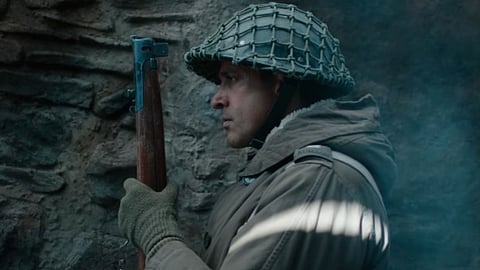


You want to believe 120 Bahadur is a different historical drama. It’s from the makers of Lakshya (2004). The enemy is not Pakistan. It’s inspired by a passage of the 1962 Sino-Indian war. The optics speak to a more modern movement of resistance. The regiment in question is made up almost entirely of the Ahir community, a telling choice in the aftermath of the Indian farmers’ protest. The landscape is Ladakh. The film even addresses that there were doubts about the authenticity of the fabled Battle of Rezang La, where 120 Indian soldiers are said to have defended a pass against more than 3000 Chinese soldiers; both countries had their own versions. You also want to believe it knows the distinction between patriotism and jingoism. You just want to believe.
But 120 Bahadur is no different. It only operates under the illusion. It plays the role of an old-school epic reclaiming the genre of national pride from the clutches of new-age Hindi cinema, but its film-making language is eerily familiar — and deafening. My ears are still ringing, or maybe that’s my mind trying to make sense of how a seemingly progressive gaze is oblivious to its own treatment. For the most part, the story of Major Shaitan Singh Bhati (Farhan Akhtar) and his team is reduced to a trope-generator war movie. It’s not enough that the heroes are underdogs; the villains must be cartoon evil figures who scoff and foam at their mouths. The depiction of the Chinese soldiers made me miss the usual depictions of Pakistani or British soldiers. “They are riddled with bullets, but they do not fall,” an enemy soldier says incredulously, to which his boss says, “it’s like they are possessed by the devil himself” — a not-so-subtle play on the name of the protagonist (Shaitan, meaning Devil), because why not? Are we really good until the others are bad?
The contrast in budgets and resources is not just highlighted, it’s amplified until it echoes through the solar system. Note a transition: a bowl of frugal soup being sipped on by a freezing Indian soldier cuts to an obnoxious feast being enjoyed by the Chinese forces (the leader is plump, of course) in a warm dining hall. We get it. The banter between the Indian soldiers is simplistic; the background score during this banter is of the village-bumpkin variety. The patriotism-in-Tinkle-comics dialogue ranges from a tearful wife saying “I know this uniform demands not just courage but sacrifice” to “Before he’s a father, husband and son, he’s a soldier” to a child of a martyr being told to “take care of both your mothers” to a rousing monologue that sounds less like words in 1962 and more like lines from 2025 written for 1962.
Everyone speaks like there is no screen between the audience and the film. When someone sings, every Border-coded soldier dreams of their respective homes and families. When someone suffers, same memories. I understand that the genre requires a level of melodrama and manipulation, but it cannot come at the cost of the flesh-and-blood humanity of these stories. The tight close-ups of faces, slow-mo action and clunky shot division erase the visual identity of the battle. There’s a single-take action sequence in a slain village where the camera visibly struggles to get out of the way of the characters. The choreography isn’t as slick as most Excel productions, neither is the production value. Farhan Akhtar is miscast as the mythology-coded Rajput braveheart; it’s impossible to stop seeing and hearing Akhtar in Major Bhati. At some point, I found myself imagining his Luck By Chance character playing the role of a war hero nearly two decades after he debuted in ‘Dil Ki Aag’.
I can go on, but I’ve made my point (said no Bollywood war drama ever). The film continues until there are no points left to be made, there are no emotions left to milk, there’s no ink left to darken. It breaks my heart a little to see lowest-common-denominator storytelling in a battlefield more than two decades after Lakshya expanded the template. 120 Bahadur has perhaps a handful of interesting ideas — like unfolding as a narration from the sole survivor, a young radio operator. The metaphor of communication — or the lack of it that leads to wars — is nice in theory, as is the film’s decision to make him the only custodian of the truth of that day. It’s his word against all of China’s; he is the link between history being remembered and erased. In this age of revisionism and hidden agendas, the concept of a storyteller whose story is scrutinised is timely.
But then the screenplay falls into the very trap it challenges. You know how it goes: if the truth sounds like fiction, it’s probably the truth. As I exited the comfortable air-conditioned hall to search for a rickshaw during a CNG shortage in a city choked with the fumes of its own spirit, I wondered about how we trivially use the word “war” for such struggles these days. Maybe you can’t blame the movies for hammering the stakes home again and again. Maybe the movies are right to yell at us like enraged veterans checking our privilege, lest we begin to question the meaning of modern freedom and democracy. We may have lost the war, but it’s the battles that silence us everyday.