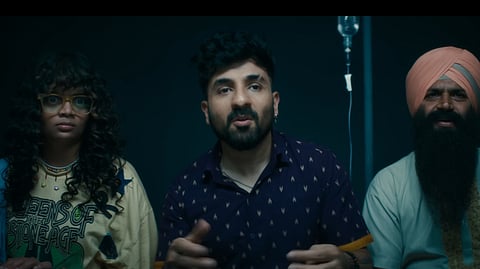


Happy Patel: Khatarnak Jasoos is like that restless kid in school whose sense of humour is so niche and Hollywood-coded that he decides to employ Indian-ness as a punchline to impress his elite classmates. He hits them with wave after wave of wonky NRI accents, Bollywood tomfoolery, spoofy imitations, endless pranks, so-unfunny-it’s-funny cultural gags — until the classmates start to enjoy his enthusiasm. His madness becomes infectious, even if he’s just too much of an acquired taste at times, because he arrives every morning with a sole purpose: to play the fool. Who doesn’t fancy a comedian that commits to their image, swings for the fences, and turns their own pandering into a joke? Maybe the kid’s comfort watch is Delhi Belly.
Which is to say: this movie isn’t for everyone. And that’s precisely why it’s so irresistible. Not everybody was laughing during the screening, but the laughs did come from somewhere. Different languages of it too: the I-see-what-you-did-there snort, the I-got-the-injoke-but-nobody-else-did chuckle, the spot-the-throwaway-line smirk, the cringey and awkward giggle that happens when the rest of the hall is silent, the I-can’t-believe-they-went-there facepalming, the second-hand squirming when something doesn’t land, and finally, the stupid grin after watching a comedy that makes you submit.
Given that Happy Patel is co-created and ‘performed’ by Vir Das for Aamir Khan Productions, I can imagine the narration of the script itself as a scene in the film. It’s why much of the film sounds funnier than it looks. I can’t help but visualise Khan’s studied laughter mutating into guffaws as he hears the makers pitch the most absurd things. Sample some. A bullet-riddled Goan don barely stumbles home…only for his irritated wife to scold him for trying to die again. A dying maid asks her British employer for a Diwali bonus…only for him to reveal it’s 3 months away. The protagonist, Happy, is a ballet-loving brown chef and wannabe spy in London with two white secret-agent dads (“do baaps”): the human version of Kung Fu Panda. He doesn’t know he’s Indian by birth until he’s assigned a mission in Goa to rescue a kidnapped English dermatologist from the clutches of a female don named Mama (Mona Singh). Mama is a gangster who loves cooking tasty and deadly cutlets; she owns an ‘FMCG-meets-Crime’ company whose latest product is supposed to end England’s post-colonial monetisation of Indians through fairness-cream and white-skin-obsession-exploiting brands. A Sikh colleague (Sharib Hashmi), who may or may not resemble Laal Singh Chaddha, instinctively yelps “Daddy” whenever he sees Happy spread his arms like Shah Rukh Khan (‘Indian mating call’). A character sighs “women — you can’t live with them” while his friend waits for him to complete the proverb (he doesn’t). I and four others snorted at this cue, like a conspiratory PJ meant for a select few. The subtitles are on their own trip, with spellings that reflect Happy’s wonky Hindi pronunciations (“paas” is “pus” of course).
The standup-set-coded humour is baked into the film. Every time our kooky hero mispronounces “tum” as “tom,” a random white tourist named Tom keeps popping into the frame; imagine how he pronounces “chatt” (roof), “chidiya” (sparrow) and “chhod” (leave). His love interest is a dancer (Mithila Palkar) who dances terribly; her passion for slapping men results in them sharing a romantic ballad called ‘Chaanta Tera’. A shootout involving garam masala is scored to the music of the hit holi anthem 'Balam Pichkari'. An NRI insists he can’t be tortured because “I’ve watched Slumdog Millionaire three times”; he promptly loses his pinky finger, which annoys him because it’s the finger he used to taste with. The fairness cream is tested on a Goan henchman who emerges in different shades of white as the film progresses. A running gag features an old waiter who moves so slowly that customers get their food days after they order; now imagine if said waiter has an OnlyFans page. (I call this “kuch-bhi comedy”). The climax features a cook-off judged by none other than Sanjeev Kapoor. A quasi-patriotic song called ‘Main Hindustani Hoon’ plays while Happy discovers his roots.
It’s not often you come across Hindi comedies that remain profoundly unapologetic, unrestrained by crowd-pleasing patterns and commercial trends. That’s not to say Happy Patel is inaccessible; it just doesn’t pretend to be something else in pursuit of validation. It’s all so free-spirited that it’s easy to forgive its hit-or-miss translation onto the screen. The tonality is more vibes than technique; fun is derived from sensing the fun that the cast and crew seem to have had during the shoot. I last felt that with Kunal Kemmu’s Madgaon Express. In fact, while writing this review, I almost recall Happy Patel as an animated movie — that’s how overproduced it is. (The three deadpan Marathi cops that high-five each other every time they blurt out a character profile reminded me of the penguins in Madagascar). We can see Happy Patel as an Austin Powers-styled spy parody, a Pink Panther-fuelled accent-fest or a Zoolander-coded satire on identity, but it’s defined by its ability to be anything it wants to be. The influences are plenty, yet the individualism is what tides it through. Even when it stalls a bit, it’s the kind of film that’s willing to slather itself in its own clumsiness rather than change the way it functions. You can blame the cast for taking the skit-like memo too seriously, but it’s the droll characterisation and kitschy staging that do the job.
A big reason Happy Patel works — even when it doesn’t — is because of Vir Das. As much as I’ve admired his social media awareness, I’ve never taken to his standup specials; it extends to the boho-core specificity of his acting career, much of which hinges on him playing fish-out-of-water screwups and Saif-in-Dil-Chahta-Hai descendants. But his conviction in and as Happy Patel feels personal. Much of the bumbling spy’s mission revolves around a conflict of identity: too brown to feel white, too Western to feel local, too artistic to feel manly, too silly to feel slick. The premise is almost incidental, but it’s hard not draw parallels to Das’ own straddling of identities and demographics over time. Happy is neither here nor there; he reframes his no man’s land as flexibility and the freedom to succeed on his own terms. Where does the character end and the creator begin?
One of the film’s main pieces revolves around Happy channeling everything he is — the lithe footwork of ballet, the flamboyant use of spices, the famous dance moves and hip thrusts he learned from all the Bollywood movies he watched for ‘training’ — to fight his nemesis in combat. All those gags come full circle, because he summons every facet of who he is to change the game. It’s an old trick, but this legitimisation of his personality becomes a callback to the wise advice that Happy receives when he aches to belong: “be yourself to be Indian”. After taking India to the world, it’s only fitting that Happy Patel is Vir Das’ be-yourself moment. Whatever people may think of that restless kid in school, he’s nothing if not authentic — and happy.