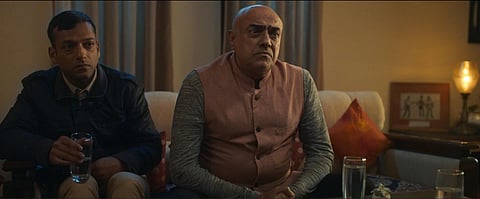


Conceptually, Kaisi Ye Paheli goes for broke. The 95-minute independent film, written and directed by Ananyabrata Chakravorty, wears the cloak of yet another small-town whodunnit. There’s a death in misty Kalimpong; sullen cop Uttam (Sukant Goel) and his boss, Tamang (Chittaranjan Giri), are flummoxed by the details: a religious girl poisoned by a holy sweet? The theatrical Bondo (Rajit Kapur, always) is summoned from Kolkata by the powers that be; the senior sleuth has a direct line to “Didi,” and behaves like he’s an amalgamation of Byomkesh Bakshi and Feluda in his head. Meanwhile, Uttam’s home situation is complicated — he resents his widowed mother (Sadhana Singh) for various reasons, not least because she constantly recalls their past life and late husband. The mother-son bond is strained, she aches for his attention, so it’s amusing when Tamang and team unofficially recruit her to be part of the investigation because of her passion for Bengali detective novels. Uttam’s colleagues confide in her like sons in their downtime; it’s a quirky touch without the energy of a quirky touch.
In theory, the film is bound by themes of social identity, grief, belonging, societal tensions and the inherent biases of the male gaze. Not to mention the distinctly Bengali relationship with culture and literature, which is often mined for humour in Hindi cinema. It has a lot on its mind, particularly in terms of parental dysfunctionality and the burden of emotional estrangement. But Kaisi Ye Paheli falters where most indies do — the limited resources limit the vision and staging of the story. Characters speak to each other like they’re explaining the backstory to us; the makers struggle to convey information through organic conversations and scenes; a ‘revelation’ has the killer on the brink of breaking the fourth wall; the longer shots seem to exist because there’s not enough time to do multiple ones; there are no real transitions or rhythm between moods and locations; the sparse score feels like less of a creative decision and more of financial one.
It’s basically first-draft film-making, where the narrative counts too much on our perception of the atmosphere-heavy template to get across its little subversions and red herrings. The grand reveal isn’t as much of a twist as the film hopes it is; a small interaction between two cops — where one is talking like he’s directly urging the audience to understand the mother-son dynamic — gives it all away in a heartbeat. I like the idea of the twist, but it also makes Kaisi Ye Paheli look like more of a short film that fumbles its feature-length padding; it doesn’t know what to do with itself beyond the gimmick.
Apart from an intense Sukant Goel as Uttam, the performances do not supply the conceit of the film. When actors play characters whose motives are supposed to be ambiguous, these characters should not appear as if they’re reverse-engineering their tics because they already know the ending. It’s obvious here, similar to that age-old habit of killers suddenly sounding creepy once the story — and not the world within — disclose their identity. Except it’s not sudden in movies like Kaisi Ye Paheli; they’re behaving strangely all along, to such an extent that they force the plot to justify their ‘off’ overtones. The performer is too aware of the climax. There is some merit in the film’s desire to make more of the human environment. The fabric is there; I like that Uttam’s boss, Tamang, for instance, isn’t entirely reduced to a comic device or an incompetent stooge. He has an arc, too. I also like that the film isn’t coy about its connections to everyday life; the political resentments and Kolkata-based Bondo’s patronising treatment of the town hide in broad daylight. It’s not normal for modern Hindi-language films to depict any sort of link between the state and its players.
But so much of Kaisi Ye Paheli unfolds like it’s stretching time and flirting with depth, trying to be a film at the intersection of fiction and life. It is just not naturally a film. It’s a striking one-liner that invokes every suspense master from Hitchcock to Ray, yet the execution lacks the nuance and technical control necessary for the genre. You want to be kinder to crowd-funded movies in this age of streaming deals and industry clans. But you hope the movies are first kinder to themselves. In short, Kaisi Yeh Paheli can start a conversation at a dinner table, but can’t sustain it beyond the second (easter) egg.