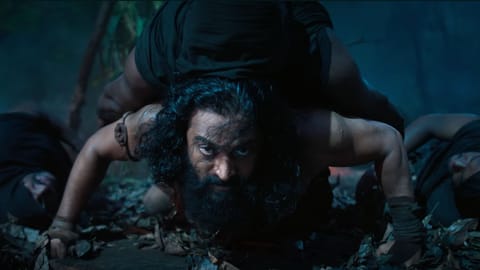


Rishab Shetty’s Kantara: Chapter 1 attempts to build upon every concept that the sensational predecessor explored in 2022. The human-nature clash, which was previously restricted to land rights issues in the coastal Karnataka village of Kantara, becomes an all-consuming war fought between the Bangra kingdom and the forest tribes in the prequel. The quick glimpses of wild boars, buffaloes and deer we saw in the original become slow, searing shots of grand tigers and lorises, brimming with symbolism here. The Bhoota Kolas, which primarily revolved around Panchurli and Guliga daivas in the original, here get even more character and space to dance us over. There’s room for a lot more spectacle, a lot more folds in the larger story of resistance, and much more visual beauty in the prequel. Even if it comes at the cost of much lesser depth in writing.
The prequel picks up years before the 2022 film left off, taking us to the Kadamba period of the 4th century, and into the invisible barriers that separate the Kantara forest tribe and the Bangra royals. But before that, it also briefly reminds us of the atrocities that created the divide. The story of a vicious king’s greed for spices and the “garden of the eshwara” nestled in the Kantara forest are complemented by stunning visuals that represent the forest’s endless mysteries. It is the same spices that bring the tribe closer to reclaiming what’s technically theirs, thus beginning a war over trade and authority over the port between the two groups.
Unlike Shiva in Kantara, Berme (Rishab Shetty) in the prequel knows and believes in the legacy that surrounds his roots. He embraces the kola traditions, worships his daivas, and openly defies authority — in this case, Gulshan Devaiah’s King Kulashekara. So, when he sees what their spices are worth, he transfers knowledge of irrigation and commerce to his happy family. There is also no balance between the two forces. Kulashekara is neither a mad king nor a foolish one. He dangles awkwardly in the middle of the realm, making a fool of himself in a few scenes and ruthlessly killing foresters in a few others. Kulashekara isn’t an equal contender for Berme by any measure, but we realise the true meaning behind this much later in the film.
The prequel, co-written by Anirudh Mahesh and Shanil Gowtham and directed by Rishab Shetty, has a lot to say about many things. Its purview doesn’t just involve a land conflict or a resistance movement, but concepts like slavery, untouchability, and a touch of occultism. But the film isn’t able to do a lot of this justice, even in a runtime close to 180 minutes. Backstories, which needed a lot more depth for us to feel one with the people of Kantara, are reduced to mere images. Berme’s origins, for instance, are wrapped in such a stunning idea: a baby boy left abandoned with a tiger left for his protection. Berme’s connection with the tigers of the forest — some of the best VFX minds have gone behind the prequel’s special effects — is an idea of beauty. But the idea could’ve been so much more if it had more space in the script. The same goes for the royals, Kanakavathi (Rukmini Vasanth makes her presence felt, even if we're wishing for her to be in a lot more scenes and subtext) and Rajasekhara (Jayaram), whose personalities hardly come out… except, of course, during moments of conflict.
The film leans a lot on its technical department to get audiences to fill the gaps. We see this in the way Arvind Kashyap films the Bangra and Kantara clans. As sophisticated and spotless as the palatial quarters are, they are cramped, and Kashyap films this at close range. In contrast, the Kantara forests are sprawling and grimy, but always have room to breathe, and so does the camera. A Bangra armyman (Prakash Thuminad gets a meaty role as the jester here) at one point says, “It’s so peaceful to live in Kantara.” While we want to feel this too, the film doesn’t have even a second to stop us from processing these details because it is busy chasing bigness. Of course, we know this is a universal side note that all big sequels come with — going from a small Kannada film to a pan-Indian spectacle isn’t without collateral damage.
But when some of these adjustments also become tonal inconsistencies in the movie, it is hard to overlook them. The humour, which exists to offset a lot of the serious drama in the film, is often out of place in a film that tackles so many important conflicts. Kantara (2022), which also enmeshed humour into its fold, dealt with this conundrum quite organically because Shiva’s world was much more grounded and set against a simpler present-day period. But Shetty gives it his all to Berme, who is an absolute master of all daiva nartakas we’ve seen on screen.
With the original Kantara’s rousing climax, we all knew what Shetty, as an actor and director, was capable of in the context of writing and performing the Guliga. But Shetty, respectful of the Tulu folk tradition’s rich history, reminds us of the endless possibilities of the Kola tradition in the prequel. While these sequences are a treat to the eyes, it does raise a few questions, ones that even the original raised: In its attempt to make things more cinematic, does the film run the risk of making the tradition more performative? And in turn, fitted to mainstream narratives? The answers aren’t clear, but the film is clear with what it sets out to do: entertain with ambition and abandon.