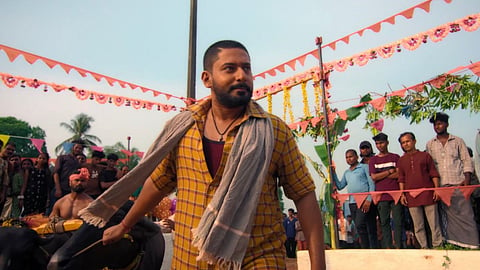


It’s easy to see why Gurudatha Ganiga was drawn to go back to his roots to tell a story from Karavali. The latest Kannada action drama is situated in the depths of Karavali (coastal Karnataka), seeking to tell us stories of friendships, intolerance, preservation and human-animal coexistence through the buffalo sport of Kambala, led primarily by Prajwal Devaraj and Raj Shetty. These conflicts might be familiar, but the background is rich and tenderly honest, urging us to come a little closer and understand the lives of the racers whose days end and begin with their cattle. The stage is set for an evocative drama, yet the writing creates a curious push-and-pull effect, leaving the film emotionally distant.
The most interesting part of Karavali is arguably its driving force. The film revolves around Dhananjaya (Prajwal Devaraj), an orphaned young man living with his grandparents. Dhana, who understands animals more than humans, is unaware of the prophecy he’s supposed to fulfil until he meets Mahabala (Mitra), an ageing, washed-up Kambala racer. Karavali switches back and forth between two important timelines: the past, which documents the legend of Mahaveera (Raj Shetty) and the present, which deals with Dhana’s reckoning with his fate. The film might be led largely by Devaraj and Shetty, but the main force here is Mahabala.
Like Dhana, Mahabala has a way with animals, is sensitive to their needs, and tends to them with a care he doesn’t particularly reserve for humans. It is his need to overcome and challenge class prejudices that forms the major conflict of the film.
Mahabala is challenged by Doddavaru (Kannada cinema’s resident baddie Ramesh Indira), a vile landlord, who monopolises the Kambala to “preserve” its sanctity and his own rotting sense of morals. Kambala is a sport for all, but one where the winner is already decided. This leads to some interesting observations of class and caste prejudice and how the effect of this hate trickles down inevitably onto helpless animals. Karavali uses long stretches of songs as its primary vehicle to move the film’s emotion forward, but this works against its mission. While characters like Mahaveera are idolised for their courage and strength by dialogue, we remain painfully left out of the party as we don’t get many scenes detailing why his exploits are important.
While the film takes an interesting turn by sticking with Mahabala as the narrator, we’re again peeled away from his world, struggling to emotionally connect with his noble cause. Their angst remains a narrative detail, never really becoming something bigger for it to pierce us. Much of the film is gorgeously shot in the rain, making the water buffaloes, slush and the mud come alive along with their human companions. The film is edited tightly, working overtime to make fate a key player of its world. At 126 minutes, it's surprising how much visual detail the film manages to pack in, even if the writing doesn't always receive the same level of attention.