

When death is recurring, life’s value deteriorates. If death is never final, life is never treasured. You will come back alive anyway, so of what use is mourning? Of what use is meaning? This question ticks Mickey 17, set in a dystopian future where a megalomaniacal wuss of a dictator Kenneth Marshall (Mark Ruffalo) wants to colonise an ice planet Niflheim, which is populated with sentient creatures. He wants to create “a pure, white planet full of superior people like us”, and if you think “pure” and “white” refer to something other than the planet, you are onto something.
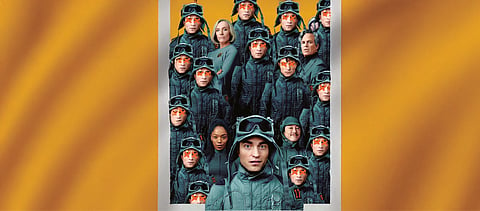
Robert Pattinson plays Mickey, a man on Earth who, having taken on too much debt, wants to flee into outer space and signs up to be an “expendable” in Kenneth Marshall’s space mission, as in someone who is thrown into the jaws of death, left to die, only to be “reprinted” back to life. That word — reprinted — hollows human life, turning man into paper, womb into machine, and interiority into data. He is a human experiment. When we meet him, he is in the 17th iteration of his life; cats and their nine mewling lives have nothing on him. Pattinson speaks like a kid, or a man on drugs, slowly, slurring his pitch, lost but also forsaken. His performance is excessively physical and excessively endearing. You want him to live, but not keep living. What he is — or what the film is — unable to mine, though, is melancholy. People keep asking him what it means to die, and he looks away, sad, and this sadness is considered enough — for him, for the film. The emotional toss up of life moving eternally forward, but a life whose value has been reduced to its utility, is left for us to fill in. Bong Joon-ho, instead, wants something more skippy.
On the expedition, Mickey falls in love with the security agent Nisha (Naomi Ackie). Their courtship is sex, and a voiceover. When, on one of his explorations he is left to die, the crew on board assume his death and print his 18th iteration. But “creepers”, these sentient creatures and original inhabitants that are both cute and creepy, save him. When he returns to the ship, he realises the duplication of being.
A philosophical question is thrown in here and never really grappled with, only teased — when a person is duplicated, what happens to their soul? Are they the same? Mickey 17’s and Mickey 18’s personalities differ, and their trajectories, with the latter hopped up on drugs, and the former on resigned melancholy, offers something of a provocation: You are not you all the time. When Nisha wants a threesome with both Mickeys, is she opening up the relationship, or deepening it?
Why does Bong Joon-ho create the space for questions he has no willingness to examine? The film, constantly on its toes, is never able to fully appreciate what it has set up.
Based on Edward Ashton’s 2022 novel of the same name, Bong Joon-ho’s adaptation is very liberal about its allusions — the dictator is Trump, the looming critique of this film is colonisation, and like Parasite’s stab at inequality, here, too, the politics is neat, unambiguous, and so simple, it emerges on the surface of the film as simplistic.
But to return Bong Joon-ho’s films to their themes is a short-sighted manoeuvre, because he weaves around this easy moral, a world so physically present, every thud, every fall, every chop of a hand feels like bodies are being returned to themselves. Yes, Snowpiercer is about inequality, yes the creature-feature Okja is hatchet at the meat industry. But there is also something slick, grisly, and comical, which is what his cinema reaches for. With cinematographer Darius Khondji’s camera that never looks away, that keeps staring in long takes where bodies simmer, there is this feeling of being part of a world that is physical, palpable, and twitching. Khondji’s elegant filming of architecture, low angles looking up, top angles looking down, produces vertigo and a neck cramp.
The film, per Bong Joon-ho’s filmography, is goofy. Its English dialogue is awkward and starched; you get the creeping feeling that this is by design, especially the deadpan questions about what it is like to die. And the pacing is rat-a-tat-tat, allowing for the various strands to be left and returned to without feeling like they were abandoned. But the film’s culminating effect is one of confused hope, as though, unable to make sense of its overfull spectacle, it reaches in all directions — except anger, except anguish — to say what it wants to say: Colonisation sucks.