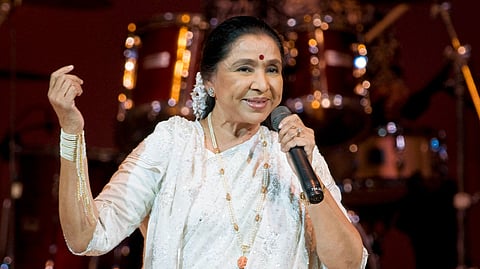


Composer Anil Biswas’s well-known quip, “Asha [Bhosle] has body while Lata [Mangeshkar] has soul,” sealed the distinction between the two sisters, both playback sensations, secreting divergent musical legacies.
Full of breath, open vocals, suggestive laughter, and gibberish sounds, Bhosle fronted a certain genre of songs. The way the ‘Tu’ from ‘Piya Tu Ab Toh Aaja’ was extended and looped around Helen’s twisting body, followed by breath-work that fell to a beat the way a note would, for example. The way Parveen Babi’ stepped off the stage to Bhosle’s ‘Aha’ in ‘Jawani Jaaneman’, for example. The way Zeenat Aman gave shape to every elongated word that Bhosle crooned in ‘Dum Maaro Dum’, for example. Bhosle recast singing its own form of acting by bringing the body into her music. So much so that when discussing ‘Piya Tu Ab Toh Aaja’, film scholar Usha Iyer described it as a “Helen-Bhosle cabaret number”.
These songs were produced at a particular moment in film history. On the one hand, new kinds of stories were being told. On the other, a new sound technology was made available to tell those stories. The introduction of multiple-track recordings in the 1970s, for example, “[m]arked by the use of unlimited bass, experimentation with scale, variations in rhythm, and the use of whispering, breathing, tittering, and grunting sounds,” according to Shikha Jhingan, author of The Female Playback in Bombay Cinema: Voice, Body, Technology. A song could be layered now, thickening its density, allowing the singer to spread outwards from the lyrical spine of the song.
This allowed for Bhosle’s “malleable voice”. Besides, the nightclub songs of the 1970s were distinct from the ones in the 1950s and 1960s, with “aural strategies of fragmentary voice, language, breath, and pitch”. Jhingan argues, that Bhosle’s “volatile scale shifts” expressed the changed connotation of the nightclub, “as a much darker space with depictions of illicit sex and sexual violence.”
So, when singer Usha Uthup noted, “All the good girls got Lata ji and Asha, and all the bad girls got me,” she might have made an oversight. Asha was that bridge between the good and bad girl.
Though this body voice of Bhosle was associated with seduction—the “oomph songs”—her voice was spread across genres. Its versatility was put to use in Boot Polish (1954) and Jagriti (1954), where she sang for both the male and female children, as it was in Rafoochakkar (1975), where she sang for both Neetu Singh and a cross-dressing Rishi Kapoor, the latter in a falsetto. “Asha Bhosle’s voice became a preferred choice for cross-dressed and contingent bodies,” Jhingan notes, the latter including beggars. In fact, she won her first Filmfare Award for ‘Garibon Ki Suno’, picturized on alms-seeking children. For Umrao Jaan (1981), on the other hand, the music director Khayyam asked Bhosle to sing one note lower to express the melancholic gravitas of a tawaif.
Bhosle would enter the song by inhabiting the body of the performer. In an interview, she noted, “When I sing, I feel the body movement. Only when you play the character does the song emerge. For instance, when I sang for Helen, I would see her face and visualise her movements. In those days, the artists would meet up with the singers. Now if I sing for Kareena (Kapoor Khan), I have to imagine what she would be doing. For Umrao Jaan, I really had to get into the character.”
Bhosle’s body voice rang across multiple languages, even those she wasn’t comfortable in. “At the age of 14, I started singing for films. My formal training was in Marathi. Once I got into filmdom, there was no need to learn English—till one fine day my son told me I had to go to London to sing an English number! I asked him how I would manage. He said, “The way you sing Tamil songs.” So I picked up an English ‘listen and learn’ book with a cassette,” she noted.
This versatility was both a function of Bhosle’s innate range, but also, of what was made available to her. She complained about the “step motherly treatment”, in a 1990 Filmfare interview, where composers flocked to her elder sister for songs requiring a flex of graceful femininity. Bhosle emerged when they needed to look elsewhere—for voices of children, both male and female, in the 1950s, and for erotic heat and playful abandon, in the 1970s.
Her versatility was in keeping with her desire to stay employed and relevant. When asked about her partaking in remixes in the 1990s and 2000s, she simply noted that one must keep up with the changing times, “There was a time when ghazals were very popular. But when the fad faded, the singers were out of work. I thought, baap re, if I only sang in a certain style, I’d be gone too.”
An artist’s talent might spring from some inner receive that cannot be accounted for. But it is the context of the time and the industry that ultimately gives that artistry a shape. Bhosle, even as she shaped the industry, was also shaped by it, and her loss is both the loss of a singer, but also of a crucial agent of film history.