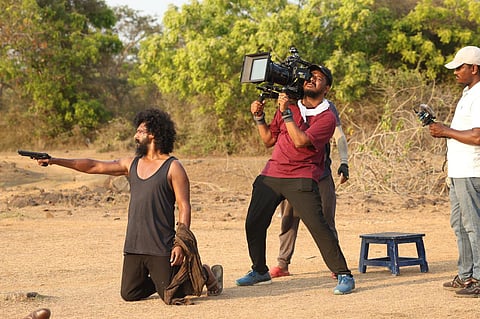


Instead of calling Arun Matheswaran the director of DC, cinematographer Mukesh G often calls him his classmate. They both studied at Chennai’s SRM College “a long time ago,” but these recurring slips — from colleague to classmate — suggest their dream of making it in movies began around the same time.
Their first collaboration, DC, became the first A-rated Tamil film starring a debut actor to gross over ₹100 crore worldwide. What stands out about its box-office performance is how strongly the film has performed in the Telugu-speaking markets and Kerala.
While Mukesh G is proud of the film’s box-office performance, he admits that he never imagined it would cross even ₹60 crore.
“I do a little bit of box-office tracking myself,” jokes Mukesh. “But in my wildest assumption, I pegged the collection at ₹65 crore. In my understanding, if the film has made more, I feel it is because people who have loved the movie have watched it repeatedly."
DC's Box-Office Win: Mukesh G on the Film’s ₹100 Crore Success
He adds that the film also benefited from the delays in its release. Secretly, he even admits that he hoped the film would open only after the summer holidays, when college reopened.
“In college, that’s what I would do. After holidays, the joy of meeting your classmates is doubled when you go for a cool movie together.”
A “cool movie”—that’s what DC has become for Gen Z, feels Mukesh. Making a cool movie with Arun was a plan Mukesh had right from their college days.
“I was supposed to work on all three of Arun’s earlier movies, but things just did not fall into place,” says Mukesh. “I wanted to break that jinx somehow for DC, even though I was already shooting for SJ Suryah’s Killer. At first, I felt I could juggle both films at once, but after a point, I knew I had to pick one.”
But there were unique challenges attached to that decision. With his three earlier films, Arun had created a particularly idiosyncratic visual style—a style Mukesh did not want to simply repeat. A series of discussions followed, and together they created a set of rules that would result in a film that looked different.
DC's Cinematography: Mukesh Reveals the Three Rules Behind the Film’s Visual Style
'No shot should last longer than 10 seconds' was Rule #1. 'Let’s shoot the entire film using handhelds' was Rule #2. And 'Let’s not use too many shots of water bodies and ultra-wide shots' was Rule #3.
There were other rules too, but the idea was to make the film look stunning without diluting the signature style that his director and classmate had already become known for.
“That’s what we ended up doing too,” he says. “Apart from three or four drone shots and four shots on a gimbal, the entire film was shot using handhelds,” Mukesh adds. “Even in intimate drama scenes, you can sense me breathing with the camera on my shoulders. In a way, it adds to the drama and the intimacy.”
What also added to the effect was the fact that the majority of the shots used either 135mm or 180mm lenses, again adding to the drama. In the major action scenes involving explosions, Mukesh says he was particular about getting a little too close to the action.
“If there’s a blast, all that dust must first cover me before it covers the actors. It gives you the feeling of the action happening around the viewer, like you too are in the scene.”
DC's Action Scenes: How Mukesh and Arun Created an Immersive Visual Experience
As for Arun’s obsession with frames within frames? “We decided to look away whenever we found frames within frames, even though both Arun and I love to use them. Instead, we decided to settle for extensive use of mirrors in the film.”
The same goes for the other rules too. “The only scene in which we used a proper ultra-wide is when Chandra [Wamiqa Gabbi] sees the sea for the first time. She’s been in a claustrophobic atmosphere, stuck inside a brothel for decades, and the ultra-wide needed to be there to make you feel Chandra’s liberation.” And what about the close-up of the moon? “That’s just Chandra meeting her namesake,” he jokes.
How Arun Matheswaran Used Mirrors and Camera Lenses in DC
The approach also worked so well because Mukesh was able to capture the performances of his lead actors “as though they were talking directly to him”. As for the action scenes, there was a musicality that had been pre-decided. Speaking about how Arun plans his major action blocks, Mukesh says the director would list particular musical tracks as references for how he envisioned them. The songs would help create a rhythm for the crew and also help during the editing stage later.
“So for the pre-interval action block that takes place in that narrow corridor at the brothel, the score Arun gave me was the remix of Ilaiyaraaja’s ‘Poongatru’.” What Anirudh was able to build onto that idea with 'Raaga of Revenge' might not need any further explanation. The track has since become one of the film’s defining musical motifs.
Anirudh’s ‘Raaga of Revenge’: How Ilaiyaraaja’s Influence and Music Shaped the Film
Ilaiyaraaja’s influence on DC does not end with its musical flavour. A lot of the film is set in the southern districts of Tamil Nadu, including Theni, where Ilaiyaraaja originally hails from.
“Arun had already gone on a recce for the Ilaiyaraaja biopic he is working on, so he was quite familiar with that terrain. But the fact that we should set several scenes in those places has added another flavour to DC.”
For all his love for Ilaiyaraaja and the masters of Tamil cinema whom Mukesh calls his inspirations, he has worked on several films in Telugu too. He is also known to be among director Puri Jagannadh’s favourite DOPs.
But what really is the difference between working with a director like Jagannadh and someone as peculiar as Arun Matheswaran?
“Puri sir too loves the film to be visual, but you have to match the quality with his pace. He finishes massive films in 80 days, of which 60 will demand the stars to be part of it. So it’s great for actors to work with him.”
Mukesh adds, “But for Puri sir, the scale and the swag must obviously be visible on screen, and there’s a lot of effort that goes into the way we shoot elevation shots for stars.”
Arun Matheswaran’s Approach to Cinematography: ‘The Shot Is the First Priority’
For Arun, the logic is very different.
“There were many days when Arun would seem worried the moment daylight would fall. Even if it’s just 4 PM, if we lose natural light, Arun would ask if we should cancel the remaining shoot and rejoin the next day.”
Like the questions that resulted in the film’s stunning look, another question sums up Arun’s obsession with visual quality.
“Arun would often ask, ‘At what time of the day would you want that shot?’” says Mukesh. “If I say 6 AM to capture the golden light, he would tell his ADs that all actors must arrive on set an hour early. The shot is the first priority. How can we end with anything lesser than a stunning-looking film when the director himself thinks like the DOP?”