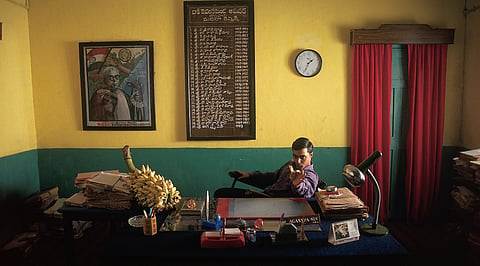


“It was just a story about a guy who is hazaar fuc**d,” director Dev Benegal writes, introducing the script of his debut fiction feature, English, August (1994). Based on Upamanyu Chatterjee’s 1988 cult namesake novel, and now restored with a fresh coat of paint by the Film Heritage Foundation, under Shivendra Singh Dungarpur, the landmark film that captured a generation unmoored premiered at the Venice Film Festival more than three decades after its initial release, this September.
Does its subversive voice still have teeth? Do the longings and lethargies of that generation resonate today? Or, set in amber, is it a mere portrait of a lost time?
A Young Man Lost in India
The film trails Agastya Sen, or August (Rahul Bose), an urban man — boy, really — who arrives at Madna, a village in the backwaters of Andhra Pradesh. A year of training for India’s elite administrative cadre, thick with ennui, irony, and disillusionment, awaits him. To keep time ticking, he reads Marcus Aurelius, listens to Pink Floyd and Miles Davis, masturbates, smokes cigarettes, swigs rum, swats mosquitoes, strains and shapes his body with long dawn runs and handstand pushups, all the while detesting the locals, whom he is called on to serve, and looking down on his superiors, whom he is called on to serve.
The collector he works for is the prototype of an Uncle — with judgments that burst from every seam. “This is India, Sen,” he keeps reminding Agastya, a reminder that cushions him in some stratospheric height, looking down. Agastya fantasises about the collector’s wife. He also makes some friendly acquaintances and spends peaceful hours untouched by irony or a sense of collapse by the sea, in a gorgeous, decrepit lighthouse — only its frame remains.
How Rahul Bose Made Boredom Watchable
English, August was Bose’s debut film. A theatre actor before this, “This was a dream debut, where you are in 80 per cent of the film,” Bose tells THR India. While he maintains it was not a “difficult role”, it was certainly a fragile one. For most of the film, Agastya looks bored — how to look bored without making it look boring? For most of the film, Agastya is irritated —how to look irritated without making it look irritating?
His is a compelling self-fellating presence, butt naked and erotically charged — “homoerotic in some ways,” Bose notes — with no other body on which to dispense this heady eros. “When an American distributor saw the film, he said, 'This guy can carry a movie',” Bose remembers. “At the time, it didn’t seem like a great compliment, as opposed to 'a great performance' or 'a wonderful actor'. Now I recognise it was the most important thing in a leading man’s career. How watchable are you? Is there something charismatic about you? These are not things you can train for. It is either there or not there.”
Benegal had to cast and shape a presence, not just a performance. Knowing fully well Agastya is an unlikeable character, offensive, ironic, and snooty, they had to not just make him look compelling, but also allow in the performance for a punctum...“that beneath the sardonic asides is a young man, looking at the whole of India and is deep inside, afraid: does he even belong to India?” Bose notes.
Agastya has to keep explaining his name to people — too Sanskritized for their ear, the Indian ear. Agastya renders himself exotic, even as he recasts everyone around him into ethnographic objects. These are strange scenes, not just because Agastya is a name that wouldn’t bat an eyelid today, but because they frame the curiosity of those around Agastya as idiocy, and Agastya’s explanation as some attempt at bored wit. At some point, without intending to, the film bleakly borrows the prejudices of its protagonist.
Though the language and delivery might seem a bit starched and affected, Benegal notes that he urged the actors to “speak the way they spoke everyday, and not try and make it sound like a posh British accent spoken on BBC. (Upamanyu Chatterjee) has famously said, “We didn’t want characters sounding like Shashi Tharoor.”
An Expressionistic Realism
Benegal credits the production designer Anuradha Parikh, the cinematographer Anoop Jotwani, the sound recordist Vikram Joglekar, and costume designer Pia Benegal, all of whom together with Benegal to evoke “the sense of heat as an internal state of mind.” They shipped in special amber/copper gels from New York to tint the image, and the room was painted a deep, throttling blue.
The film’s form, too, gave voice to Agastya’s fractured self and the novel’s winking style—“not neo-realism but an expressionistic realism,” Benegal tells THR India. “This is a film which was truly written on the editing table…to turn interiority into atmosphere” Benegal notes, “While we were editing Upamanyu asked me, “Why did we even write a screenplay? We are writing the film right here!””
Shot in about 50 days in and around Visakhapatnam, the difficult conditions of the shoot—all that heat, unsanitary environments, and unappetising food—gave way to another conundrum. How to distribute this film, a film without precedent? Indian films made largely in English, like Pradip Krishen’s In Which Annie Gives It Those Ones (1989) and Electric Moon (1992) were made for television and passed around in cassettes.
Finding Its Audience
“English, August has five languages, and that stumped the Indian Censors who insisted, “a film can only have one language”,” Benegal notes. All Indian distributors turned down the film, for they could not even imagine an audience for it. Sunder Kimat Rai, the Country Head of 20th Century Fox at that time, took a punt. “He said, 'the demographics match.' I had no idea what ‘demographics’ even meant,” Benegal remembers, “And he was right. The young college going audience discovered the film and the cinema theatre owners were surprised at the huge turnout.”
Benegal remembers the owners of Regal, a single screen theater in South Mumbai that can seat over a thousand people, hated the film and did not want to screen it. “They were very angry when on the first day it crossed the “holdover” i.e. more than 50 per cent of the cinema was full,” Benegal notes. Bose remembers the film ran at Regal for about three weeks.
What Happened to the English-Language Indian Film?
Like a roadmap, English, August set forth a wave of English language Indian films, whose preoccupations and protagonists were urban, profane, and carried the invisible burden of speaking for a generation, the young, unabashed but unmoored urban elite.
There was Kaizad Gustad’s Bombay Boys (1998), Benegal’s Split Wide Open (1999), Bose’s Everyone Says I’m Fine! (2001), Ram Madhvani’s Let’s Talk (2002), and Raj & DK’s Flavours (2003). In between Riyad Wadia made his short anthology film, Bomgay (1996), regarded as India’s first gay film, infamous for its gay sex scene in a library, starring Bose, again, in the nude. (“These are trivial things,” Bose responds to his nudity, in both English, August and Bomgay.)
What happened to these films? Bose feels that priorities shifted in the new millennium, “The English speaking film maybe had 10 million as potential audience members. But if you did the same film in Hindi — which would be culturally dishonest — you could make a Hinglish film with 4x5 that audience. Jhankaar Beats (2003) and Pyaar Ke Side Effects (20006) was that genre. It decimated the English language movie.”
A Film Lost, Then Resurrected
English, August itself would get lost, the original film negatives, at Prasad Labs, destroyed in the flood. The director Edward Yang, who saw the film at the Torino Film Festival, where he was a jury member in 1994, had kept a 35 mm print of the film at the Taiwan Film archives. There was also a low contrast print with a French television network, but the laboratory had shut down and Dungarpur could not locate the low contrast print.
Dungarpur had to, instead, work with two 35 mm release prints — one preserved at the National Film Archive of India and the other in their foundation’s archive, donated by Benegal. The process of restoring the film was, in fact, more expensive than making it. “What we are seeing is not just a restoration, but a resurrection of the film,” Benegal notes.
It is no coincidence that FHF got its hands on English, August, for they have been the hands behind the restoration of films like In Which Annie Gives It To Those Ones (1989) and Amma Ariyan (1986), politically strident films that scratch at new, more brazen ways to make movies. “Film Heritage Foundation chose to restore English, August in keeping with our policy to restore unusual, artistically important films that are in danger of being lost—either deteriorating slowly over time or surviving only as poor quality versions circulating on small screens,” Dungarpur notes.
While the underlying genre of the English language film and English, August itself withered away from the public stage, its central preoccupation sailed through like a geist finding a different vocabulary in different movies, for unto every generation, its own story about a young urban lad roughing it up, and coming of age in the village.
Be it Shyam Benegal’s Ankur (1974), English August, Ashutosh Gowarikar’s Swades (2004), and the hit show Panchayat (2020-). Each story expresses, through the protagonist, the anxieties of its day, and the generational priorities that grow from it, like mold. You can read into these films the socio-political context in which they were shaped, ripe for civilisational psychoanalysis. If Ankur bore out a Nehruvian disillusionment and Swades a neoliberal ghar-wapsi, English, August, suspended in ennui, was stuck between two generations, one which framed the village as the source of disrepair and the other which saw it as some primal innocence. So much of this suspension has disappeared, even as its trace has not been entirely wiped off.
Years later, when Benegal was driving through the area they shot in, he was struck by an urge to revisit the decrepit lighthouse by the sea, the gorgeous structure that was Agastya’s respite. They couldn’t spot it. “It seemed to have vanished from view,” he writes in the introduction, “Upon enquiring we were told that a local doctor had it pulled down as it obstructed his view of the sea. We met the doctor who confirmed this quite nonchalantly. ‘This is India, Sen,’ as the Collector would say.”