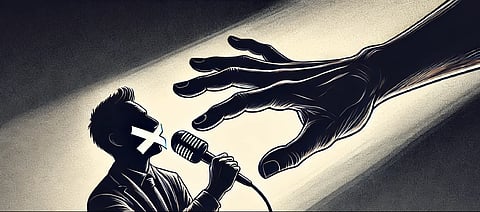


On November 20, the Tamil Nadu Active Producers Association (TFAPA) issued a statement calling for theatre owners to ban YouTube reviews from being filmed from inside the theatre premises. This came less than a week after Suriya’s Kanguva opened to mixed reviews. The letter blamed such public reviews for the sub-par performance of films such as Indian 2, Vettaiyan, and Kanguva, all released this year, calling such reviews, “personal attacks and the incitement of hatred under the guise of film reviews." Just a year ago, several Kerala-based Film Associations had called for a similar ban of reviews filmed within theatre complexes, a restriction that eventually was not implemented.
This statement adds to the long list of ways the film fraternity has sought to curb or control reviews and public opinions about films once they have been released. Just two days before this statement was released, actor Jyotika posted on Instagram, calling out negative reviews of Kanguva. Terming them the work of “multiple group propagandas”, she, however, admitted that she too felt the shortcomings of the film’s first half-an-hour, and its jarringly loud sound design. She wrote, “I’m surprised with the negative reviews from (the) media and certain fraternities, as it’s not done by them to this high level for the most unintellectual big-budget films I have seen earlier with age-old stories, where women r stalked, double meaning dialogues r spoken and have the most over the top action sequences.”(SIC)
This is not limited to Tamil movies alone. The makers of Kannada film Martin are said to have issued copyright strikes against YouTube reviewers uploading negative reviews of the Dhruva Sarjun action movie. Other creators were sent email notices demanding the removal of such reviews from YouTube altogether.
One such strike was issued against Anmol Jamwal, who runs the YouTube Channel Tried And Refused Productions. The thumbnail of his Martin review read “worst movie of 2024.” In response, he took it down. Jamwal admits to not having experienced a similar situation with Hindi reviews, although he feels that the opposition to film reviews is widespread. “ Hindi film producers, however, have struck down videos that reveal spoilers way too soon after a film’s release, but I have not seen filmmakers in Mumbai use legal grounds (to remove) content that is strictly (restricted to) speaking about the film itself. The Martin situation was so blatant that representatives of the film literally said they would do anything to protect their film. What am I to say or think if there is such a brazen use of influence, not realising the laws of fair use are at play on YouTube? That’s the most frustrating part because there’s a clear lack of knowledge on the part of filmmakers or producers wanting to censor opinions on the basis of YouTube copyright law. All opinions get clubbed under ‘hate’.”
Not too long ago, actor Salman Khan filmed a defamation case against Kamal R Khan for his negative review Radhe (2021). In the Malayalam film industry, producers angered by negative reviews Mammootty’s Turbo (2024) sent copyright strikes to YouTubers whose video thumbnails displayed even the film’s posters. And in the Hindi film industry, Karan Johar’s Dharma Productions issued a press release stating that it would no longer host press screenings to avoid “paid” reviews.
In November 2023, the Kerala High Court issued a directive preventing reviews from being published for a period of seven days following a film’s release. This was in response to a plea submitted by Aromalinte Adyathe Pranayam director Mubeen Rauf, who had the backing of the Producers’ Association. It eventually didn't get implemented. Later in January, the High Court even mooted the idea of a dedicated portal on which both producers and the public could upload complaints against malicious film reviews online. All of these are just a few recent examples highlighting the many ways in which filmmakers have been on the front foot to curb reviews in all forms.
How do film reviewers deal with violence and harassment? Recently, Kerala-based online reviewer Unnikrishnan T.N had to deal with threatening phone calls on two occasions. One involved a film’s director verbally abusing him, culminating in a death threat. Just last month, he received a call from the producer of another film, who then made similar threats. On both occasions, he decided to publish call recordings of the threats.
He also promptly filed police complaints. “It took 16 visits to the police station for a case to be registered against the film’s director. Filmmakers are more often in a position of power and they feel that they can use their means to stifle voices against their film,” he says.
But this doesn’t explain the rise in such attacks against reviewers, even though film criticism is as old as filmmaking itself. More than the impact of such reviews on the overall box-office collection, there is another reason for such reactions, says Unnikrishnan. “It has also got to do with the OTT market. If you’ve noticed, there are films in theatres playing without anyone in attendance. But if you check on booking apps, you’ll see that one row of seats has been booked. This is done by the producers so that they can play the movie in theatres for long enough to be able to start pitching it to an OTT platform.”
He adds that OTT platforms today are aware of such manipulative tactics and have a list of trusted reviewers whose videos they watch before purchasing a film. “If reviews from such creators are negative, it affects the sale or the price of the film. That’s why producers feel the need to be so defensive against reviewers. It’s purely business.”
Another reason, Unnikrishnan cites, is the rise of middlemen who promise positive reviews. “These are guys who take money from producers, saying they’re close to all the popular reviewers. If our review is positive, they say it’s their doing. And if it’s negative, they claim that they tried their best to keep it moderate.”
“Reviews are different from critiques. There are reviews that veer towards the personal, which include statements like, ‘I did not expect you to do such a character’,” says actorParvathy Thiruvothu, speaking ahead of the release of the film Her. “In a critique, you comment on so many aspects, such as the making, and you place the film within the pop-culture scenario. As a critic, you will have your own take on how this film will push pop-culture forward. There is real science and education that goes into critiquing a piece of art. But reviewing is something mixed up witha lot of things. At the end of the day, if it seems like it is deliberately ripping apart a film, you can see through it. That is obviously uncalled for.”
Unnikrishnan agrees, adding that an element of competition has made reviews “extreme”. “Since it is now reasonably lucrative to become a reviewer on YouTube, we see new ones popping up with each new film. With so much competition, a creator feels that the most extreme or the harshest review will be the easiest way to build an audience. This has resulted in newer creators who bring down the quality of the discourse. In some, they go so far as to tell filmmakers to never make movies again.”
But why is there such a need to tackle reviews instead of accepting it as part of the business? “I genuinely think that this censorship or the need to curtail opinions online all stem from a clear lack of confidence with their own content,” says Jamwal. “I see filmmakers and producers saying that reviewers are irrelevant and that the audience is king, but why would they feel the need to censor reviewers if we are so irrelevant? It’s been rather frustrating because they are quick to appreciate the audience and repost our reviews when they are favourable, but have zero room for introspection when provided with constructive criticism.”
With the awareness only increasing among audiences and with strong opposition against such forms of censorship, will filmmakers finally become more tolerant of reviews? “I think this is only going to get worse and will further widen the gap between filmmakers refusing to evolve and an audience that now clearly can observe that they are playing ‘catch up’. I hope it’s not the case though,” he adds.
Unnikrishnan, though, is more hopeful. “The harshest reactions are usually from people who have refused to change with the times. A new director coming up today is aware that reviews are part of the business. Amidst all the noise, one shouldn’t forget that there are also directors and producers who take reviews very seriously and use them as an opportunity to improve. They know we are not against them, and that we’re all in this because of our mutual love for cinema.”