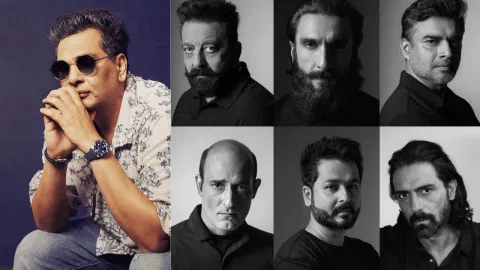


Casting director Mukesh Chhabra is currently experiencing deep joy and gratitude. Catching him after the long weekend, post the storming release and reception of Dhurandhar: The Revenge, there is a palpable sense that the film marks an important moment in his career. “It took me 20 years to reach here, after doing over 300 films,” Chhabra tells THR India.
When he began working as a casting director, in Rang De Basanti (2006), the job profile was nascent. Previously, directors would cast for their films, their assistants auditioning prospectives, decisions made and discussed in Cafe Coffee Day. “They used to cast the same three people in every film—same villain, same right hand, same mother, same sister, same driver. Now the audience gets to see so many new actors and faces,” Chhabra notes.
The rise of the casting director coincided with the rise of realism and the presence of tier-two and three cities in Hindi cinema—accents, faces, comportment that was in tune with the milieu and place of the films became a categorical necessity.
Initially, it was directors like Vishal Bhardwaj, Rakeysh Omprakash Mehra, Hansal Mehta, Anubhav Sinha, Rajkumar Hirani, Imtiaz Ali, and Anurag Kashyap who made use of Chhabra’s intuition and insight.
“But now, every single director in Bollywood, even the big directors making commercial films, has a casting director,” Chhabra notes, having worked on films as small as Chiller Party (2011) to the upcoming tentpole releases King and Ramayana. He is one of the first persons to come on board a project, after the writer, producer, and director.
Today, over 70 people are working in his company, scouring local theater groups, Instagram, Facebook, local acting and film schools looking for the next breakout star. Besides, thousands of people walk into his office every day in pursuit of a part, however peripheral. “We keep recording data. But I only focus on a film once I get a script. I personally don’t find talent through Instagram,” Chhabra notes.
A member of Casting Society of America (CSA), he has long rallied for reframing casting as an artform that deserves recognition in its own right. Along with names like Shanoo Sharma, Nandini Shrikent, Shruti Mahajan, Parag Mehta, Kavish Sinha, Abhishek Banerjee, and Anmol Ahuja, casting has increasingly become imperative, and not merely incidental, to storytelling in India.
This year, the Academy Awards finally recognised casting as a category. Chhabra is waiting for India to catch up, “I hope in our country, more people take this job seriously, and I hope the National Award people also pay some attention to our work.”
Chhabra and Aditya Dhar, the director of Dhurandhar, met when they were ADs, and became quick and close friends. Impressed with Dhar’s script, he started shopping around for actors. They used references of the real life people on whom the film is loosely based, but soon hit a roadblock.
Casting for Rehman Dakait, the leader of the Baloch gang, for example, was particularly difficult. An important character and delicious villain, he disappears after the first part. “We were discussing so many actor’s names for the film, but the actors kept saying no, because they didn’t want to be part of an ensemble film.”
The physicality of these actors Chhabra was considering would have been perfect for the role, he notes, “Sometimes you don’t have to create a look for an actor,” hoping the actor slips into that character the way they walk into a room. But to every actor, every role, their own destiny. After the film’s release, he got calls from all the actors who rejected the part, dripping in regret.
“Akshaye Khanna’s name came towards the end. Akshaye has this capacity—give him anything and he will surprise you. When I first called him, he said, “Are you mad?” But I told him to just come at least and hear the story. He came and after the narration, looked at me and said, “Fantastic!” in that typical way of his. Within the day he called and confirmed he’s doing the film. It was that quick,” Chhabra notes.
Madhavan, too, was a mere call away, “I had known him since the Rang De Basanti days. I told him, trust me, I am doing this film, and we need only 10-12 days from him. He was shooting for De De Pyaar De 2 (2025) at Mehboob Studios. Aditya [Dhar] went to the studio to meet him, and he called me within an hour, and said he is fantastic—a great actor. Madhavan, too, immediately said yes. He brought an authority to his performance. There is no action. He speaks calmly, and never loses his control.”
A lot of Chhabra’s stories involve actors trusting his instinct to come and audition or listen to a narration. Shefali Shah, too, heeded his advice. Chhabra was struggling to cast the lead role for the first season of Delhi Crime. “Every single actress I went to said no,” Chhabra remembers. The director, Richie Mehta, was from Canada, and did not know anyone. Besides, there was no streaming platform attached to the show. It was sold to Netflix much later. But Chhabra called Shefali and requested her to hear the story, an important one, “Shefali immediately understood and agreed.”
Chhabra is no stranger to challenges. Casting Munni in Bajrangi Bhaijaan (2015), for example, was especially hard, “Aisi ladki dhoondna tha jise poora Hindustan pyaar kare,” (I had to find a girl whom every Indian could love) Chhabra notes. He auditioned over 700 kids for that. “My brief was to break Masoom (1983) ka Jugal Hansraj, honestly,” he laughs.
Kai Po Che, too, was a difficult assignment, because the film was mounted on three fresh faces—Amit Sadh, Sushant Singh Rajput, and Rajkummar Rao. With OTT, these pressures are less, even as the scope of acting has magnified, “I have no pressure to cast a bigger star for a show, I only think of the character. I have a free hand. If Scam 1992 was a film I would not be able to cast Prateek Gandhi in it,” Chhabra who has also cast for shows like Family Man, Delhi Crime, Maharani notes.
Chhabra has a unique perspective on casting. When asked how he distinguishes good acting from good casting, he responds, “I don’t think about acting. I only think about casting for my character. If the acting is not that great but the actor is correct for my part, I will go with that actor.” The challenge, then, is to find actors aligned enough to inhabit characters, as opposed to actors talented enough to reach characters.
With Dhurandhar Chhabra expanded the challenge. “I wanted to cast every single person whoever is on screen, whether for a scene or dialogue. That was my request to Aditya. My eight assistants and I spent 2 years auditioning and casting over 300 people for the film.”
Sara Arjun was found through this process of auditioning. She was one among a thousand auditions for the role. Chhabra was looking for a face that was untouched by any baggage of previous films. “When I saw her audition, I went mad. The scene in Dhurandhar: The Revenge, when she confronts Ranveer Singh about being an Indian agent was her audition scene,” Chhabra notes.
It is the joy of discovery in his voice, and in having discovered, being celebrated. People are asking him what his next project is, looking forward to what fresh face he is going to push into the limelight. It is a question often asked to directors or writers. The ambit, though, has expanded.