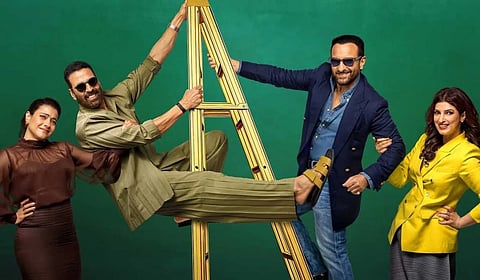


Oh, thank god, that fetid opening “food section” has been lopped off the proceedings of the talk show Two Much—where the two hosts, Twinkle Khanna and Kajol, would stand with their guests in front of a table of food that looks like the sad, last croissant in the closing hour of a cafe, puffed up to look half-French, sealed in stale air-conditioning. Where are the food stylists? The beetroot salad in the last episode, with Alia Bhatt and Varun Dhawan, was colour corrected to the shade of Vanish detergent—a missed sponsorship opportunity.
I get the intention—of food being so formative to our idea of hosting people at home, that the talk show wants to borrow this tradition to Indian-ize the globalized format. But offering food is not supposed to be this prim and performative, stiff and stifling—it is relentless, shameless, and ultimately joyful. Kajol complains of standing in heels at the grazing table. Food should feel comfortable.
The guests, though, just look around the food and wonder if, perhaps, their tightly wound, precisely built body is worth the rudeness of telling the hosts—no. Bhai did it, few others can. “Do I have to eat the almond, or can I just pick it up?” Bhatt wondered in the previous episode.
In the latest episode, with Akshay Kumar and Saif Ali Khan, this segment has been axed. They get right into the conversation—which is really a strand of themes forcefully constellated into one show. You can see how they shift uneasily, quickly, awkwardly from one topic to the next. You can see the laundry list of topics running on the heads of the hosts. Where is the presence—that ephemeral thing that makes conversations sing?
Marriage takes up central space in the episode, naturally, but also, tiresomely. At a distance, everything can be made to feel coherent. What can be said of marriage from a bird’s eye view that is worthy of airtime? The same platitudes—sexist, dull—are retreaded, the woman is always right; always pretend like you are listening to your wife.
It is nice, though, to see the various ways in which marriage has manifested. Either as mentorship—“she brought you up well,” Kajol shrieks about Saif’s first wife, much older than him; or sportsmanship—Khanna lays out a blueprint, “Love has very little to do with marriage. It is a good starting point. But marriage is about being a team.”
In what I suppose is the cash cow of this episode, Khan goes into the details of the infamous break-in and stabbing he endured to protect his kids. Akshay Kumar speaks of the humble background he came from—cramped in a room in Chandni Chowk. They speak of cinema in the 1990s. “Chand pe jaa raha hai kya?” a stuntman asked Kumar when he wore knee and elbow pads from America to an action scene, a kind of joyful recklessness that is missing in cinema-making today. When the guests are allowed to stay close to life, and not abstract away from it, the show finds its footing. For these are men who have lived full lives. Of what use is a summary? A summation? Anecdotes, not analysis, is fodder.
The fundamental problem with the show is that it is unable to figure out who is asking the question, and who is answering it. Sometimes it refuses the distinction between a comment and a question—one bleeding into the other. But primarily, the distinction that the talk show hosts make, between asking a question whose answer they already know, for the sake of the audience, and asking a question that they are genuinely curious about, for their sake, cannot be seen. It all feels synthetic, perhaps because Kajol does not have the curious personality of an interrogator, but her laughter resonates; or Twinkle, on the other hand, who has her arsenal of one-liners and metaphors to rip out as quick, witty asides, and rushes through questions as though it is a chore.
I suppose both Khanna and Kajol, taking upon themselves the mantle of womanhood, bring up the topic of ageing, asking the men if they worry about it, the way women worry about, say, menopause. Quickly, the question turns. Is it that men worry about their own ageing, or their wives ageing? Kajol thinks the question is the former, and Khanna, the latter—and neither are truly discussed. The point of this segment is, merely, to have it. How else to differentiate a talk show with two women at the helm? It is so patronizing, and I would be more furious if I were less bored, which I suppose is the running tagline of the show, thus far.