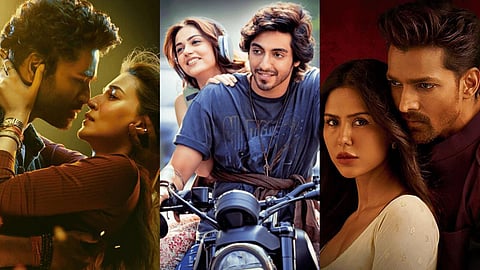


In 2025, the Hindi film audience, particularly younger viewers, showed up for love stories that... hurt. While the year was dominated by extremes, from the thunder of Dhurandhar to the public stumbling of War 2 and Sikandar, running parallel to the chaos was a streak of emotionally charged, angsty love stories that leaned into heartbreak, trauma and music-heavy longing.
Films like Saiyaara, Ek Deewane Ki Deewaniyat, Tere Ishk Mein and the re-release of Sanam Teri Kasam collectively reshaped the conversation at the box-office as they presented a heady cocktail of sad songs, broken hearts, and sold-out shows.
The four films amassed a cumulative worldwide gross of nearly ₹900 crore, with Mohit Suri’s euphoric Saiyaara alone contributing a whopping ₹570 crore. To understand why this shift had been building — and why lighter rom-coms are collapsing—THR India spoke to Shailesh Kapoor, Founder and CEO of Ormax Media, which closely tracked audience behaviour across the genre last year.
"There has been a steady appetite for emotionally intense love stories,” Kapoor says. “What hasn’t really worked is the rom-com template. The light, glossy, multiplex-oriented romance that borrows heavily from a Western grammar.” Kartik Aaryan and Ananya Panday’s youthful rom-com Tu Meri Main Tera Main Tera Tu Meri, for instance, is headed for a disappointing finish, folding under ₹40 crore.
Among last year’s biggest success stories, Saiyaara stands slightly apart. Led by Ahaan Panday and Aneet Padda, both landing a dream Bollywood debut, the film emerged as the highest-grossing romantic title of Hindi cinema ever.
“Saiyaara is actually a softer film compared to the others. But it shares a thematic commonality — the protagonist going through heartbreak, emotional conflict, and personal loss. That emotional spine is what connects it to this broader trend," Kapoor notes.
That connective tissue—emotional vulnerability rather than escapist fantasy—also defined Milap Zaveri’s Ek Deewane Ki Deewaniyat, starring Harshvardhan Rane and Sonam Bajwa, and Aanand L Rai’s Tere Ishk Mein, fronted by Dhanush and Kriti Sanon. Both films posted strong theatrical numbers, particularly in Tier-2 and Tier-3 markets, with combined global grosses estimated at ₹280 crore-plus.
Kapoor argues that this moment didn’t come out of nowhere.
“When the JioHotstar show Thukra Ke Mera Pyaar worked so well on streaming in 2024, despite being a small-budget show with no fancy locations, it was already telling us something. Then Sanam Teri Kasam doing well again only reinforced the idea that audiences were missing this genre,” Kapoor notes.
At the heart of it all looms the long shadow of Kabir Singh. Released in 2019, the Sandeep Reddy Vanga-directed film rewired mainstream Hindi romance by pushing it into messier and what the industry calls “edgier” territory. The Shahid Kapoor-Kiara Advani starrer was rewarded with a staggering global box office of over ₹380 crore.
“The principle is the same,” Kapoor explains. “You’re looking at male protagonists who are broken, volatile, emotionally exposed. These love stories don’t necessarily end well, or they pass through trauma before finding any resolution. Young male audiences, especially, connect deeply with that.”
If one looks at the kind of music that has worked over the years, Kapoor notes, they are very "Vishesh Films-Emraan Hashmi" coded. “In those songs, heartbreak was always central, even when the films weren’t strictly romances, the music carried that angst.”
In 2025, film soundtracks became a genius new-age marketing tool. Songs from Ek Deewane Ki Deewaniyat and Tere Ishk Mein lived on reels for weeks before release, embedding themselves into youth culture long before the opening day, he adds.
“Music has become a part of the narrative ecosystem. When a film targets youth, and the music clicks, you see it translate directly into strong first-day numbers.” That explains why these films opened aggressively, even as more family-oriented titles took time to grow. According to Kapoor, the geography of Hindi cinema has also shifted post-pandemic.
“Dependence on Mumbai and Delhi multiplexes has reduced. Smaller towns, single-screen markets like UP, Bihar, Rajasthan and Madhya Pradesh are contributing significantly now — and this kind of content works very well there,” Kapoor notes.
The irony, perhaps, is that while rom-coms once dominated the urban imagination, it’s heartbreak that now feels more universal. As Kapoor puts it, none of these films have yet reached Kabir Singh levels in terms of music or storytelling. “But if something really solid comes along, there’s no reason a film in this space can’t do ₹500–600 crore.”