

Animal’s Rannvijay, Kabir Singh’s Kabir, Rockstar’s Jordan, Tamasha’s Ved and Haseen Dillruba’s Rishu walk into a bar. There is no punchline here, because they are no joke. They participate in a victimhood-measuring contest. Rannvijay declares he had to sleep with a female agent knowing who she was and cheated on his wife to make his dad proud; it was very difficult. Kabir claims he slapped a girl to make her love his alpha masculinity; it was very hard. Jordan says he quotes Rumi and chose to meet his dead soulmate in a field beyond; it wasn’t easy. Ved claims his girlfriend fixed him by rejecting his alter-ego; it was terrible. Rishu declares he chopped off his hand to be with his bad-boy-craving wife; it’s been a sacrifice. In walks Tere Ishk Mein’s Shankar, who lights a cigarette and scoffs at them all.
Shankar says — and he speaks painfully slowly — that he has taken revenge for Raanjhanaa’s Kundan, his infamous brother from another mother who died for being a romantic stalker. Shankar claims that this time, the girl also pays the price for refusing to reciprocate, for trying to change his DNA, and for ‘leading him on’ under the pretext of an educational experiment. He is a true martyr to the cause. The others cheer and clink glasses. Ek Deewane Ki Deewaniyat’s Vikramaditya enters the bar and screams that he won over his hater by guilting her with his suffering and generosity, but nobody pays heed. They barely recognise him. Saiyaara’s Krish enters but everyone mocks him for being a soft-boi rockstar who devotes himself to the girl’s story instead. It is after all Shankar’s world — and we’re just cringing in it.
I’ve always thought that director Aanand L. Rai and writer Himanshu Sharma’s ideas about the transformative powers of love are hit-or-miss arrows in the dark — provocative, unhinged, wild, conceptually shameless even, but never uninteresting. A mentally ill girl’s imaginary ex is actually her father? Sure. A dwarf flies to Mars as atonement? Why not. Hate it or be perplexed by it, you cannot ignore it. But Tere Ishk Mein is the kind of movie that needs a restraining order. Even its restraining order needs a restraining order. Its one-sided love is an aesthetic; violence is an aesthetic; male entitlement is an aesthetic; female agency is an aesthetic; madness is an aesthetic; patriotism is an aesthetic; spirituality is an aesthetic; smoking is an aesthetic; death is an aesthetic; you are an aesthetic. I admit that, as a man who romanticises pain as an expression of love, I have inherent blind spots. I can get swayed, despite the film-critic brain warning me not to. But the film is such a non-surgical strike on wokeness, feminism and counterculture that not even my gender identity can fool me anymore.
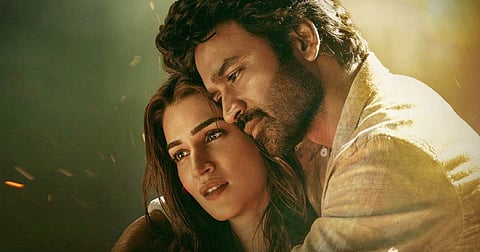
The story does everything to normalise cuckoo. Shankar (Dhanush) is a Tamil student in Delhi with anger issues. His superpower is that he gets arrested but nobody files an FIR against him; this isn’t a movie where FIRs are filed, even if he later burns down the lawns of the Joint Secretary himself. Mukti (Kriti Sanon) — meaning ‘salvation’ — is a Ph.D. student whose 2200-page thesis explores male rage and violence as something like an appendix that can be removed from a body. This is the saner part, mind you. When she sees Shankar on campus, she decides to use him as her guinea pig. The stakes: if she successfully “cures” his rage and turns him from animal to human, she will get her degree. Animal agrees, but what she pretends to be oblivious to is the fact that our man chooses to follow Gandhi’s path (during a riot, he lets a driver slap him back — cue thesis signed) because he falls for her. He changes for love. The implication is that she is exploiting his poor, middle-class manhood.
At some point, she takes him to a hotel, strips and agrees to have sex with him as compensation — he refuses like a good animal, of course, because his line “You’re ready to shed your t-shirt for work, but I cannot shed my shirt for love” is meant to elicit claps from a testosterone-filled cinema hall. (Is it ever lust if it disregards consent and still manages to be ‘sanskari’?). I did hear some happy sighs behind me. It could have been the sound of my soul leaving my body, but I can’t tell. Manic-pixie Mukti is made to string along a madman for a thesis that’s not half the potshot at the criticisms of Bollywood masculinity that it thinks it is. This is just the first half.
The film enters Dhadkan mode after that, when humble Shankar decides to prove that he’s worthy of marrying the rich girl. There’s a random UPSC-exam montage that might give 12th Fail an existential crisis. When he doesn’t get what he wants, the screenplay insists that it isn’t his fault. Nothing is. The logic being: why would you let a beast taste blood and expect him to alter his primal instincts? The hell he causes then is shown to be his genetic birthright, never mind the bizarrely tone-deaf scene of Shankar crashing her wedding and pouring holy water on her face from an acid bottle. Subversive is not the word. Religion suddenly enters the chatroom, as does national pride; there’s a parallel present-day track of best Indian Air Force pilot Shankar needing counselling from a heavily pregnant Mukti in a twist of fate. It’s all on her, again, because if she doesn’t sign his release form, she is denying the country their best pilot in an escalating war against not one but two enemies. India needs her to succumb. There’s a cameo in Varanasi, too, that unfolds in a Raanjhanaa multiverse nobody asked for. That controversial AI-generated climax letting Kundan live has nothing on the entirety of Tere Ishk Mein, which seems to have been conceived to teach everyone that nobody can love like violent and weepy incels.
The thing about Tere Ishk Mein is that it’s not even fundamentally sound. It is detached from the (civilised) world we live in as well as the grammar of storytelling. At some point, when Shankar is carrying a bleeding Mukti to the army hospital, a colleague casually tells him to get her to sign the counselling form because they need him; never mind that she’s almost comatose in his arms. I won’t even get into the security detail at her bureaucratic father’s South Delhi bungalow; Shankar waltzes in and out so often during the film that it’s natural to assume that her dad has a humiliation kink. Such strange staging and detailing count on the viewer to suspend disbelief and submit, but it urges us to suspend sense and comply instead.
Whatever the role, Dhanush rarely delivers a dull and misguided performance; that streak breaks today. His Shankar is so busy milking every ounce of sympathy in a misogyny-wired setting that the character does not register as human. Now you’ll say Shankar was supposed to be an ‘animal’ anyway; if that’s the literal case, where are the whiskers? Why is every growl so stilted? Is love his cage or his tetanus shot? Kriti Sanon’s Mukti brings to mind a Kanika Dhillon-written character. She smokes and drinks a lot so she must be capable of betrayal and self-punishment. There’s a stretch of film where she’s pregnant, drinking, married, sick and regretful enough to ask Shankar to father her baby? I didn't mean to end that sentence with a question mark. It just happened.
If you wonder how Shankar became a pilot after passing his UPSC prelims, keep wondering. The 169-minute film may or may not have an answer. A.R. Rahman’s music tries to go the Mohit Suri-soundtrack way, but you can tell it’s working overtime to sell the deranged premise. “I hope you realise that those who die for love are also somebody’s sons” is not quite the big-screen flex in an incel-infested landscape. The narratives of young men (and women) having to prove their loyalty by bleeding are designed to evoke the doctrines of faith and mythology. The gods must be crazy, though, if a quirky song compares the hardships of passing a government exam to the hardships of “getting a girl”. Sometimes there is no redemption, especially when a film burns itself to a crisp and asks us to worship the funeral pyre. Ironically, I’m struggling to stay calm about a protagonist whose anger issues are never cured. Taking deep breaths right now would be great in theory, but tell that to the AQI — the air today is almost as poisonous as the air-conditioned halls we seek refuge in.