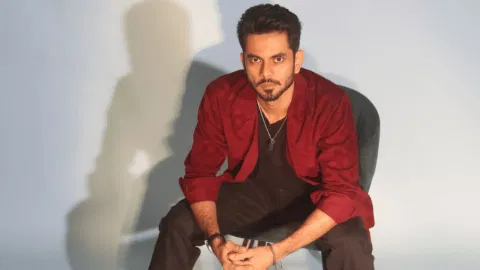


In his early 20s, Aditya Rawal’s life resembled the interval point of a film. He stood at a crossroads, torn between two things he loved deeply: football and cinema. Both promised possibilities, but one called louder. Choosing meant letting the other go. Rawal chose acting over the goalpost and some of that past still bleeds into his performances today. Raw, hungry, and a chameleon on screen, he carries the residue of that decision with him.
“The first two or three years were heartbreaking. I was a goalkeeper and the other goalkeeper in that setup was Gurpreet Singh Sandhu. Today, he’s the captain of India. Imagine watching someone you played alongside go on to play in Europe and captain the country while you’re starting a completely new field!” laughs Rawal as he looks back on the journey that eventually led him to Bamfaad (2020), Faraaz (2022), and two breakout performances this year in Prime Video’s Daldal and Subedaar.
Born to actors Paresh Rawal and Swaroop Sampat, Aditya grew up surrounded by films. His grandfather loved Alfred Hitchcock, while his father was a fan of the Coen Brothers, and their films were almost always playing at home. Such was his grandfather’s passion for cinema that, Aditya says with pride, he learned Bengali in his thirties just so he could properly watch the films of Ritwik Ghatak and Satyajit Ray.
“So that was the ecosystem I grew up in,” he says, adding that his movie diet also included Indian classics — including his father’s National Award-winning Sardar (1993), which shaped his early understanding of cinema.
In an interview with THR India, Aditya Rawal talks about growing up around cinema, navigating the realities of the industry, and why writing and theatre remain central to the kind of artist he hopes to become. Edited excerpts.
What’s your headspace like right now, with Daldal and Subedaar out and people discovering your work?
It's very gratifying to know that you’ve done a good job in something that’s connecting with people. When I first took up the part in Daldal—after the auditions and everything—I was a little scared. These kinds of roles can go really wrong. But I trusted Amrit and Suresh sir completely. Daldal was the most difficult character I’ve played—it’s so dark and disturbing. Subedaar was just as challenging but it was the most fun I’ve had on a set. Watching people like Anil Kapoor and Suresh Triveni work is incredibly inspiring. Their passion and hunger to prove themselves—even after everything they’ve achieved—is unbelievable. Not once did I feel tired on that set. If I did, I’d just look at them and the energy would come back.
Your debut film Bamfaad came out in 2020. How would you describe the last six years?
It’s funny to think about. For the most part it’s been gratifying. I’m admittedly not very good with PR. My social media presence barely exists. So while the huge public recognition might not always be there, what I’ve had is appreciation from people whose opinions I respect—people I’d love to work with. Sometimes those conversations turn into opportunities, sometimes they don’t because the money bags don’t think it’s viable. But that’s part of the process.
Overall I’ve stayed very motivated. Of course there are peaks and troughs. There are moments where you feel on top of the world and then moments where you’re like, “Yaar, phone baj kyun nahi raha hai?”
But I have writing and theatre. I always have something to wake up for. I remember a joke: why don’t actors look out the window first thing in the morning? Because then what will they do for the rest of the day! That problem I never had. I genuinely enjoy telling stories—whether as a writer or actor, on stage or on film.
You’ve seen the ups and downs of the industry closely at home through your parents’ careers. What did you learn from that?
From my father, I’ve learnt to put my head down and keep working. From my mother, the same thing—but you can do it with a smile on your face.
In the ’80s my father had a great start. In the ’90s he was still doing good work and getting appreciation, but often doing things he wasn’t passionate about. At the same time I could see the passion he put into theatre. He always filled his time with either something that would run the house or something that gave him creative satisfaction. Seeing that made me realise it’s all about the work.
The other thing about him is that he’s never been enthralled by the trappings of fame or power. Even when he was an MP, he let go of privileges people normally crave. The less you want, the more powerful you are. If you’re not bothered about the frills, it’s only about the work. That’s what I learned from him.
Does growing up in that environment keep you grounded?
I suppose so. People talk about nepotism, but our biggest advantage is that we’ve seen the process up close. We know everything is temporary. Most of it is noise. My father cuts it out completely. I don’t think you can afford to do that today—you have to be on Instagram and things like that. It’s marketing. If you’re good at it, great. My job is to maintain my mental sanity and learn how to deal with it.
Even when some of your projects were not releasing, many filmmakers, including Hansal Mehta and Anurag Kashyap, spoke highly of you. What does that kind of validation mean?
It gives you immense confidence. It’s not like your life changes overnight and you start feeling like you’re flying in the sky. But when people whose work you admire—people you grew up watching—say that you’re doing good work, it means a lot. I grew up watching Hansal Mehta and Anurag Kashyap’s films. So if they say “isko kaam aata hai,” that’s the biggest validation.
In fact those names you mentioned have also given me opportunities. Bamfaad was presented by Kashyap sir. Suresh Triveni and I met during COVID and started writing something together before Daldal happened. There are many such moments. Sometimes a director hears about you through a casting director, sometimes someone has seen your work somewhere. You just have to be patient. If it comes, great, if not, I will focus on theatre!
When did you realise you could be an actor? And does the writer in you ever clash with the actor?
There’s never really a conflict. They go hand in hand. After spending months on set—hair, makeup, being around a hundred people—I crave the opposite: waking up, sitting at my desk and writing. Being an actor makes you a better writer and vice versa.
I always knew I could act. I did school plays, theatre in college. But while I was playing football seriously, I started writing a lot. I thought I’d mostly be a writer—screenplays, plays, poetry—and occasionally act.
I was around 18–20 when I started writing seriously. I loved the process: thinking about stories while walking, hanging out with friends, constantly building narratives in my head. I also got the right kind of feedback, from my parents and from people like screenwriters Abhijat Joshi and Soumya Joshi. Nobody said, 'Waah kya screenplay hai.' They just said, 'you have something, keep working.' For an 18-year-old, that’s the right motivation.
What was the first film set you remember being on?
The first real set experience I had was Oh My God in 2012 (starring his father). I was basically a glorified intern for one schedule! It was enough to make me realise I didn’t want to be an assistant director. I’d rather write. Growing up, though, most of my exposure to my parents’ work was through theatre rehearsals, not film sets.
You also wrote two films your father acted in. What was that experience like?
Yes! Jo Tera Hai Woh Mera Hai (2024) and the Gujarati film Dear Father (2022). One was based on his play, so that was already written. The other was something I wrote when I was at NYU. Seeing something you wrote as a student eventually get made was amazing, even if it didn’t have the ideal release circumstances.
Working on it deepened our relationship. The banter was still there, but it was lovely collaborating on something in depth. You also learn that making a film is not just about writing or acting—it’s about navigating personalities, relationships, and processes. Knowing when to say what matters a lot.