

AI generated summary, newsroom reviewed
Yashasvi Juyal’s debut feature, The Ink-Stained Hand and the Missing Thumb, premiering in the competition section at the Karlovy Vary International Film Festival was meant to be the pilot episode of a Netflix series.
Juyal was part of Netflix’s Take Ten cohort, receiving a grant from the Netflix Fund for Creative Equity to make a fully funded pilot for a potential series.
“I was inspired by the pilot of Twin Peaks by David Lynch. The pilot was a standalone feature — and it premiered at Telluride. During the mentorship program, Varun Grover even said that the pilot need not just be a 30-40 minute episode, but it can be a standalone IP. That really inspired me,” Juyal tells THR India.
After the pilot was made, left to his own devices, Juyal decided to re-sculpt it into a feature film, with additional grants from Visions Sud Est, Red Sea Fund, and Hong Kong. At the Red Sea Film Festival, he was even mentored by Spike Lee who sat with the film and shed feedback. At Doc Producing South, Juyal pitched the film to Shaunak Sen who came on board as Executive Producer.
There are also a bevy of producers — Bhavna Kankaria, Neha Kaul, Sharib Khan Vikas Kumar, and Viraj Sikand. “The film was only possible because of the support, because they believed in my voice,” Juyal notes. It is a distinctive voice dripping in montane ennui — shots that are in no urgency to arrive at their meaning; cuts that are in no urgency to usher in subsequent meaning; conversations that taper out without resolution; images that linger, watching characters smoke till they reach the stub of their cigarette.
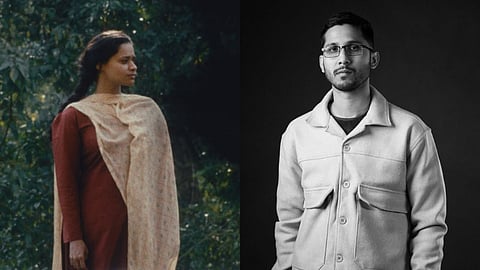
Set in 2003, The Ink-Stained Hand and the Missing Thumb follows Santosh (Dheeraj Kumar) and Rajji (Bhumika Dube), lovers who work at a highway toll booth. Rajji is not only obsessed with the television science programme anchored by Professor Pluto (Sudarshan Juyal) — inspired by Doordarshan’s Brahmand: The Universe, she also wants to find a way out of this town, while Santosh is content with the slow inertia of a life barely leaving behind its imprint. Santosh’s sudden and shocking demise corrodes the film’s slow drift, as does his miraculous return from the maws of death, pushing the film into knotty questions of the science and mythology of afterlife and of time’s relative flux.
“I have seen Dehradun shift in its urban sprawl immediately, from 2018-2026, the town has now slowly merged with Delhi, like a cross-dissolve in the edit,” Juyal notes. He wanted to preserve the memory of Dehradun in the early 2000s, “It was slow, humorous, poetic, but political at the same time because Uttar Pradesh and Uttarakhand got separated, and these highways came, carved out of rural spaces. These villages changed, aspirations shifted.”
Shot by Dipesh Manral in 4:3 and colour corrected by Mahak Gupta, the film’s square-ish images are as nostalgic as they were necessary. Juyal could not shoot wide without letting the recent urban sprawl enter his image. Manral and him, instead, decided to keep the image a controlled square within which ennui could unfold like vapour.
Juyal’s previous short films include The Last Rhododendron and Rains Don’t Make Us Happy Anymore. Flitting between Dehradun and Delhi, he now triangulates between the two cities and Mumbai, where his brother, the actor Raghav Juyal, too, is based.
The Ink-Stained Hand and the Missing Thumb premieres on July 9th.