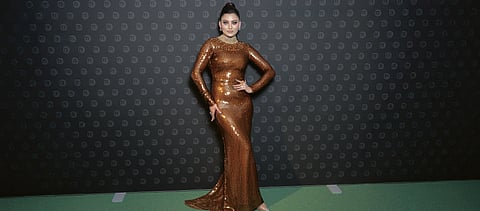


In an industry where image is everything, Urvashi Rautela seems refreshingly — or perhaps recklessly — oblivious to the art of self-censorship. Over the past few weeks, she has become a lightning rod for Internet chatter, by making statements that have veered from candid to controversial, from amusing to absurd. Her comments, often delivered with an unwavering confidence, have been dissected, made into memes, and shared with an almost gleeful enthusiasm.
But here’s the thing — Rautela doesn’t seem to mind. In fact, she insists that there’s no strategy behind her statements, no deliberate attempt to grab headlines. She’s just being herself.
Edited excerpts from a conversation:
You've garnered a lot of buzz in the entertainment industry. Can you talk to us about three key moments or turning points in your career?
If I have to pinpoint three significant milestones, the first would be my transition from winning Miss Universe India to entering films. My first film, Singh Saab the Great — I think that was the moment I realised it's not just about looking good on screen, but also about excelling in the craft. There are so many dynamics involved in becoming an actor. Acting itself is a discipline, and that's what I learned when I did my first film. A lot of realisations came after the film was released. Until then, I wasn’t mentally prepared for whether I would love acting or not.
The second would be when I became a Miss Universe judge. I was invited by Israeli Prime Minister Benjamin Netanyahu, and that was a very significant experience because my family also was with me. It was also special to present the Bhagavad Gita to Prime Minister Netanyahu.
The third would be every time I worked with a superstar in my career — whether it was Hrithik Roshan in Kaabil, Anil Kapoor and John Abraham in Pagalpanti, or legends like Chiranjeevi garu in Waltair Veerayya, Pawan Kalyan garu in Bro, and Nandamuri Balakrishna garu in Daaku Maharaaj. Every time I worked with these superstars, I understood why they are legends. Their experience and dedication teach you so much on set. For me, those moments have been incredibly significant in my journey.
The success of Daaku Maharaaj has generated significant public discourse, and you’ve been a big part of it. Your interviews and promotional appearances have been the talk of the town. I’d like to believe that all of this is something you discuss with your team strategically. Can you walk us through what a typical strategy meeting looks like when planning a campaign?
It was very straightforward. We had our grand success meet in Anantapur and another in Hyderabad, where the entire team was present — our director Bobby Kolli garu, the producer, and Nandamuri Balakrishna garu. After that, I returned to Mumbai for the success interviews of Daaku Maharaaj.
It was a very basic lineup of interviews — just like what we're doing now. There was no specific strategy behind them. It was just a natural flow of conversations about the film, my character as a police officer, and celebrating the film’s success.
So, there was no media training involved? You’ve been in this industry for a while — you know that actors receive PR training to avoid controversy. Managers and PR teams advise on what to say and what not to say.
I completely agree with what you bring up. Every actor has managers and PR teams constantly advising them on how to answer certain questions. If you watch many actors' interviews today, you’ll notice how structured and rehearsed their answers are. After a while, it all starts sounding monotonous because everyone is repeating the same responses.
I personally believe that one should be candid. It’s important to express yourself naturally.
So, are you saying you don’t do PR-prepped interviews and prefer candid conversations?
Not exactly. It’s not about rejecting PR-approved answers entirely, but I also believe in being natural and raw with my audience.
The choreography of Dabidi Dibidi has sparked a lot of conversation around the kind of movement and stylistic choices that were made. In a previous interview, you've spoken about how you always want to be graceful. But the criticism for this song is that it is very unrefined or almost violent in its movement.
This song, Dabidi Dibidi... if we really focus on the vocals or the audio part, it is made for Balayya's fans. Every lyric, every sentence, every word is crafted according to their mindset. When you look at my rehearsal clips, everything went really well. It was like how we usually choreograph for any song. I was working with Master Shekar, with whom I've collaborated before — this was my fourth time. So it wasn't like I was shocked or doing something completely out of the ordinary. During rehearsals, everything was smooth and under control.
But honestly, everything happened so suddenly that it's been hard to assess why people are talking about the choreography in this way. We didn’t realise it would be received like this because, during rehearsals, everything went as planned.
Are you saying that the audience's perception is what was surprising for you?
No, I mean the way it was received. How do I explain it? Everything was done so nicely. It's a peppy song; it's supposed to be a massy song. We never expected people to talk about it in this manner. As a team, we truly didn’t anticipate this reaction.
We thought it would be taken positively, and I also read other perspectives about it. But since day one, I have always made sure to keep my identity and professionalism separate. Whatever constructive criticism comes my way, I make sure it doesn’t overshadow my passion and enthusiasm. I always embrace constructive criticism as an artist and remain mindful of my work.
Now that you've received such comments, you will probably be more mindful about choreography in the future?
When you talk about my choreography, it's actually very simple. There's nothing wrong with it. In fact, if you just focus on me in the frame, you’ll see that it's really fantastic.
But when you’re part of a song that has a lot of crass movements; even if you are not doing them, they are still a part of the overall sequence...
Yeah, that's why I said that I always ensure my identity remains separate from my work. It’s important to receive feedback wholeheartedly and not let it overshadow my passion and commitment to my craft.
Recently, you've been seen in quite a few south films. Have you noticed any differences between working in the Hindi film industry and down south?
I started with Bollywood, and now I'm working in the south. For me, both are quite similar. At the end of the day, cinema is cinema — whether it's French, Hollywood, Indian or any region. The style of working is always the same. I’ve also worked with Middle Eastern directors, and it’s the same process. The major difference is that call times are usually 8 to 10 AM in Bollywood, whereas in the south, it's more like 6 to 7 AM.
What about the kind of characters you get to play and the stories being told? In Daaku Maharaaj you play a police officer, but your introduction scene features you doing yoga. On one hand, you’re playing an empowered cop, but on the other, the lensing of that character is quite sexualised. Where do you stand on this?
My stance is that when I sign a film, I trust and believe in my director. When a character is written, it's part of the story’s narrative. As an actor, we can’t interfere too much or dictate how a character should be portrayed. Once we sign a film, we cannot question the director’s vision. Filmmaking isn’t just about my perspective, it’s the director who is the captain of the ship. Their decision is the most important. A director deserves creative freedom, and as an actor, I respect that.
Do you feel you've been typecast, especially in Bollywood? Looking at your filmography, is this the kind of work you want to do, or is it just what’s being offered to you?
There are many roles I want to do, and many genres I want to explore. I started with Singh Saab the Great, where I played a non-glamorous housewife. In Sanam Re, I was given the choice of doing a glamorous or de-glam role, and I chose the glamorous one. In Hate Story 4, I played a supermodel. In Pagalpanti, it was another glamorous role. But in Inspector Avinash, I had a zero-makeup look, playing a simple housewife. I enjoy variety. I don’t want to do just one kind of character, and want to keep challenging myself.
Since you have a glamorous public image due to your pageantry background, do people take your creative input seriously on set?
Coming from a beauty pageant background is a bonus. If you look at Priyanka Chopra, Aishwarya Rai, Sushmita Sen — they are beauty queens and phenomenal actors. Having that background is an advantage. It expands my audience, and I’m very proud of it. It helped me get my first big break.
I want to touch upon the controversy surrounding the watch and ring. Did you follow the memes? Does any of it ever hurt, or do you just take it in your stride?
If I focus too much on it, I wouldn’t be able to do my work. At the end of the day, these YouTubers and meme creators are just trying to make money. They exploit public figures for content, but they’re doing it for survival. Of course, as a human, some things do hurt, but I understand why they do it.
Does it ever make you want to be less candid?
No. I want to stay genuine. I believe in self-love and celebrating my achievements, big or small.
I also want to ask about your comment on Kiara Advani and Game Changer. It created a lot of discourse. Did your PR team ask you to be more careful?
I never made any statement. The journalist asked me a question, and I simply repeated it. The clip that went viral was edited to seem like I was making the statement myself, but that’s not the case. Nobody from my team told me to be careful.
What's next for Urvashi Rautela? More south films, pan-Indian films, or Hollywood?
I don’t limit myself by industry or language. If the script and director are good, I’m in. My upcoming projects include an international single with Jason Derulo releasing in February. Then I have Welcome 3 with Ahmed Khan, Baap which is the Indian remake of The Expendables, Black Rose that is based on Shakespeare’s novel, and Inspector Avinash Season 2.