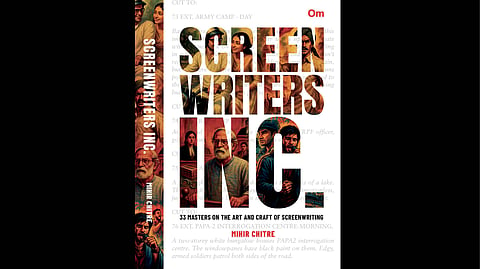


In Screen Writers Inc. - 33 Masters on the Art and Craft of Screen Writing (Om Books), advertising creative and filmmaker Mihir Chitre has assembled something rare: a masterclass in storytelling, drawn from the minds of India’s most compelling screenwriters. From Imtiaz Ali and Shakun Batra to Sai Paranjpye and Reema Kagti, this first-of-its-kind collection pulls back the curtain on the craft that shapes our cinema. What follows is an excerpt from Chitre’s conversation with writer-director Abhishek Chaubey — the architect behind Omkara, Ishqiya, Dedh Ishqiya, Sonchiriya, and Udta Punjab.
Here, Chaubey navigates the terrain between Shakespearean tragedy and noir comedy, unpacking the messy brilliance of screenwriting, the magic of creative collaboration, and the elusive alchemy that transforms a promising idea into cinema that haunts you long after the credits roll.
In writing Omkara, you and Vishal [Bhardwaj] set out to adapt none other than Shakespeare. How daunting was the task?
Look, I read Shakespeare in college because I am a literature student. So, I was acquainted with his work. When I read the first half of the script of Omkara, I was very impressed with it. Because Vishal had not studied Shakespeare in college, and by the time he started adapting Shakespeare, he was never daunted by the idea of Shakespeare. He was very impressed with the basic conflict of the story. And, before Omkara, he had only done one other adaptation of his which was Maqbool which he wrote with Abbas (Tyrewala). Vishal wanted to do another adaptation and the two of us kept discussing it. In his first draft of Omkara, a lot of the mood of Othello was already there. Now, at that point Vishal had a film with Aamir Khan called Mr. & Mrs. Mehta, which imploded in production. Suddenly, he didn’t have a film lined up and had the time to get to this. Around the same time, he met Ajay Devgn, who offered to work with Vishal if he did another Shakespeare. So, it was a nice coincidence of sorts. Now, Ajay only had dates in January, and we were in November. So, I was worried that Vishal had a chance to make a really big film and he hadn’t written anything, and it could all be a mess. So, we had two choices to set the story in. Either DU politics or a western UP gangster film. We decided on the latter, which was closer to what I had in mind.
Omkara had a unique journey, and I have never been able to work like that before and after. We spent a week in Meerut, meeting a few gangsters, and made a note of some wonderful lines, characters, and behaviours. From there, we immediately went to Mussoorie, and with all the data and the world that we had imagined, we wrote the film in eighteen days! That is nuts. It’s insane. But finishing a script like Omkara in eighteen days is exceptional. Our backs were against the wall, and it just happened. If we try it again, I am not sure it will happen. So, this cannot be used as a reference.
How did the journey of Kaminey start? Also, do you agree that Kaminey is one of the weaker films that you have written?
Vishal had once conducted a workshop in Africa and someone had got his script to the workshop, which Vishal had really liked. It was set in the slums of Nairobi. So, when it came to Kaminey, Vishal called up that guy and asked him if his film was made. It wasn’t and Vishal officially bought the rights from him, and we adapted it. That guy is also credited in the film. Well, I wouldn’t say I am too unhappy with the film. I think the last third of the film has a problem. But I am a writer on the film, and Vishal’s vision for Kaminey was different from what he had had for Maqbool and Omkara and those films. With Kaminey, he wanted to have fun. It was never supposed to have the seriousness of those films. Also, he wanted to explore the technical side of filmmaking. It is so sharp, the way it looks, the way it moves. Even the writing is like that – witty, punchy. So, it was meant to thrill on the surface instead of shaking you from within.
I don’t have a problem with that. If that’s what we want to do, that’s what we want to do. And we wrote it to the brief. Also, I was there only on the first draft of the film because I was getting into the prep of Ishqiya. So, Sabrina Dhawan came on board to help Vishal with the later drafts. And Supratik (Sen) was the other writer on it.
I think if there is anything that can be called ‘Indian zany’, it is Ishqiya. Can you take me through its journey?
I was looking for a film to direct myself because I had worked with Vishal and written with him for several years. I was a little tired of the process and Vishal was tired of me too. So, he told me it was time I made something of my own. I was looking for a subject, and I had a story I had written long back. I wanted to do something like a comedy noir. So, I wrote down the basic idea as a three-pager and pitched it to Vishal. He immediately loved it. But then the writing process went crazy because Vishal and I were so much in love with our craft, writing crazy scenes and dialogues, that somewhere we lost sight of the plot. We had some hilarious scenes, but it was really not going anywhere. It would have at best been a zany art film, which I wouldn’t mind, but it would have bombed at the box office for sure. So, it came to a point when we thought of moving on to some other project, but I had belief in the characters.
That’s when Vishal got Sabrina on board, and I worked with her for a month, when she cracked the idea of Krishna’s (the character played by Vidya Balan) past and her husband’s backstory. The fact that her husband is alive and not dead was Sabrina’s idea. And that sort of completed the film and got it back on track. Then I rewrote almost the entire script which went on for about a year and a half. For that year and a half, I did not make a single rupee, and that was surely a painful time. But then fortunately the film was made and it became what it did.
What is success for a screenwriter?
Easy availability of funds for the next film. Maybe even a raise. Money is definitely a factor. Also, general appreciation. Your peers, your colleagues, your friends, if they genuinely appreciate your work that means something to you.
What is a failure for a screenwriter?
I think I experienced some of it with Matru Ki Bijlee Ka Mandola though I don’t think it is as badly written as it is made out to be.
Excerpt carried with permission from publisher Om Books International.
To read more exclusive stories from The Hollywood Reporter India's November 2025 print issue, pick up a copy of the magazine from your nearest book store or newspaper stand.
To buy the digital issue of the magazine, please click here.