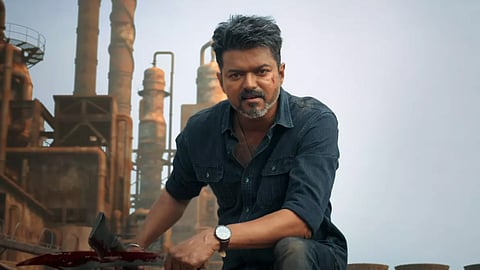


Emblematic of a footloose, bumbling heroism, C. Joseph Vijay, the current Chief Minister of Tamil Nadu, affectionately called ‘Thalapathy’ or Commander by his fans, will breathe his last as an actor with Jana Nayagan, finally set to release this Thursday.
Originally slated for release on January 9 earlier this year for Pongal, the film was postponed for several months following a dispute between its producers and the Central Board of Film Certification (CBFC). The delay took a dramatic turn when the entire film leaked online on April 9, leading to widespread piracy across social media and other platforms. After the certification issues were resolved, the makers finally announced a new release date of July 23.
Meanwhile, in the interim period, Vijay, who is the founder and chief of the Tamilaga Vettri Kazhagam (TVK), was sworn in as the Chief Minister of Tamil Nadu on May 10; he took the oath of office and secrecy at Chennai's Jawaharlal Nehru Stadium, leading the state's first coalition government following the Assembly elections held on April 23.
This is an arcing path, from acting to politics, that many before him — MGR, Jayalalithaa, Vijayakant, Kamal Haasan — have paved in Tamil Nadu.
13 years ago, in an interview with NDV Hindu, Vijay noted the desire to “convert the fans’ association into a people’s movement,” even as he was evasive about his entry into politics. Finally, that conversion was activated.
Launched as a child artiste by his father, the director S.A. Chandrasekhar, at the age of 18 he debuted as an adult actor in Naalaiya Theerpu (1992). The film didn’t work, and Vijay’s unusual appearance and stiff presence became the butt of jokes in his initial years. After a string of flops, Vijay’s father approached the actor Vijayakant, not only one of the top actors of the time, but also a regular collaborator, to do Senthoorapandi (1993) with Vijay. As a gesture of goodwill, Vijayakant did the film for free.
Vijay’s father also played a pivotal role in mobilising the fan clubs, the Vijay Makkal Iyakkam (People’s Movement). He even gave his son his first moniker — ‘Ilayathalapathy’, or young commander in Rasikan (1994) — a moniker that Vijay would grow into, and then, outgrow, when he would be called, Mersal (2017) onwards, just ‘Thalapathy’ or commander. (Incidentally, this was also a sobriquet used to address the former Chief Minister M.K. Stalin.)
A consummate fan of Rajinikanth, Vijay took on that mantle of charming, comic-adjacent heroism, being playful with the cigarette, yanking one, say, from his collar. In fact, he enacted an iconic scene from Annamalai (1992) to his father to convince him of his acting prowess. Vijay added to this heroism his repertoire of footloose dancing, working with choreographers like Raghava Lawrence and Prabhu Deva who turned his body into a limbed disco. When Vijay dances on screen, the ‘cut’ often feels violent and unnecessary. What do you mean you want a close-up of the movement or a different perspective?
In the 2000s he made a swerve from romantic comedies like Kushi (2000), Priyamanavale (2000), and Friends (2001), to action, with films like Thirumalai (2003) and, later, Ghilli (2004), which cemented his reputation in the popular imagination, building his stardom — for stardom in the aughts came from not from music but muscle. A dip in his filmography was erased in the early 2010s with Nanban (2012) and his return to action in Thuppakki (2012).
Vijay was also cementing his stardom beyond the borders of Tamil Nadu, even as he held onto his firm conviction that he will only do films in Tamil. Tholladhavan Thullu (1999), for example, ran in theaters for 100 days in the neighbouring state of Kerala, and Vijay became a staple hero in that state where the superstars were aging, with no young blood in their rearview.
Off-screen, Vijay’s presence became increasingly political, going on a day-long fast in 2008 to bring an end to the Sri Lanka Civil War, flying down to Delhi in 2011 to perform his solidarity alongside Anna Hazare’s anti-corruption protest at the Ramlila Maidan, and meeting the grieving families of those murdered in the police firing on anti-Sterlite protestors in Thoothukudi in 2018.
Associated with Coca Cola from 2000 to 2003, Vijay also became its brand ambassador in Tamil Nadu in 2009. Later, in 2014, in Kaththi, he played a character critical of such brands. When asked about this flip, Vijay responded during a Twitter chat, “When I read the script of Kaththi, it made sense to me and I voiced it through Jeeva’s character. I am a normal person who has corrected himself after realising I have been wrong on certain issues.”
On-screen, his politics began to coagulate. In Mersal (2017), for example, the Digital India initiative and the Goods and Service Tax was poked at. In that vein of an actor-politician, Jana Nayagan is a political drama, where the first poster — of Vijay posing for a selfie with thronging fans — was a hark back to his iconic selfie from the sets of Master (2021) in Neyveli in February 2020.
Following are five Vijay films that serve as milestones in his over three decade long career as an actor.
Running for over 270 days in theatres, this film was the first major breakthrough in Vijay’s career. This film was later remade in Telugu, Kannada, and Hindi. Here, Vijay plays a peacemaker between two feuding families, in order to unite lovers — offspring from these homes.
For a film without too much action or romance, Vijay might have seemed an odd choice. In fact, the director Vikraman was advised by many people not to take Vijay, but having seen him in a song on TV, he was convinced Vijay was right for the role, predicting his future stardom.
With music by Ilaiyaraaja, Kadhalukku Mariyadhai, directed by Fazil, was a remake of the director’s successful Malayalam film, Aniathipravu (1997). One of Vijay’s biggest hits in his career back then, this fuzzy love story with family at the center of it, won Vijay his first Tamil Nadu State Film Award for Best Actor — one of the first awards he received for acting, with a sense that he was emerging into his artistry, even as his artistry was trying to settle into stardom.
Directed by Dharani, here Vijay plays an aspiring Kabaddi player, who goes out of his way to protect and house a helpless woman, played by Trisha, from the clutches of a powerful goon in her pursuit, played by Prakash Raj. Ghilli changed the shape of Vijay’s career, becoming the first Tamil film to gross over ₹50 crores at the domestic box office. With this film, his turn to action-comedy would become final.
In 2024, when a re-mastered version in 4K was re-released worldwide, it ran to housefull theaters, collecting around ₹30 crore, becoming one of the highest grossing re-releases in India.
Vijay plays an intelligence officer in the Indian Army, who on holiday, finds himself tracking down and destroying a sleeper cell. The film was the first Vijay and first non-Rajinikanth Tamil film to enter the 100 crore club, and buoyed by the success, the director AR Murugadoss-Vijay collaborated for a few more films — Kaththi (2014), Sarkar (2018) — called the ‘Vettri Koontani’ (victorious combination). Besides, the “I am waiting” dialogue that Vijay belts out pre-interval, became a formula, a popular reckoner, used in pre-interval scenes of other Vijay films as well.
A strange vocabulary descended with this film. In interviews, director Lokesh Kanagaraj noted Master would be a “50-50” blend of Vijay’s star power and his own directorial style, turning the film into a balance sheet. He wasn’t wrong, for it felt like the first time Vijay allowed a director’s voice to guide the story, punctuating it regularly with his theatrics — his initial dance, and as he finds a moral spine, his eventual action. Master would become a blueprint for Tamil superstars — how to be reined in by a directorial vision, and use that vision, not as a constraint, but as a trampoline to launch off from. Besides, being the first tentpole film to release during the pandemic, it also helped release the anxiety of theater owners, reviving Tamil cinema.